

Friday 28 February 2025
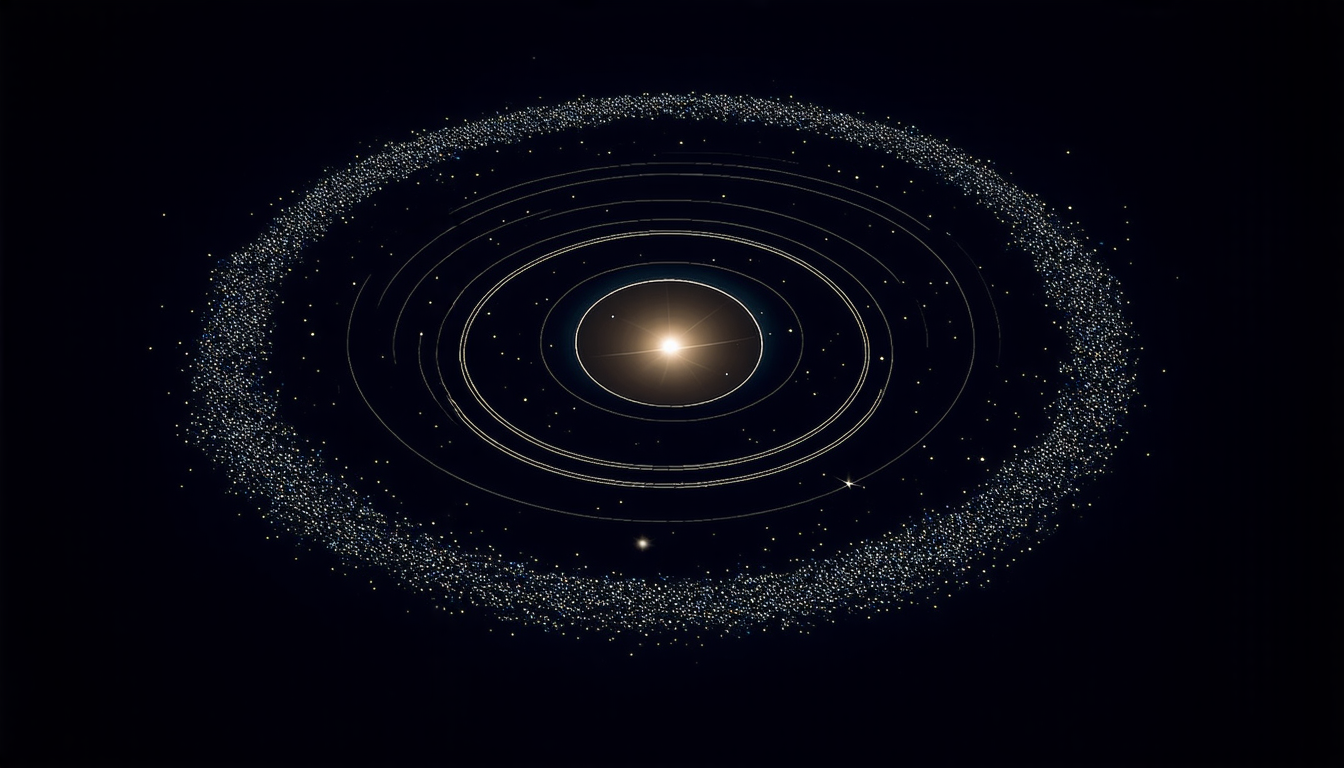
A mysterious arc of dust and debris has been puzzling astronomers for years, orbiting a young star known as HD 181327. The oddity lies in its asymmetrical shape, with one side appearing much brighter than the other. Now, scientists believe they have finally cracked the code behind this enigmatic structure.
The HD 181327 system is home to a planet thought to be responsible for the arc’s peculiar shape. Researchers used complex computer simulations to recreate the conditions within the disk and tested various planetary masses and orbits until they found a match. The result was a planet with a mass of around 2-5 times that of Jupiter, orbiting at a distance of about 62 astronomical units (AU) from its star.
But what’s truly fascinating is how this planet affects the surrounding dust and debris. The simulations showed that tiny particles, measuring only microns in size, are responsible for the arc’s brightness. These grains are thought to originate from an exo-Kuiper belt, a region of icy bodies beyond the orbit of Neptune, which are perturbed into orbits that bring them closer to the star.
The planet’s gravitational influence is what gives these particles their peculiar shape. As they orbit the star, they interact with the planet, causing some to be flung towards the outer reaches of the disk while others remain in a tight, circular path around the star. This creates an arc-like structure that appears brighter on one side due to the accumulation of more dust and debris.
This finding has significant implications for our understanding of planetary formation and evolution. It suggests that planets can play a crucial role in shaping their surrounding environments, influencing the distribution of material and potentially even creating conditions suitable for life.
The absence of similar structures at longer wavelengths is also an important observation. This could be due to larger particles, which do not take on the same distinct arc as seen at smaller sizes. The results highlight the importance of considering particle size and orbital dynamics when studying debris disks.
HD 181327’s unique features make it an ideal target for future observations and studies. Astronomers will be eager to learn more about this system, potentially using advanced telescopes like the James Webb Space Telescope to gather higher-resolution data and further refine our understanding of the planet’s mass and orbit.
This discovery not only sheds light on the mysterious arc but also opens up new avenues for exploring the complex relationships between planets and their surrounding environments.
Cite this article: “The Mysterious Arc of Dust: A Planetary Puzzle Solved”, The Science Archive, 2025.
Asteroid Belt, Planetary Formation, Exo-Kuiper Belt, Debris Disk, Gravitational Influence, Orbital Dynamics, Particle Size, Astronomical Units, Star System, James Webb Space Telescope





