

Friday 28 February 2025
The quest for a better understanding of treewidth, a fundamental concept in graph theory, has been an ongoing pursuit among mathematicians and computer scientists. Recently, researchers have made significant strides in this area, shedding light on the intricate relationships between treewidth, excluded planar minors, and the complexity of algorithms.
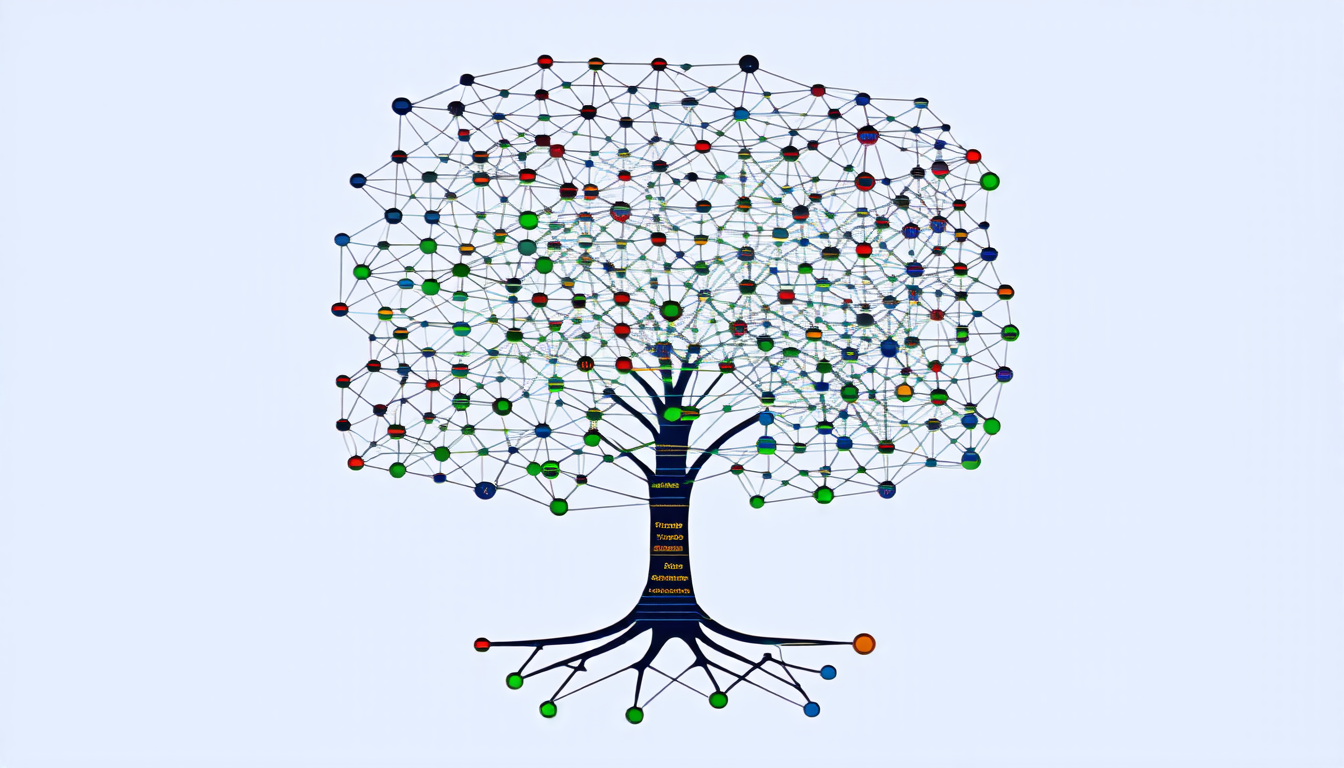
Treewidth is a measure of the similarity between a given graph and a tree-like structure. It’s a critical concept in the study of graph theory, as it can be used to determine the efficiency of algorithms designed to solve problems on these complex networks. The treewidth of a graph is defined as one less than its bramble number, which represents the minimum size of a hitting set for a certain type of subgraph.
Researchers have long sought to establish a tight bound on the treewidth of graphs that exclude specific planar minors. A minor is a smaller graph obtained by contracting edges and deleting vertices from the original graph. Planar minors are particularly interesting, as they can be used to model real-world networks with complex topologies.
A team of mathematicians has now made significant progress in this area, developing a new method for bounding treewidth in terms of excluded planar minors. Their approach involves analyzing the structure of these graphs and identifying specific patterns that can be used to limit their treewidth.
The researchers’ technique is based on the concept of a bramble, which is a family of connected subgraphs that intersect or are joined by edges. By studying the properties of these brambles, they were able to establish a tight bound on the treewidth of graphs that exclude specific planar minors.
One of the key insights behind this work is the recognition that treewidth is closely tied to the concept of excluded planar minors. The researchers showed that if a graph excludes a certain planar minor, then its treewidth can be bounded in terms of the size and complexity of that minor.
This breakthrough has important implications for the study of algorithms on complex networks. By establishing tight bounds on treewidth, researchers can design more efficient algorithms that can handle large-scale graphs with ease.
The new method also opens up new avenues for research, as it provides a powerful tool for analyzing the structure of complex networks. By applying this technique to real-world data, scientists may be able to uncover hidden patterns and relationships that could not be detected using traditional methods.
In the future, researchers plan to continue exploring the connections between treewidth, excluded planar minors, and algorithmic complexity.
Cite this article: “Breaking Barriers in Graph Theory: New Insights on Treewidth and Excluded Planar Minors”, The Science Archive, 2025.
Graph Theory, Treewidth, Bramble Number, Graph Algorithms, Planar Minors, Excluded Minors, Network Analysis, Complexity Theory, Algorithmic Efficiency, Graph Structure





