

Friday 28 February 2025
In a breakthrough study, researchers have developed an innovative analytical framework for modeling the behavior of laminated composite rings on nonreciprocal elastic foundations under various loading conditions. This new approach has significant implications for designing and optimizing complex systems in fields such as automotive, aerospace, and biomedical engineering.
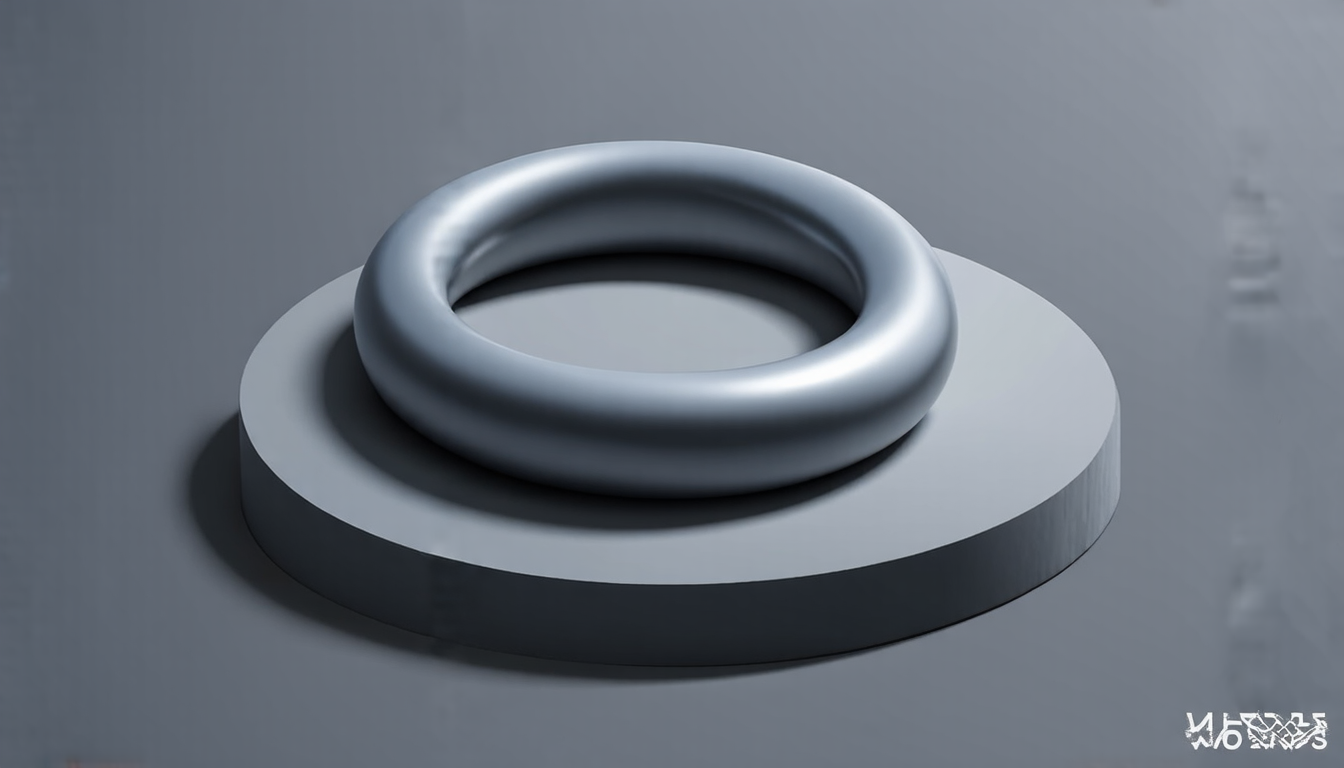
The study focuses on the interaction between a laminated ring and its foundation, which is often represented by an elastic material with varying stiffness properties. The researchers used advanced mathematical techniques to develop a closed-form solution that accurately predicts the stress distribution and deformation of the ring under different loading conditions, including non-axial symmetric loads.
One of the key challenges in modeling this system is the complexity of the interactions between the ring’s layers and the foundation. Traditional methods often rely on simplifying assumptions or numerical simulations, which can be time-consuming and may not accurately capture the underlying physics. The new framework overcomes these limitations by incorporating advanced composite material theories and refined beam theories to model the behavior of the laminated ring.
The researchers also explored the effects of various design parameters on the system’s performance, including the ring’s dimensions, laminate lay-up architecture, and lamina anisotropy. They found that subtle changes in these parameters can have significant impacts on the stress distribution and deformation of the ring, highlighting the importance of careful optimization in designing these systems.
The study’s findings have far-reaching implications for various applications, such as non-pneumatic tires, flexible bearings, expandable tubulars in oil wells, and vascular stents interacting with blood vessel linings. In each of these cases, accurate modeling of the ring-foundation interaction is crucial for optimizing system performance and ensuring safe operation.
The researchers’ innovative approach has opened up new avenues for research in this area, enabling more precise predictions of stress distribution and deformation in complex systems. As engineers continue to develop novel materials and designs, this study’s framework will play a critical role in helping them optimize their creations for maximum effectiveness and safety.
Cite this article: “Modeling Laminated Composite Rings on Nonreciprocal Elastic Foundations: A Breakthrough Study”, The Science Archive, 2025.
Laminated Composite Rings, Nonreciprocal Elastic Foundations, Analytical Framework, Stress Distribution, Deformation, Loading Conditions, Beam Theories, Composite Material Theories, Anisotropy, Optimization





