

Friday 28 February 2025
Scientists have made significant progress in developing a new type of artificial intelligence that can learn and adapt like humans do. This AI, called EnerVerse, is designed to help robots perform complex tasks by teaching them how to understand and interpret visual data from their surroundings.
To achieve this, the researchers developed a system that combines machine learning with computer vision techniques. The AI is trained on a large dataset of images and videos, which allows it to learn patterns and relationships between different objects and scenes. This enables the AI to recognize and respond to visual cues, such as shapes, colors, and textures.
The EnerVerse system consists of two main components: the generative model and the policy head. The generative model is responsible for predicting future states of the environment based on current observations, while the policy head determines the best course of action for the robot to take in response to those predictions.
During training, the AI is given a series of tasks to perform, such as picking up objects or navigating through mazes. As it completes each task, the AI receives feedback in the form of rewards or penalties, which helps it adjust its behavior and improve its performance over time.
One of the most impressive features of EnerVerse is its ability to generalize from a few examples. This means that once the AI has learned how to perform a particular task, it can apply that knowledge to similar situations without needing additional training data.
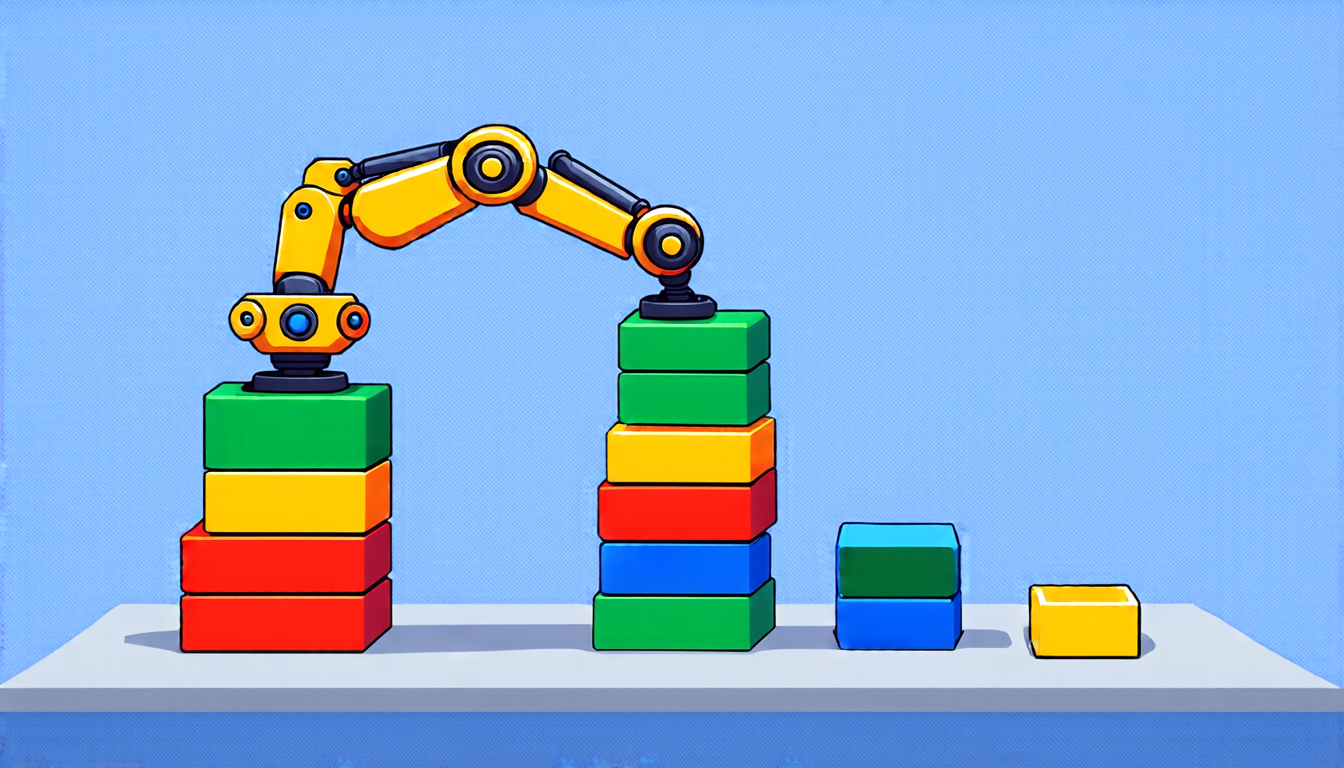
The researchers have also tested EnerVerse in real-world scenarios, using a robotic arm to manipulate objects and navigate through a virtual environment. The results are impressive, with the AI able to successfully complete tasks such as picking up blocks and placing them into designated compartments.
EnerVerse has potential applications in fields such as manufacturing, healthcare, and space exploration, where robots need to be able to adapt to new situations and make decisions based on visual data. The development of this technology is an important step towards creating more advanced and autonomous AI systems that can work alongside humans.
Cite this article: “EnerVerse: An Artificial Intelligence System That Learns and Adapts Like Humans”, The Science Archive, 2025.
Artificial Intelligence, Machine Learning, Computer Vision, Robot, Enerverse, Generative Model, Policy Head, Visual Data, Autonomous Systems, Advanced Ai





