

Saturday 01 March 2025
Researchers have come up with a novel way to measure the absorption coefficient of infrared radiation in water using a TV remote control and a smartphone. The study, published in a recent issue of Physics Education, demonstrates how this simple experiment can be used to teach students about the Beer-Lambert law, which describes how light interacts with matter.
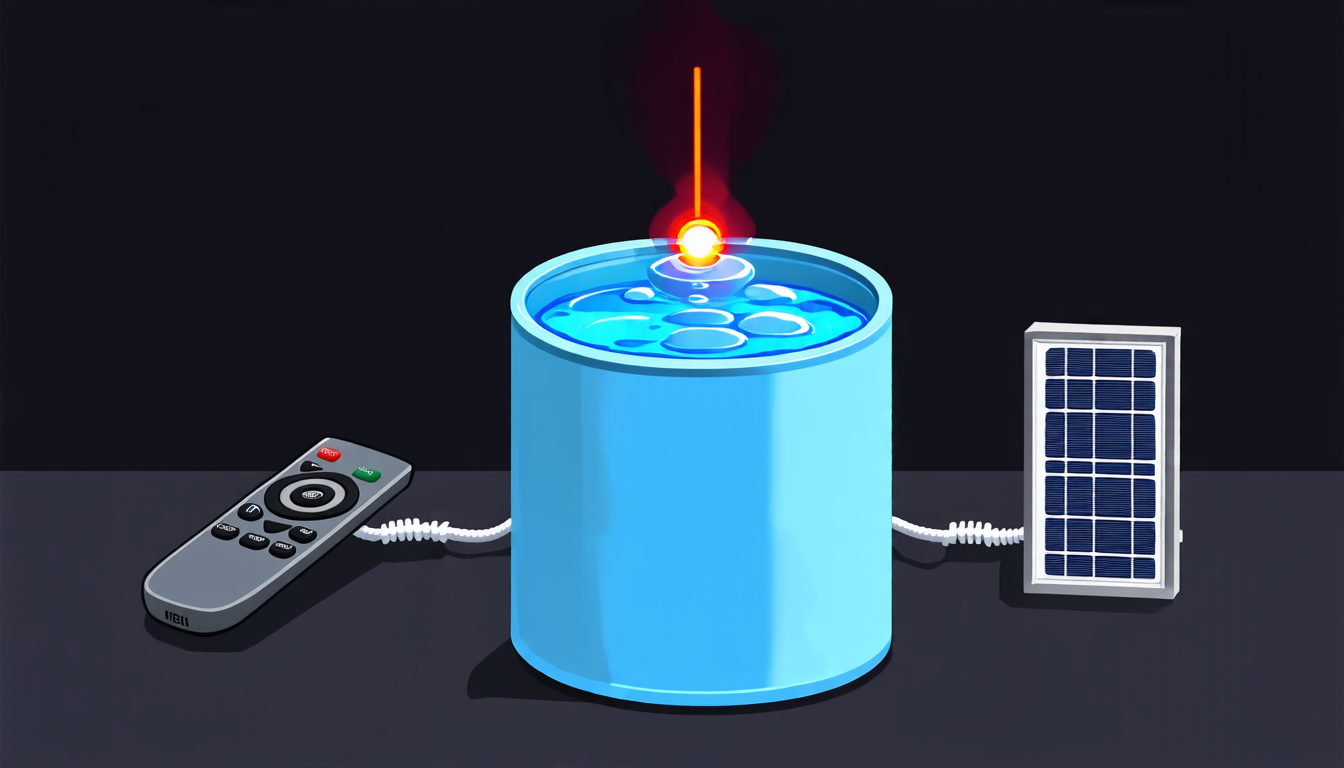
The researchers created an experimental setup that consisted of a TV remote control emitting infrared radiation, a cylindrical container filled with water, and a solar cell connected to a speaker. The remote control was placed above the water column, and when pressed, it sent out pulses of infrared light. The intensity of these pulses was measured using the solar cell, which converted the light into an electrical signal that could be detected by a smartphone.
The team then recorded the sound produced by the solar cell using the smartphone’s built-in audio recorder. By analyzing the audio file, they were able to measure the logarithm of the registered intensity as a function of the height of the water column. This data was then fitted to a linear model, which revealed an absorption coefficient of 0.113 cm-1.
This result is in good agreement with values reported in the literature for the same wavelength of infrared radiation. The study shows that this simple experiment can be used to teach students about the Beer-Lambert law and how it relates to the absorption of light by matter.
One of the advantages of using a TV remote control and a smartphone is that it makes the experiment accessible to students in high school and early university physics courses. The setup is also relatively inexpensive, which makes it an attractive option for schools with limited budgets.
The researchers believe that this experiment has the potential to inspire students to explore the properties of light and matter in a more hands-on way. By using everyday objects like TV remote controls and smartphones, they can make complex scientific concepts more accessible and engaging.
In addition to its educational value, this study also highlights the importance of innovative teaching methods. By incorporating modern technology into traditional physics experiments, educators can create interactive and immersive learning experiences that engage students and encourage them to learn more about science.
Overall, this study demonstrates how a simple TV remote control and smartphone can be used to teach complex scientific concepts like the Beer-Lambert law. The experiment is not only easy to set up but also provides valuable insights into the properties of light and matter.
Cite this article: “Measuring Absorption Coefficient with a TV Remote Control and Smartphone”, The Science Archive, 2025.
Physics, Education, Infrared Radiation, Beer-Lambert Law, Light Absorption, Water, Tv Remote Control, Smartphone, Solar Cell, Experiment





