

Sunday 02 March 2025
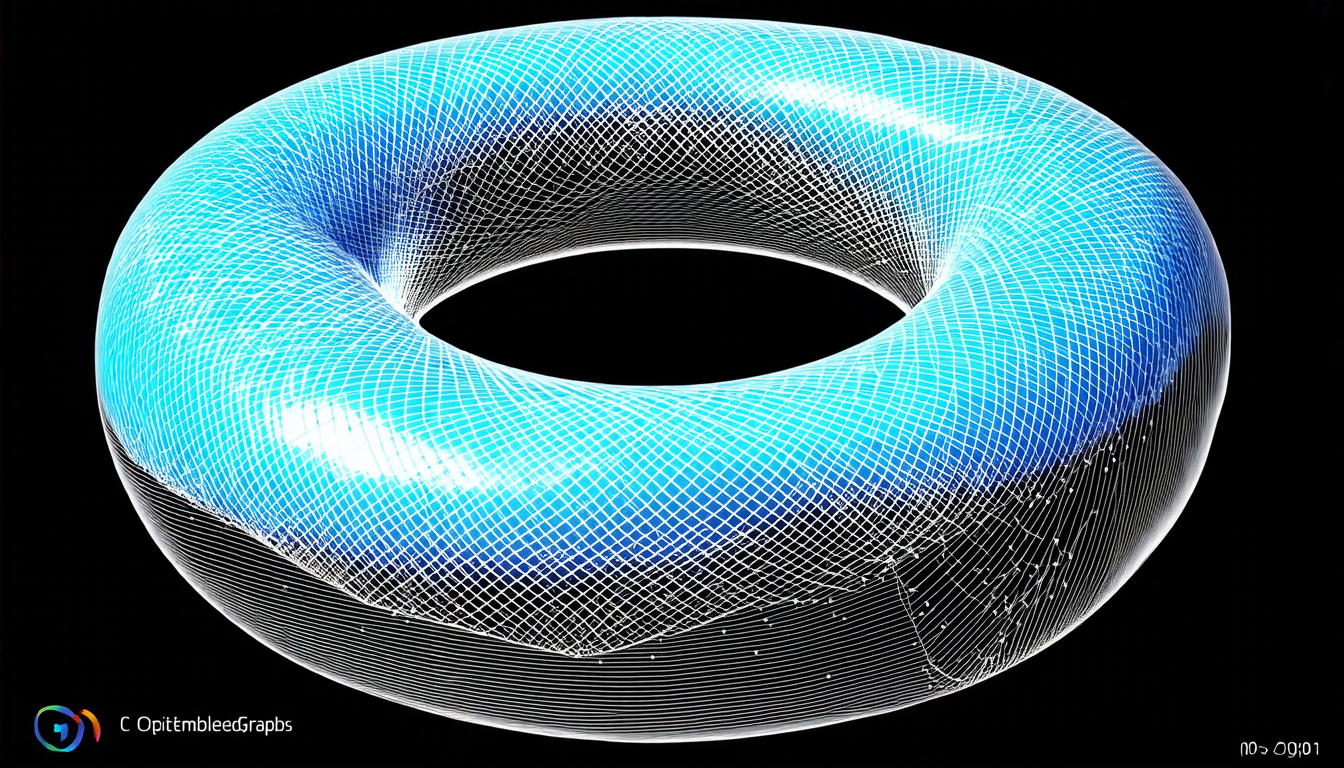
A team of researchers has made a significant breakthrough in understanding the properties of graphs, which are mathematical structures used to represent connections between objects. The study focused on optimal 1-embedded graphs, which are drawn on a torus (a doughnut-shaped surface) so that every edge crosses another edge at most once.
The researchers found that these graphs have unique properties when it comes to connectivity and matching extendability. Connectivity refers to the ability of a graph to stay intact even if some edges or vertices are removed. Matching extendability, on the other hand, is the ability to add more edges to a matching (a set of edges that connect distinct vertices) without breaking any existing edges.
The study showed that optimal 1-embedded graphs have a minimum connectivity of 4, which means that removing four or fewer edges will not disconnect the graph. This is because these graphs are drawn on a torus, which has certain topological properties that make it difficult to separate the graph into disconnected components.
In addition, the researchers found that optimal 1-embedded graphs have unique matching extendability properties. They discovered that these graphs can be classified into three categories based on their matching extendability: 1-extendable, 2-extendable, and non-extendable. The 1-extendable graphs are those that can be extended to a perfect matching (a matching that covers all vertices), while the 2-extendable graphs can be extended to a perfect matching with at most two additional edges.
The study also showed that optimal 1-embedded graphs have a strong connection between their connectivity and matching extendability. For example, a graph that is not 1-extendable has a minimum connectivity of 8, which means that removing eight or fewer edges will not disconnect the graph.
These findings have important implications for computer science and mathematics. Optimal 1-embedded graphs are used in various applications such as network design, data storage, and coding theory. Understanding their properties can help researchers develop more efficient algorithms and improve the performance of these applications.
The study also has potential applications in other fields such as biology and chemistry, where graph theory is used to model complex systems and networks.
Overall, this research provides new insights into the properties of optimal 1-embedded graphs and highlights the importance of understanding their connectivity and matching extendability. The findings have significant implications for computer science, mathematics, and beyond, and will likely lead to further research in these areas.
Cite this article: “Unlocking the Secrets of Optimal 1-Embedded Graphs”, The Science Archive, 2025.
Graph Theory, Optimal 1-Embedded Graphs, Torus, Connectivity, Matching Extendability, Network Design, Data Storage, Coding Theory, Computer Science, Mathematics





