

Sunday 02 March 2025
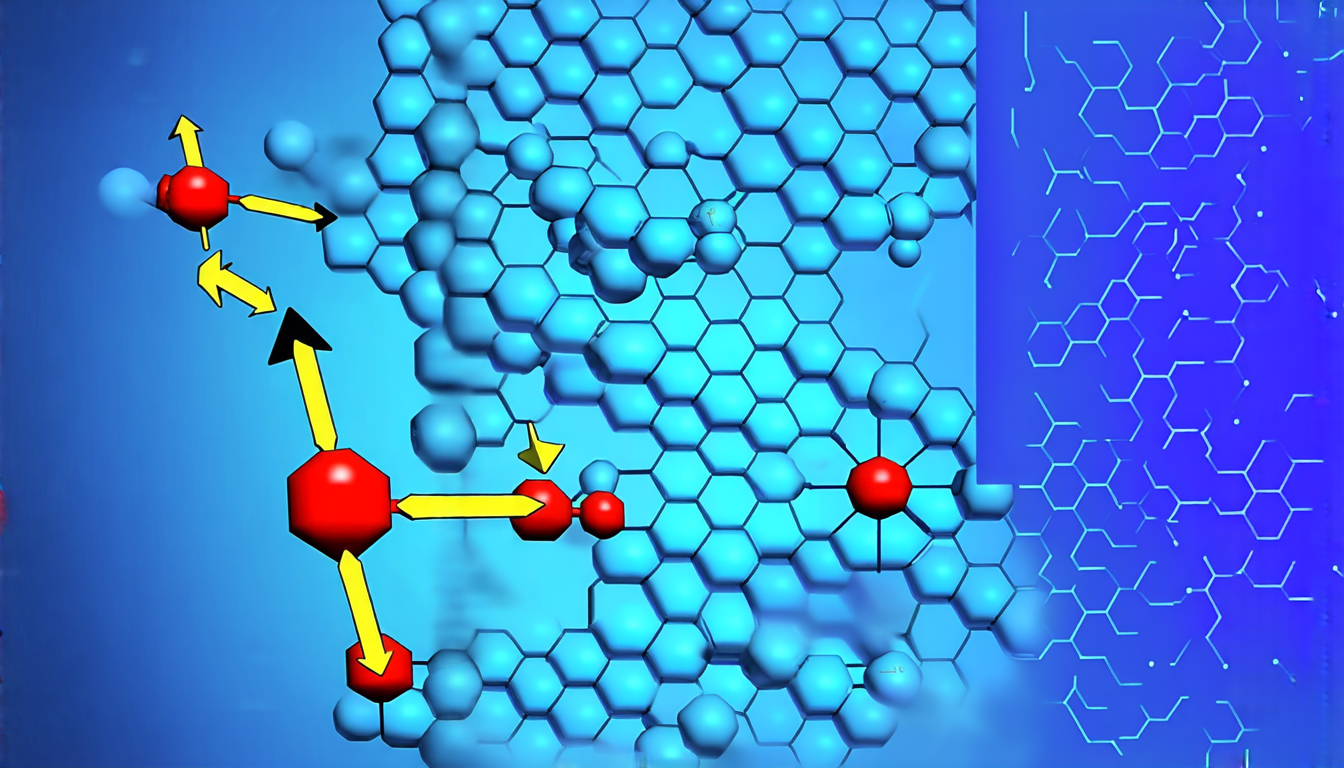
Researchers have made a significant breakthrough in understanding the behavior of phonon polaritons, tiny particles that are a mix of light and sound waves. These particles have been found to exhibit unique properties when interacting with certain materials, such as hexagonal boron nitride (hBN).
Phonon polaritons are created when light is shone onto a material, causing the atoms in the material to vibrate at specific frequencies. These vibrations, or phonons, interact with the light and create a new type of particle that has properties of both light and sound.
In their research, scientists used advanced computer simulations to study the behavior of phonon polaritons in hBN. They found that these particles can be confined to very small areas, just a few nanometers across, while still maintaining their unique properties.
One of the most interesting findings is that phonon polaritons in hBN can exhibit circular polarization, which means they can rotate the plane of vibration as they move through the material. This property has potential applications in fields such as optics and electronics.
The researchers also found that the confinement of phonon polaritons to small areas can lead to significant enhancements in their properties. For example, the energy density of these particles can increase by several orders of magnitude when confined to a small area.
These findings have important implications for the development of new technologies that rely on the manipulation of light and sound waves. For example, phonon polaritons could be used to create ultra-compact optical devices or to enhance the efficiency of solar cells.
The study also highlights the importance of understanding the behavior of phonon polaritons in different materials. By studying these particles in various materials, scientists can gain insights into their properties and potential applications.
In addition to hBN, other materials such as gallium phosphide (GaP) and alpha-molybdenum trioxide (α-MoO3) were also studied. The researchers found that the behavior of phonon polaritons in these materials was similar to that observed in hBN, but with some differences.
The study used a combination of advanced computer simulations and experimental techniques to investigate the properties of phonon polaritons. The simulations involved solving complex mathematical equations that describe the behavior of light and sound waves in different materials.
The experimental techniques used included scanning near-field optical microscopy (s-SNOM), which allows researchers to visualize the distribution of phonon polaritons in a material with high spatial resolution.
Cite this article: “Unlocking the Secrets of Phonon Polaritons: A Breakthrough in Understanding Tiny Particles of Light and Sound”, The Science Archive, 2025.
Phonon Polaritons, Hexagonal Boron Nitride, Light, Sound Waves, Nanometers, Circular Polarization, Optics, Electronics, Solar Cells, Materials Science





