

Sunday 02 March 2025
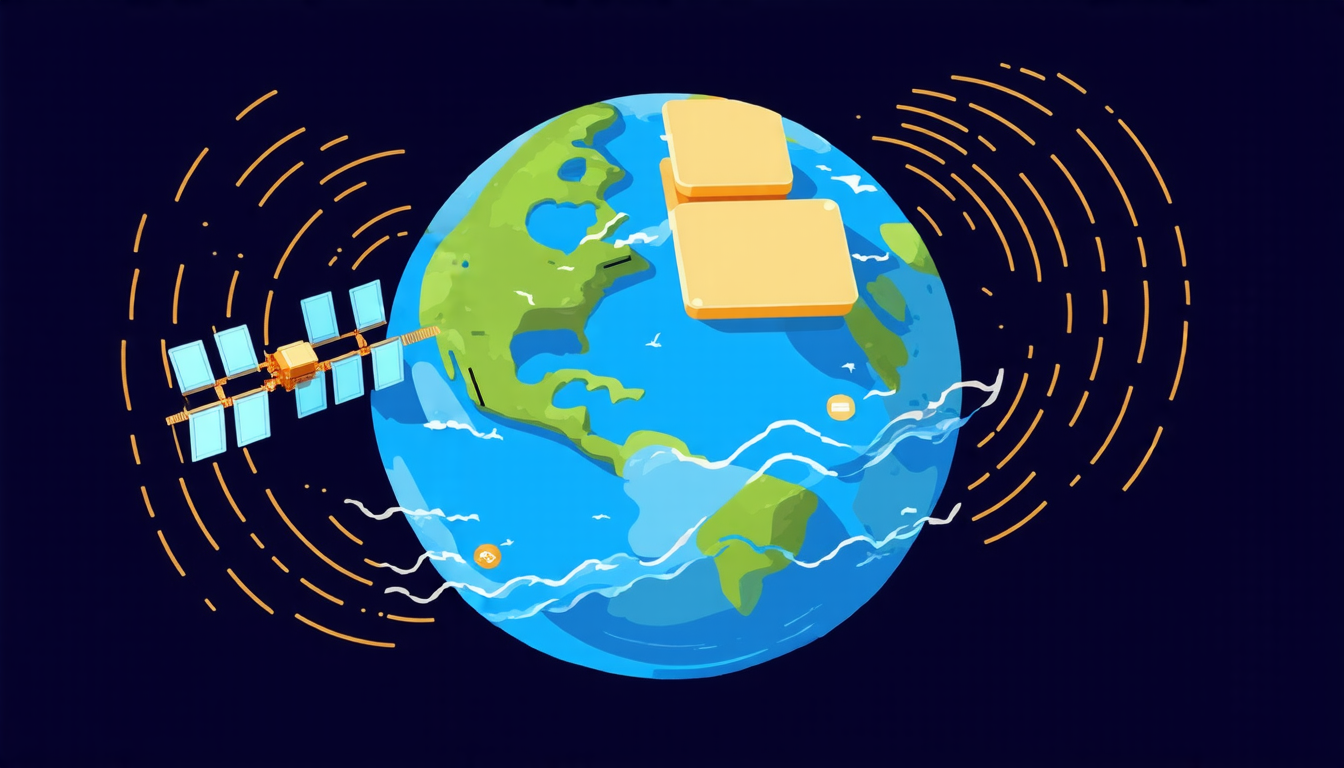
The quest for a more comprehensive understanding of radio signals has led researchers to explore new ways of mapping and monitoring these invisible waves. In recent years, the development of low Earth orbit (LEO) satellite networks has opened up fresh opportunities for studying radio signals in unprecedented detail.
To achieve this, scientists have turned to a technique called compressive sensing, which allows them to reconstruct complex patterns from limited data samples. This approach is particularly useful when dealing with high-frequency signals, like those transmitted by LEO satellites, which are difficult to detect and analyze using traditional methods.
The problem lies in the sheer volume of data generated by these satellite networks. With thousands of satellites orbiting the Earth, collecting and processing all this information would be a daunting task without advanced technology. Compressive sensing offers a solution by leveraging the fact that most radio signals are sparse, meaning they contain mostly zeros or very small values.
By applying compressive sensing algorithms to the data collected from LEO satellites, researchers can reconstruct accurate maps of radio signals in three-dimensional space and time. This allows for more precise monitoring of spectrum usage, identification of potential interference sources, and even detection of unknown signals.
The benefits of this technology extend beyond scientific research. With more efficient spectrum management, communication networks could be optimized to provide better coverage and faster data transfer rates. Moreover, the ability to detect and respond to unauthorized or malicious signal activity would enhance national security and public safety.
To further advance this field, scientists are exploring new methods for tensor decomposition, a mathematical technique used to break down complex datasets into smaller, more manageable components. By combining compressive sensing with tensor decomposition, researchers hope to develop even more accurate and efficient ways of analyzing radio signals.
As the world becomes increasingly reliant on wireless communication networks, the need for advanced technologies like compressive sensing and tensor decomposition will only continue to grow. With these tools, scientists can better understand and manage the invisible waves that shape our modern world, paving the way for faster, more reliable, and more secure communication systems.
Cite this article: “Decoding Radio Signals: Advances in Compressive Sensing and Tensor Decomposition”, The Science Archive, 2025.
Radio Signals, Compressive Sensing, Leo Satellites, Satellite Networks, High-Frequency Signals, Data Processing, Spectrum Usage, Interference Detection, Tensor Decomposition, Wireless Communication.





