

Sunday 02 March 2025
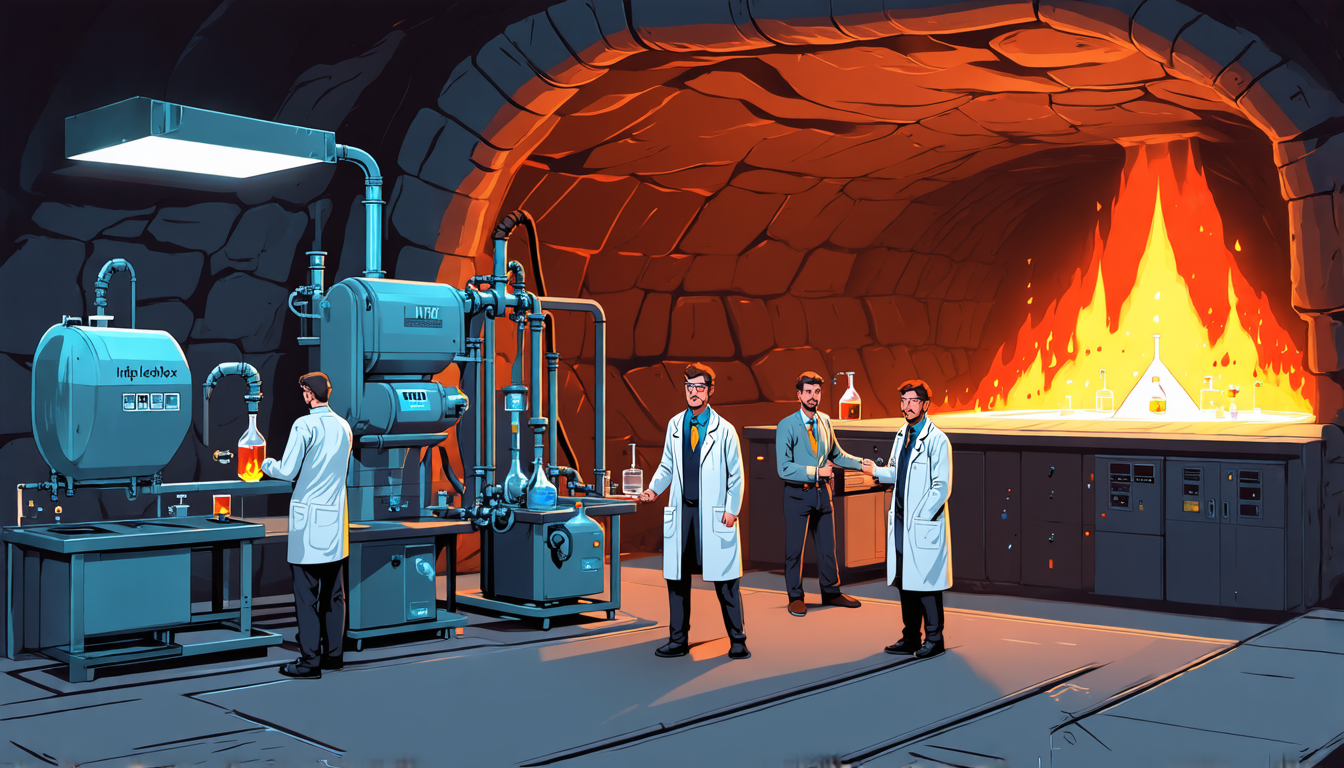
Deep beneath the earth, in a laboratory nestled within the Jaduguda Mine in India, scientists have been searching for signs of dark matter, a mysterious substance that makes up roughly a quarter of our universe but has yet to be directly detected. Their tool of choice is an unusual one: superheated liquid droplets.
The experiment, called InDEx (Indian Dark matter search Experiment), uses tiny droplets of tetrafluoroethane (C2H2F4) suspended in a gel matrix to detect the faint signals generated by dark matter particles interacting with normal matter. The team has been running the detector at 555 meters below the earth’s surface, where cosmic radiation and other background noise are significantly reduced.
The InDEx experiment is sensitive to low-mass dark matter particles, which are thought to be responsible for the observed rotation curves of galaxies and the large-scale structure of the universe. The detector’s ability to detect these particles relies on the unique properties of superheated liquids, which can undergo rapid nucleation when excited by high-energy particles.
The team has reported their results in a recent paper, detailing the analysis of 48.6 days’ worth of data collected at a threshold energy of 5.87 keV. While no definitive dark matter signals were detected, the study sets new limits on the cross-sections for spin-dependent and spin-independent interactions between dark matter particles and normal matter.
The InDEx experiment’s focus on low-mass dark matter is particularly interesting, as many other direct detection experiments are geared towards detecting heavier WIMPs (Weakly Interacting Massive Particles). The team’s results suggest that even at these lower masses, the detector remains sensitive to the expected signals from dark matter particles.
The InDEx experiment is an important step forward in the quest to understand dark matter, and its unique approach has opened up new avenues for exploration. As scientists continue to refine their understanding of this mysterious substance, experiments like InDEx will play a crucial role in uncovering its secrets.
Cite this article: “Uncovering Dark Matters Secrets with Superheated Liquid Droplets”, The Science Archive, 2025.
Dark Matter, Jaduguda Mine, Index Experiment, Superheated Liquid Droplets, Tetrafluoroethane, Gel Matrix, Cosmic Radiation, Background Noise, Low-Mass Dark Matter, Wimps





