

Sunday 02 March 2025
Scientists have made a significant breakthrough in understanding how fractures in rock affect the extraction of lithium and energy from geothermal systems. Lithium is a crucial component in many modern technologies, including electric vehicles and renewable energy storage systems. Geothermal energy, on the other hand, is a clean and sustainable source of power.
Traditionally, geothermal energy has been extracted by drilling into hot underground reservoirs and pumping out the heated water or steam. However, this process can be limited by the temperature and pressure of the reservoirs, making it difficult to extract large amounts of energy. To overcome these limitations, scientists have turned to co-producing lithium and energy from geothermal systems.
The research focused on a specific type of geothermal system called a doublet configuration, where hot water is injected into the ground through one well and then extracted as steam or hot water through another well. The team used advanced computer simulations to study how different fracture networks in the rock affected the flow of lithium-rich brine and energy production.
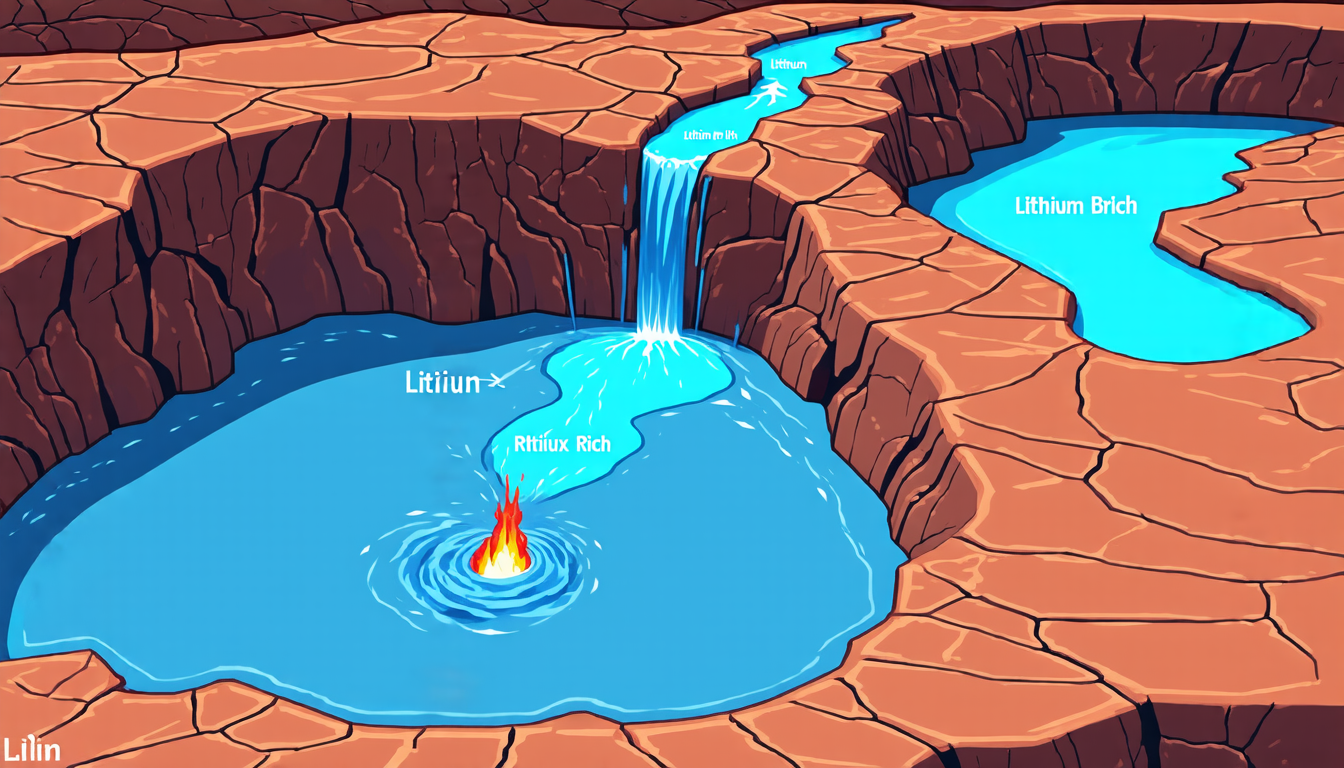
The results showed that fractures play a critical role in controlling the movement of lithium-rich brine and energy production. Fractures can act as pathways for the brine to flow through, allowing it to be extracted more efficiently. However, they can also create short circuits, causing the brine to bypass certain areas of the reservoir and reducing its overall extraction efficiency.
The study found that fractures with different geometries and densities had a significant impact on lithium production. Fractures with higher densities and more complex networks were able to extract more lithium than those with lower densities or simpler networks. This suggests that understanding the geometry and distribution of fractures in geothermal reservoirs is crucial for optimizing lithium extraction.
The researchers also found that energy production was less affected by fracture geometry and density, but still played an important role in controlling the overall efficiency of the system. The study highlights the importance of considering both lithium and energy production when designing and operating geothermal systems.
The findings have significant implications for the development of new geothermal power plants and the extraction of lithium from geothermal brines. By better understanding how fractures affect the flow of lithium-rich brine, scientists can optimize the design and operation of geothermal systems to maximize both energy and lithium production.
In addition, the study demonstrates the importance of integrating geological and fluid flow simulations to understand complex geological systems. The researchers used a combination of advanced computer simulations and field data to develop a comprehensive understanding of the fracture network’s impact on lithium extraction.
Cite this article: “Fracture Networks Key to Optimizing Lithium Extraction from Geothermal Systems”, The Science Archive, 2025.
Geothermal Energy, Lithium Extraction, Fractures, Rock Properties, Reservoir Simulation, Fluid Flow, Energy Production, Doublet Configuration, Brine Movement, Geological Modeling





