

Sunday 02 March 2025
The universe is a vast and mysterious place, full of secrets waiting to be uncovered. One of the most pressing questions scientists have been trying to answer is what caused the rapid expansion of the universe in its early days, known as inflation. A new study offers fresh insight into this phenomenon, suggesting that a type of particle called an axion could be responsible for generating gravitational waves during this period.
Axions were first proposed in the 1970s as a solution to a problem with the standard model of particle physics. They’re hypothetical particles that are thought to interact very weakly with normal matter, making them extremely difficult to detect. However, recent advances in technology have made it possible to study axions more closely, and scientists have been exploring their potential role in inflation.
The new study uses a combination of theoretical modeling and computer simulations to investigate how axions could affect the universe during inflation. The researchers found that axions could indeed generate gravitational waves, which are ripples in the fabric of spacetime that were first predicted by Einstein’s theory of general relativity.
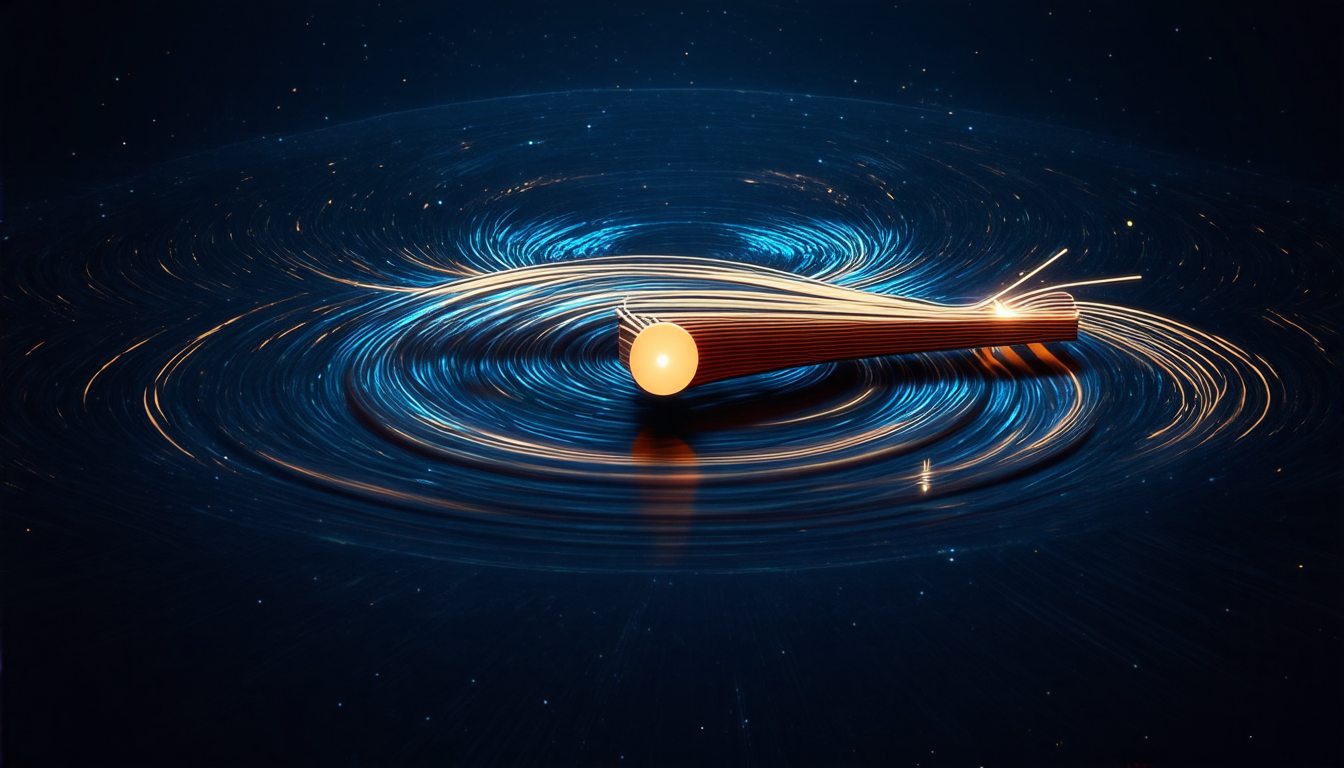
These gravitational waves would have been produced as the axions oscillated back and forth during inflation, kind of like a violin string vibrating to produce sound. The frequency and amplitude of these vibrations would depend on the properties of the axions and the conditions in the early universe.
The implications of this discovery are significant. For one thing, it could help scientists better understand the origins of the universe and how it evolved over time. It also opens up new possibilities for detecting gravitational waves, which could provide a window into the early universe that’s not available through other means.
One potential way to detect these gravitational waves is through the use of space-based telescopes like LISA (Laser Interferometer Space Antenna). LISA is designed to detect tiny changes in spacetime caused by massive objects orbiting each other, but it could also be used to detect the faint signals produced by axions during inflation.
In addition to providing insight into the early universe, the detection of axion-generated gravitational waves could also help scientists better understand the properties of dark matter and dark energy. These mysterious components make up a large portion of the universe’s mass-energy budget, but their nature is still unknown.
The study’s findings are a reminder that there’s still much to be learned about the universe, even after centuries of scientific progress.
Cite this article: “Unlocking the Secrets of the Early Universe: Axions and Gravitational Waves”, The Science Archive, 2025.
Universe, Inflation, Axion, Particle Physics, Gravitational Waves, Spacetime, Einstein, Lisa, Dark Matter, Dark Energy





