

Sunday 02 March 2025
The intricate dance of T Coronae Borealis, a symbiotic recurrent nova, has been unravelled by astronomers in a remarkable feat of observational prowess. This binary system, comprising a white dwarf and a red giant, has been observed to undergo a series of spectacular outbursts, with the latest one being particularly noteworthy.
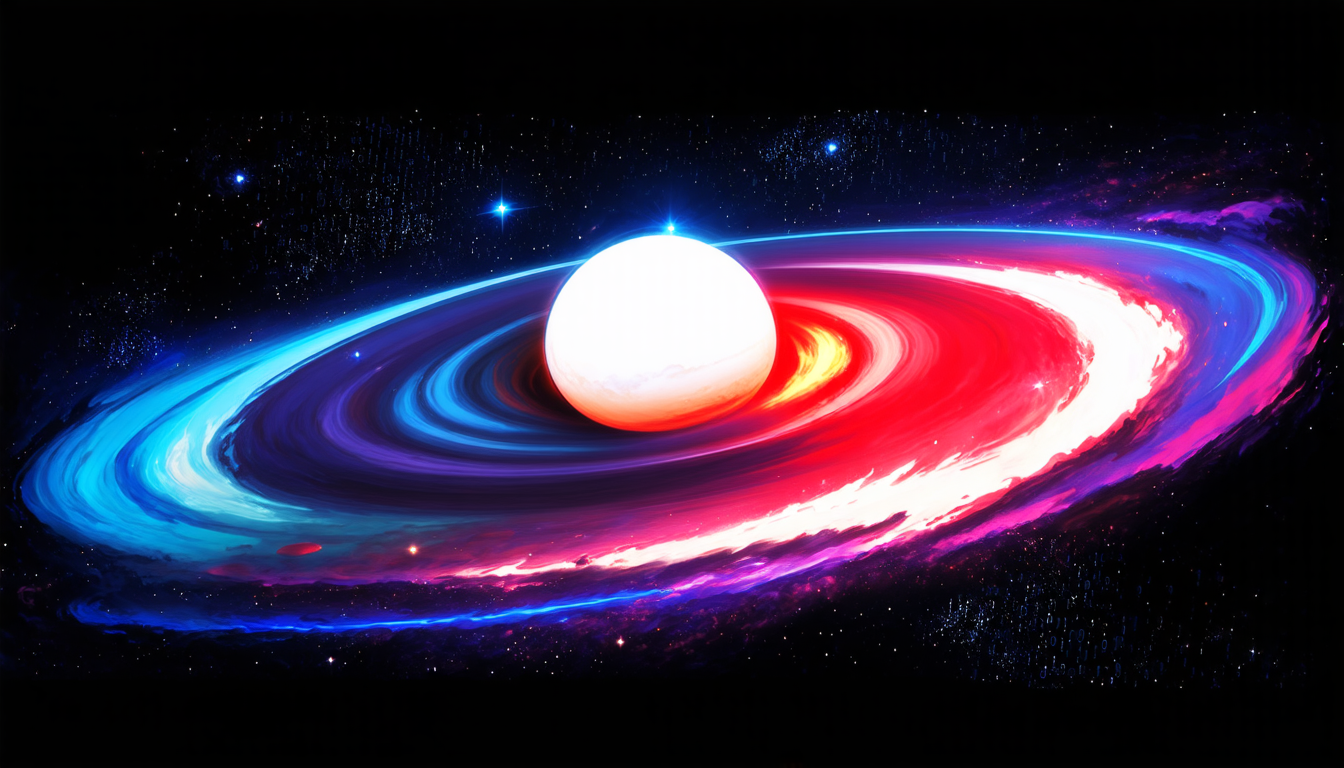
The researchers’ findings suggest that the super-eruption was triggered by an instability within the disc surrounding the white dwarf, which in turn led to an increase in mass transfer from the red giant. This surge in accretion resulted in enhanced radiation from the system, causing it to brighten significantly.
One of the key aspects of this study is the use of Doppler tomography, a technique that allows researchers to map the velocity field within the disc. By analyzing the motion of gas and dust within the disc, scientists can gain insight into the underlying physical processes driving the system’s behavior.
The data gathered by the team reveals a complex interplay between the red giant and the white dwarf, with matter flowing from the former towards the latter. The resulting accretion disc is highly dynamic, exhibiting both radial and azimuthal velocity gradients. This intricate dance of gas and dust ultimately gives rise to the system’s characteristic emission lines.
The team’s observations also provide valuable insights into the secular evolution of T Coronae Borealis. By monitoring the temporal changes in the emission lines over an extended period, researchers can infer the long-term behavior of the system. These findings suggest that the system has undergone a series of outbursts in the past, with each event triggering a subsequent increase in mass transfer.
The study’s results have significant implications for our understanding of symbiotic recurrent novae as a class. By unraveling the intricate dynamics of T Coronae Borealis, researchers can gain a deeper appreciation for these complex systems and their role in shaping the universe around us.
In the end, this research serves as a testament to human ingenuity and our capacity to observe and interpret the wonders of the cosmos. As scientists continue to probe the mysteries of the universe, it is clear that there is still much to be learned from these remarkable celestial bodies.
Cite this article: “Unveiling the Intricate Dance of T Coronae Borealis”, The Science Archive, 2025.
T Coronae Borealis, Symbiotic Recurrent Nova, Binary System, White Dwarf, Red Giant, Accretion Disc, Doppler Tomography, Mass Transfer, Outburst, Emission Lines





