

Monday 03 March 2025
The tunneling of spin current and charge current between two-dimensional electron systems is a fundamental phenomenon in condensed matter physics, allowing researchers to probe the underlying electronic properties of these systems. In recent years, scientists have been exploring ways to manipulate this process by introducing magnetic layers into the mix, which can drive the flow of spin current through spin pumping.
Now, a team of researchers has taken this concept to the next level by developing a theoretical framework for understanding spin transport in two-dimensional-to-two-dimensional tunneling systems driven by spin pumping. The work, published in Physical Review B, provides new insights into the role of magnetization dynamics in tunneling transport and opens up fresh avenues for exploring non-adiabatic spin pumping phenomena.
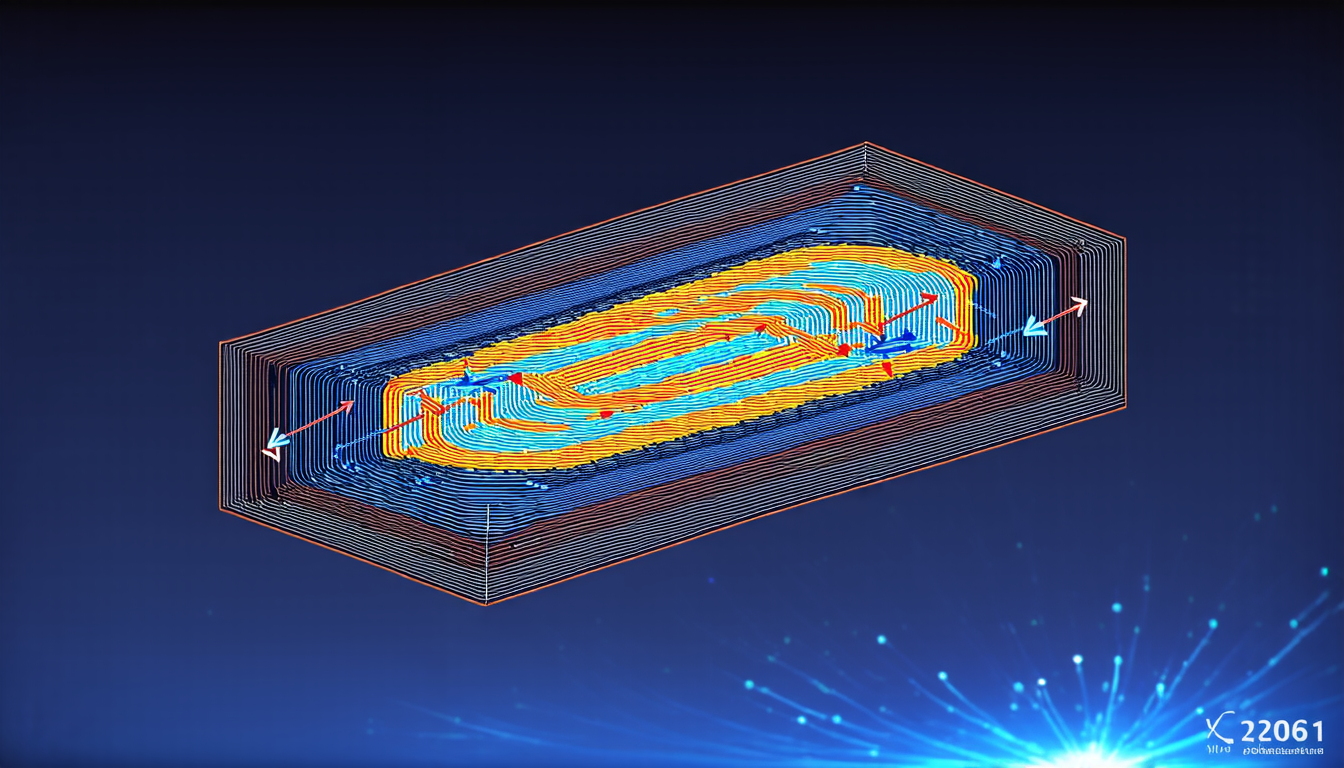
The researchers’ approach centers on a vertical heterostructure consisting of two layers of metallic two-dimensional electron systems separated by an insulating barrier. One layer is exchange-coupled to a magnetic layer driven at resonance, which generates a precessing magnetization field that couples to the electronic spin degrees of freedom in the other layer.
By employing the Floquet-Keldysh Green’s function formalism, the team derived general expressions for the tunneling spin and charge currents across a broad range of driving frequencies. These equations allow researchers to calculate the spin current and charge current driven by the magnetization precession, which is crucial for understanding how spin pumping affects the behavior of these systems.
The study reveals that the spin current is influenced by system parameters such as the precession angle, driving frequency, and interfacial exchange coupling. The researchers found that resonance tunneling can occur when the ratio of driving frequency to exchange coupling exceeds a certain threshold, leading to significant deviations from the conventional behaviors in the adiabatic regime.
The implications of this work are far-reaching, enabling researchers to explore novel spin pumping phenomena at higher frequencies and potentially leading to new applications in antiferromagnetic spintronics. The study also highlights the importance of considering non-adiabatic effects in spin transport, which can have a significant impact on the behavior of these systems.
In practical terms, this work could lead to the development of more efficient spin-based devices, such as spin filters and spin diodes, which are crucial for next-generation electronics. Additionally, the study’s findings could be used to improve the performance of existing spin-based technologies, such as magnetic storage devices and spin-based sensors.
Cite this article: “Spin Transport in 2D-2D Tunneling Systems Driven by Spin Pumping”, The Science Archive, 2025.
Spintronics, Spin Pumping, Tunneling Transport, Two-Dimensional Electron Systems, Magnetic Layers, Magnetization Dynamics, Floquet-Keldysh Green’S Function, Non-Adiabatic Effects, Antiferromagnetic Spintronics, Quantum





