

Monday 03 March 2025
The quest for accurate tissue segmentation in medical imaging has long been a challenge. Conventional methods rely on pixel-level annotations, which are time-consuming and expensive to obtain. Weakly supervised semantic segmentation (WSSS) offers a more feasible solution by utilizing image-level labels instead. However, existing WSSS approaches often struggle with low spatial resolution and unclear boundaries.
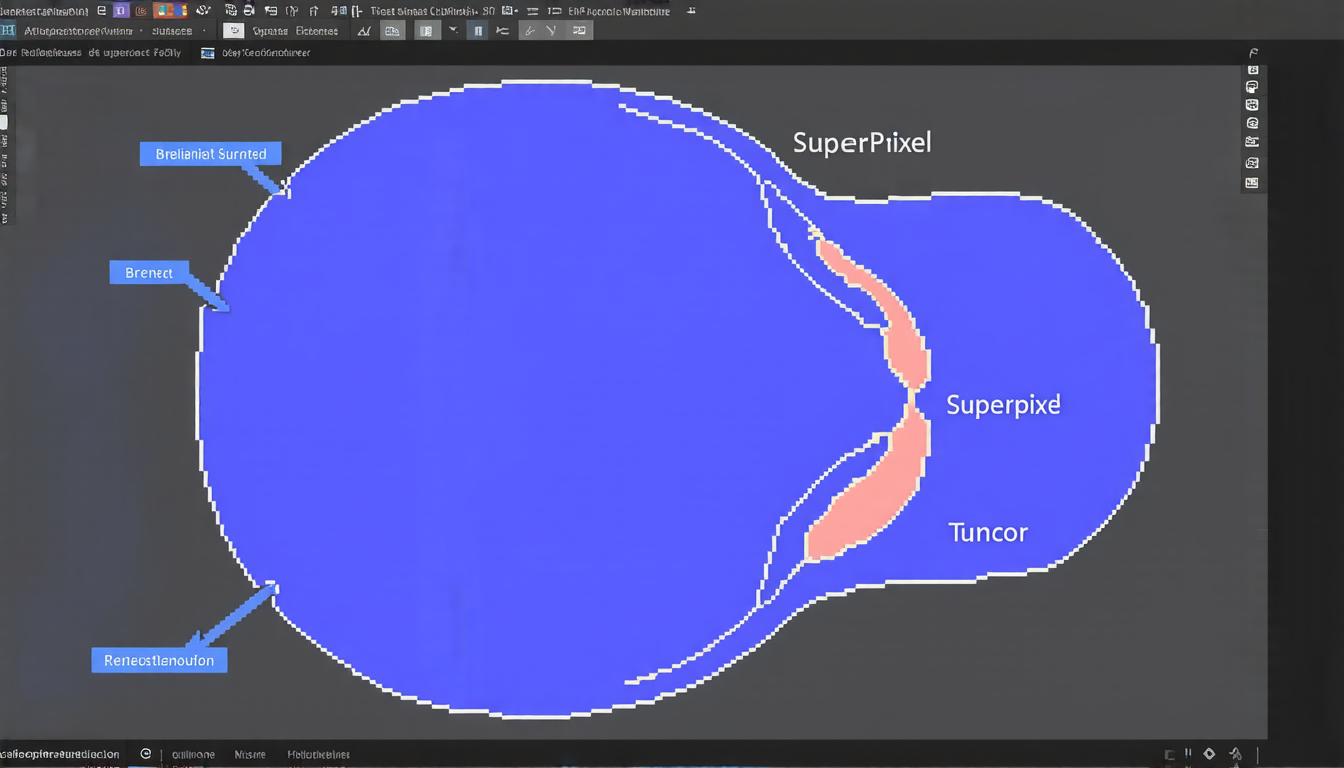
To address this issue, researchers have proposed a novel multi-layer superpixel correction algorithm that refines the boundaries of Class Activation Maps (CAMs). By combining superpixel clustering with floodfill techniques, the algorithm improves the quality of segmentation masks. This approach is particularly effective in correcting semantic boundaries, which are crucial for accurate tissue classification.
The algorithm begins by generating pseudo-masks using CAMs at various depths within a convolutional neural network (CNN). These pseudo-masks serve as a starting point for refinement. Next, superpixel clustering is applied to partition the image into natural regions, which are then processed using floodfill techniques. This step ensures that pixels with similar characteristics are grouped together, resulting in more accurate boundary definitions.
The algorithm’s effectiveness is demonstrated through experiments on the Breast Cancer Semantic Segmentation (BCSS) dataset. The results show that the proposed approach achieves state-of-the-art performance in terms of mean intersection over union (mIoU), outperforming existing WSSS methods. The algorithm’s strength lies in its ability to refine semantic boundaries, which is particularly important for accurate tissue classification.
The researchers’ approach also highlights the importance of refining segmentation masks at the correct stage. Modifying CAMs too early can lead to a loss of important features, whereas adjusting them later in the process can have a significant impact on performance. This insight underscores the need for careful consideration when developing WSSS algorithms.
In the future, this research has implications for various medical imaging applications, including cancer diagnosis and treatment planning. The ability to accurately segment tissue types will enable clinicians to make more informed decisions about patient care. Additionally, the algorithm’s potential for adaptation to other image domains makes it a promising tool for researchers exploring WSSS in different contexts.
The proposed multi-layer superpixel correction algorithm offers a significant advancement in WSSS, demonstrating the power of combining CAMs with superpixel clustering and floodfill techniques. As medical imaging technology continues to evolve, this research will play a crucial role in pushing the boundaries of what is possible in tissue segmentation and classification.
Cite this article: “Refining Tissue Segmentation with Multi-Layer Superpixel Correction Algorithm”, The Science Archive, 2025.
Medical Imaging, Weakly Supervised Semantic Segmentation, Image-Level Labels, Class Activation Maps, Superpixel Correction, Floodfill Techniques, Convolutional Neural Network, Breast Cancer, Tissue Segmentation, Mean Intersection Over Union





