

Monday 03 March 2025
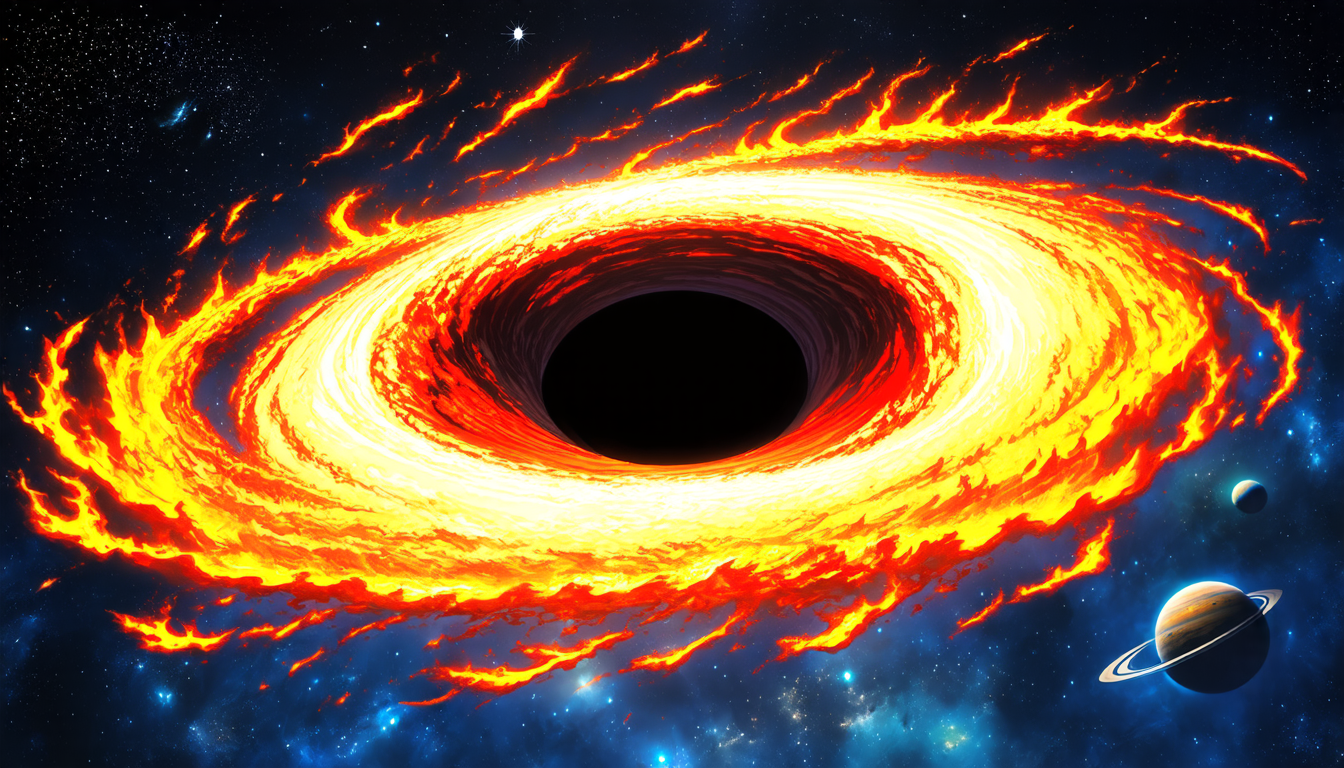
A new way of studying black holes has been discovered, and it’s revolutionizing our understanding of these cosmic monsters. By analyzing the light that escapes from black holes, scientists have found a way to detect the presence of powerful winds that surround these objects.
These winds are thought to be created by the intense heat and radiation emitted by the black hole as it devours nearby matter. As this material spirals towards the event horizon, it becomes superheated, releasing an enormous amount of energy in the form of X-rays and gamma rays. This energy is then absorbed by the surrounding gas and dust, causing it to expand rapidly and create strong winds.
The detection of these winds has been made possible by a new technique called ‘rms spectroscopy.’ Essentially, scientists are measuring the variability in the light emitted by the black hole over time, rather than just looking at its overall brightness. This allows them to pick up on subtle changes in the wind patterns that would otherwise go unnoticed.
One of the most exciting discoveries made using this technique is the detection of a massive wind surrounding the black hole known as V404 Cygnus. Located about 8,000 light-years away from Earth, this black hole is one of the brightest and most active ever observed. By studying its wind patterns, scientists have been able to learn more about the conditions around the event horizon, where matter is being pulled in and heated up.
The winds detected by the scientists are incredibly powerful, with some reaching speeds of up to 10 million kilometers per hour (6.2 million miles per hour). This is much faster than any wind on Earth, and it’s likely that these winds play a crucial role in shaping the surrounding environment.
This new technique has far-reaching implications for our understanding of black holes and their role in the universe. By studying the winds surrounding these objects, scientists hope to learn more about how they form and evolve over time. This could ultimately help us better understand the origins of galaxies and the formation of stars.
The detection of these powerful winds also raises interesting questions about the potential for life around black holes. If there are planets orbiting nearby stars that are being affected by these strong winds, it’s possible that life could have evolved in unique ways to adapt to this environment. This is an area that scientists will be exploring in the coming years.
Overall, the discovery of powerful winds surrounding black holes has opened up a new frontier for astrophysicists.
Cite this article: “Unveiling the Secrets of Black Hole Winds”, The Science Archive, 2025.
Black Holes, Winds, Radiation, X-Rays, Gamma Rays, Spectroscopy, Event Horizon, V404 Cygnus, Astronomy, Astrophysics





