

Monday 03 March 2025
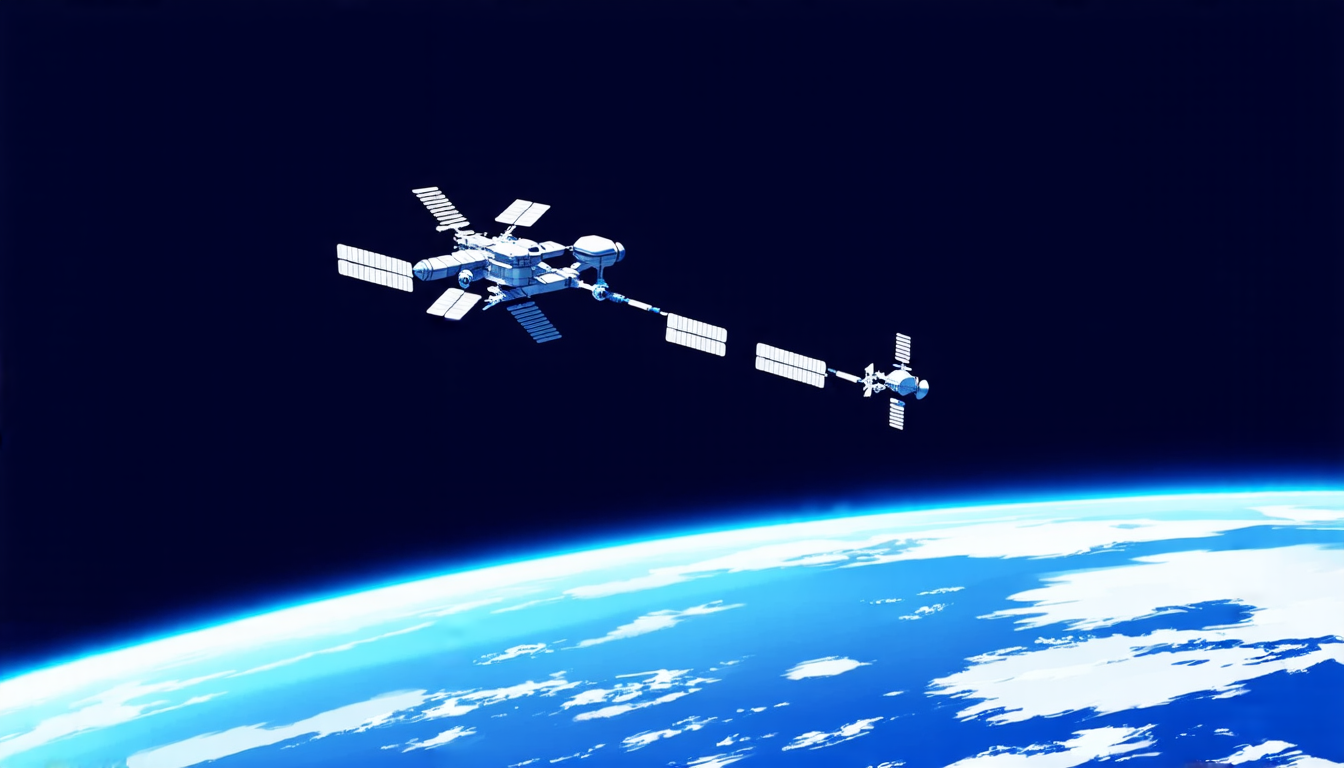
Scientists have made a significant breakthrough in developing a new method for collaborative spacecraft servicing, which could revolutionize our ability to maintain and repair satellites in orbit.
Currently, maintaining satellites is a complex and challenging task that requires a lot of resources and expertise. Satellites are often launched with limited fuel reserves, and as they age, their orbits can become unstable, making it difficult to communicate with them or even locate them. This makes it hard for scientists to gather valuable data from these spacecraft, which could lead to a loss of critical information.
To overcome this challenge, researchers have developed a new approach that uses artificial intelligence and machine learning algorithms to enable multiple spacecraft to work together to service other satellites in orbit. The system is designed to use relative position measurements, rather than precise velocity information, which is often difficult or impossible to obtain from distant satellites.
The team used a combination of neural networks and Lyapunov-based control methods to develop an adaptive controller that can adjust its behavior based on the changing dynamics of the spacecraft in real-time. This allows the system to adapt to unexpected changes in the satellite’s orbit or velocity, ensuring that the servicing process remains stable and efficient.
The team tested their system using simulations involving six servicer spacecraft tasked with tracking a single defunct spacecraft. The results showed that the system was able to achieve steady-state tracking errors of approximately 5 meters within 200 seconds, meeting the precision requirements for initiating servicing operations.
This breakthrough has significant implications for the future of space exploration and satellite maintenance. By enabling multiple spacecraft to work together to service other satellites in orbit, scientists will be able to gather more data from distant planets and stars, which could lead to new discoveries and a deeper understanding of the universe.
In addition, this technology could also enable more efficient use of resources by allowing satellites to be repaired or upgraded in orbit, reducing the need for costly launches and minimizing waste. This could also lead to the development of more reliable and sustainable satellite systems that can operate for longer periods of time without the need for frequent maintenance.
Overall, this new method for collaborative spacecraft servicing has the potential to revolutionize our ability to explore and understand the universe, while also reducing costs and improving efficiency in space operations.
Cite this article: “Collaborative Spacecraft Servicing Breakthrough”, The Science Archive, 2025.
Spacecraft Servicing, Artificial Intelligence, Machine Learning, Satellite Maintenance, Orbit, Velocity, Neural Networks, Lyapunov-Based Control, Adaptive Controller, Space Exploration





