

Monday 03 March 2025
A new approach to analyzing long videos has been developed, which could revolutionize our understanding of complex video content. The technique, known as VideoMindPalace, uses a sophisticated graph-based representation to organize critical moments within a video into a structured and hierarchical framework.
The challenge with analyzing long videos is that they often contain extensive temporal spans and concentrated spatial activity zones, making it difficult for machines to understand the relationships between these components. To address this issue, researchers have developed VideoMindPalace, which captures key information from the video data and represents it in a graph structure.
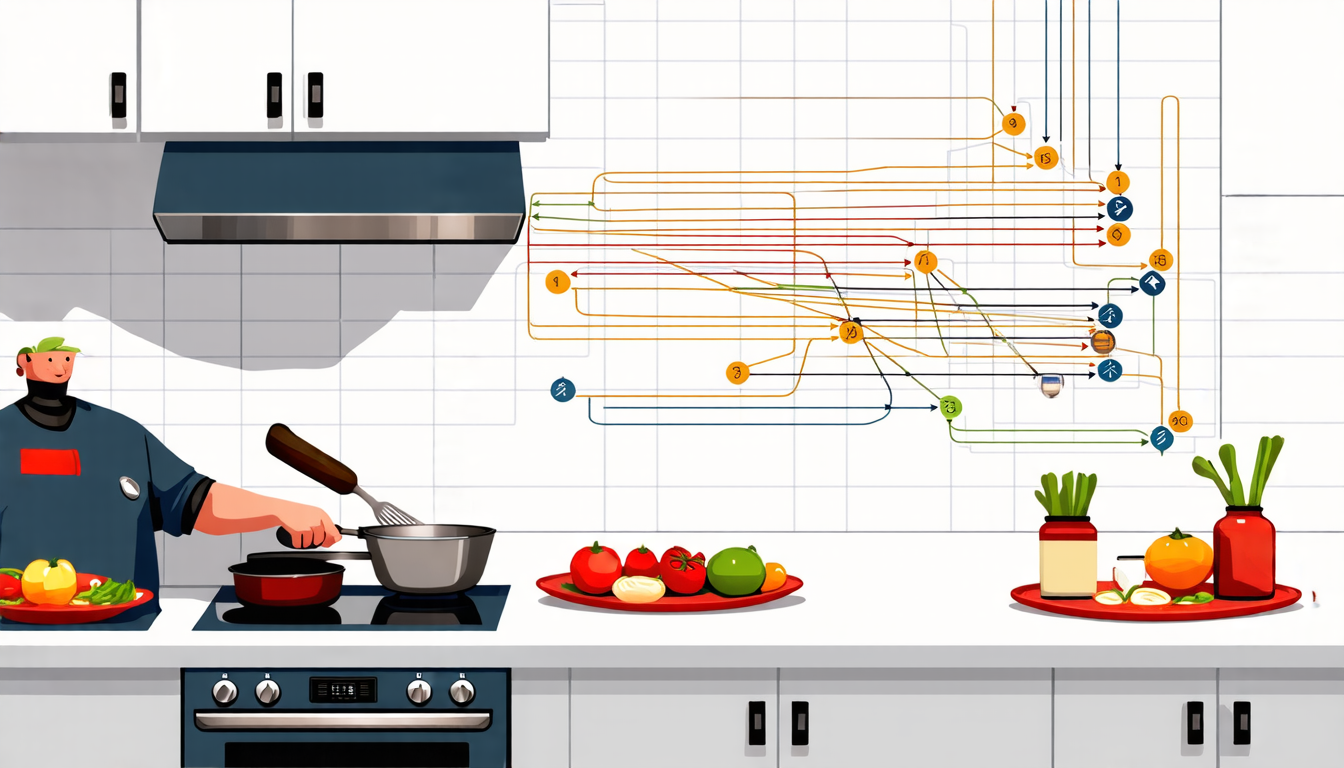
This approach involves three layers of representation: human-object interaction, activity zones, and scene layout. The first layer captures the interactions between humans and objects within the scene, including their spatial relationships and temporal durations. The second layer clusters these interactions into higher-level activity zones, such as rooms or areas with recurring activities. Finally, the third layer groups these zones into larger spatial groupings based on room-level context.
By using this layered representation, VideoMindPalace can provide a comprehensive understanding of the video content, including both spatial and temporal relationships between key events. This enables machines to reason about complex scenarios, such as determining the layout of a kitchen or identifying the sequence of actions performed by an individual.
To evaluate the effectiveness of VideoMindPalace, researchers tested it on a benchmark dataset containing 200 videos from egocentric recordings of daily activities. The results showed significant improvements in spatial, temporal, and layout-aware reasoning tasks compared to existing methods.
The implications of this technology are vast, with potential applications in areas such as video surveillance, robotics, and virtual assistants. For instance, VideoMindPalace could be used to improve the accuracy of object recognition systems by providing a more structured representation of the scene. Additionally, it could enable robots to better understand complex environments and navigate through them more effectively.
The development of VideoMindPalace highlights the importance of representing complex data in a way that is intuitive and accessible for machines to understand. By leveraging graph-based representations, researchers can unlock new insights into video content and improve our ability to analyze and reason about complex scenarios.
Cite this article: “VideoMindPalace: A Graph-Based Representation for Analyzing Complex Video Content”, The Science Archive, 2025.
Video Analysis, Graph-Based Representation, Long Videos, Video Content Understanding, Machine Learning, Spatial Reasoning, Temporal Reasoning, Layout-Aware, Robotics, Virtual Assistants, Object Recognition





