

Tuesday 04 March 2025
As scientists continue to push the boundaries of our understanding of complex systems, a recent study has shed new light on the behavior of solitons in a semilinear wave equation. In simple terms, solitons are stable, self-reinforcing waves that can form in certain physical systems, such as electromagnetic fields or fluid dynamics.
The researchers, led by Asma Azaiez and Jacek Jendrej, used advanced mathematical techniques to analyze the behavior of these solitons in a specific type of wave equation. The equation describes the interaction between a complex-valued wave function and its conjugate, which is a fundamental aspect of many physical systems.
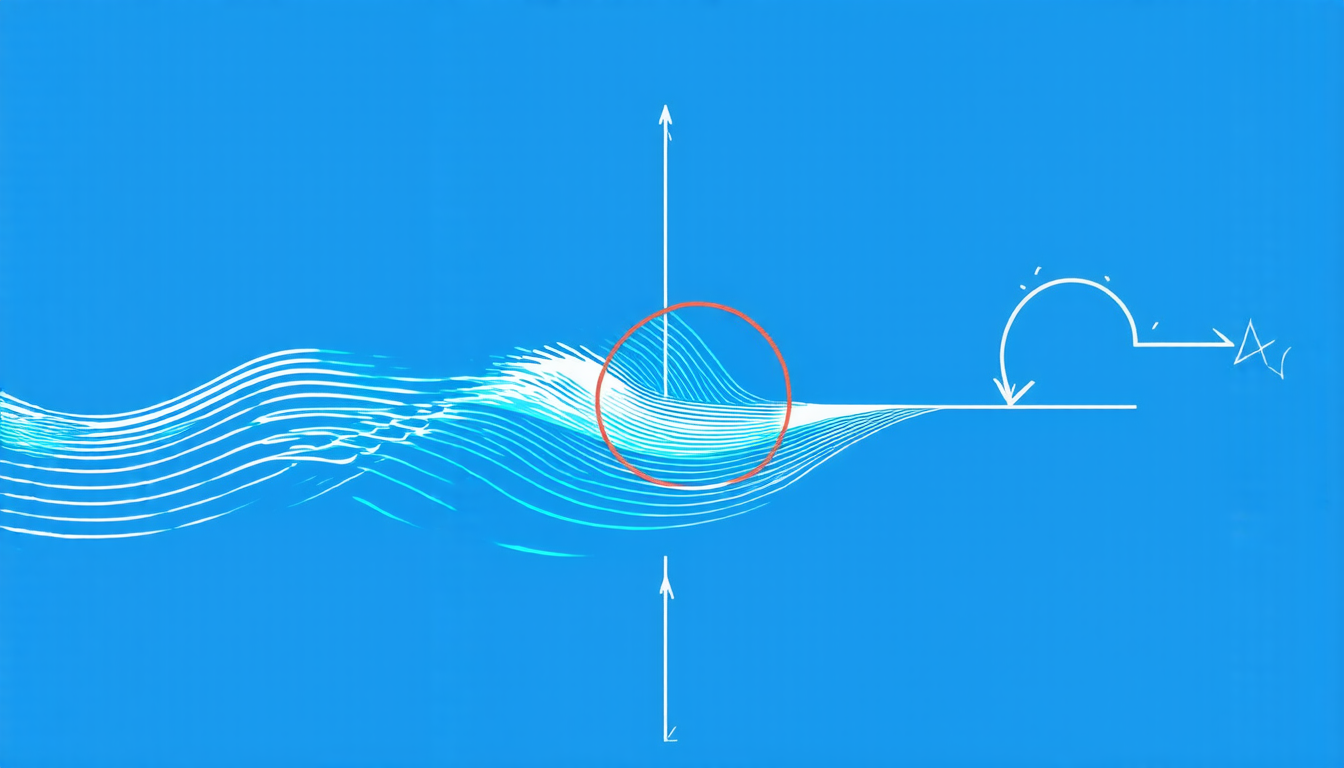
One of the key findings of the study is that near a characteristic point, where the wave function becomes singular, the solution can be decomposed into a sum of decoupled solitons with alternate signs. This means that at these points, the behavior of the solitons becomes essentially independent of each other, allowing researchers to focus on individual solitons rather than the entire system.
The study also reveals that near characteristic points, the slope of the solution can be estimated using a simple formula, which is a significant improvement over previous estimates. This has important implications for the study of complex systems, as it allows researchers to better understand the behavior of solitons in these systems and make more accurate predictions about their properties.
Another key aspect of the study is its focus on the blow-up surface, which is the set of points where the solution becomes infinite. The researchers found that near the blow-up surface, the solution can be approximated using a self-similar change of variables, which simplifies the analysis and allows for more accurate estimates of the blow-up rate.
The study’s findings have significant implications for our understanding of complex systems and their behavior. By better understanding the properties of solitons and their interactions, researchers can gain insights into a wide range of physical phenomena, from electromagnetic fields to fluid dynamics. The study’s results also highlight the importance of advanced mathematical techniques in the analysis of complex systems, demonstrating the power of mathematical modeling in uncovering new truths about the natural world.
Overall, this study represents an important advance in our understanding of solitons and their behavior in complex systems. By providing new insights into the properties and interactions of these waves, researchers can gain a deeper understanding of the underlying physics and make more accurate predictions about the behavior of these systems.
Cite this article: “Unveiling the Behavior of Solitons in Complex Systems”, The Science Archive, 2025.
Solitons, Semilinear Wave Equation, Complex Systems, Mathematical Modeling, Physical Phenomena, Electromagnetic Fields, Fluid Dynamics, Blow-Up Surface, Self-Similar Change Of Variables, Advanced Mathematical Techniques





