

Tuesday 04 March 2025
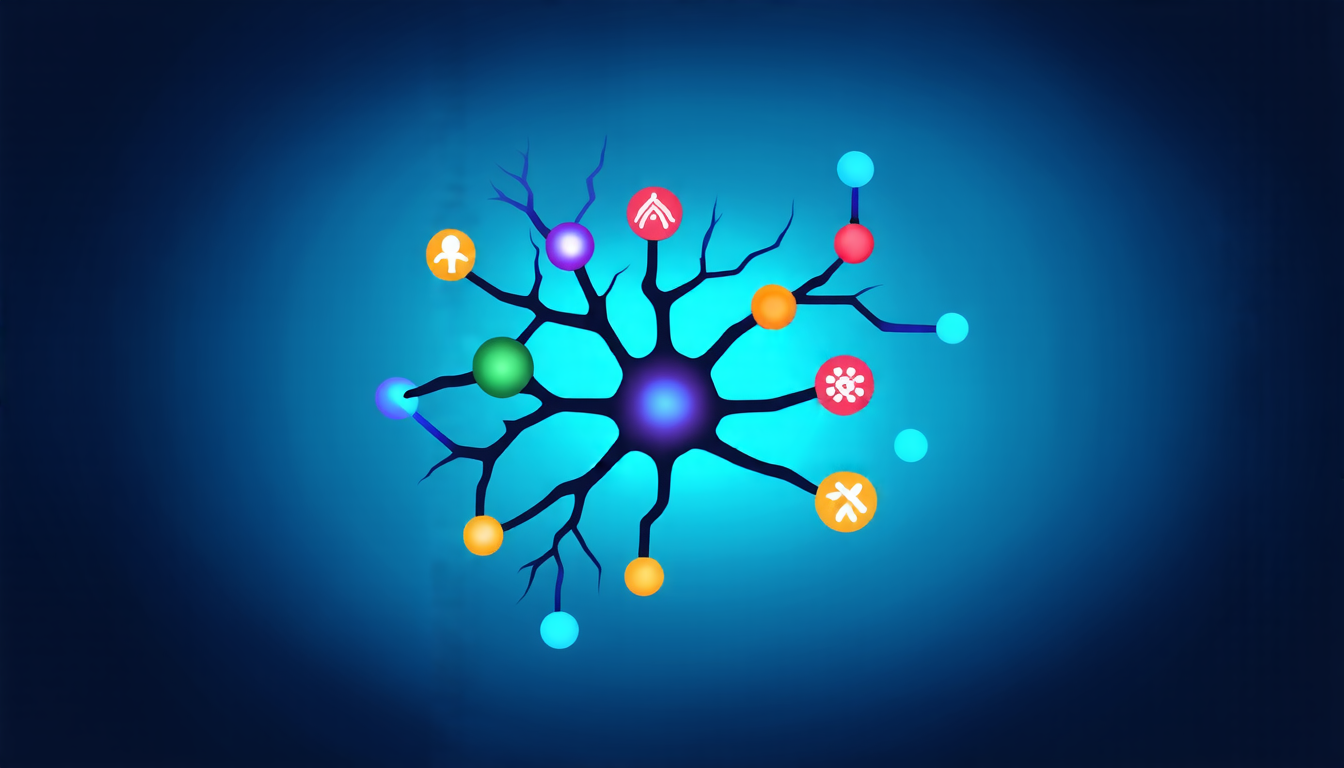
The intricate networks of neurons and synapses in our brains are a marvel of complexity, and scientists have long sought to unravel their secrets. One approach has been to study the connections between these brain cells using graph theory, which is typically used to analyze social networks or traffic patterns.
A recent paper has taken this approach further by developing a new method for analyzing directed graphs – those where the connections between nodes have direction. This technique, called directed q-analysis, allows researchers to identify hubs of activity and detect patterns in the brain’s neural networks that may be linked to cognitive processes like attention and memory.
The key innovation is the use of a mathematical construct called a flag complex, which represents the network as a set of interconnected simplices – three-dimensional shapes made up of vertices and edges. By analyzing these simplices, scientists can identify the most important nodes in the network and how they interact with each other.
One of the biggest advantages of directed q-analysis is its ability to handle large datasets. The brain’s neural networks contain billions of connections, making it challenging to analyze them using traditional methods. However, by representing the data as a flag complex, researchers can process this information much more efficiently, allowing them to identify patterns and relationships that may not be apparent through other means.
The study also highlights the importance of considering the directionality of brain connections. In traditional graph theory, nodes are often treated as equivalent, regardless of whether they send or receive signals. However, in the brain, the direction of connections is crucial for understanding how information flows between different regions.
For example, in a recent analysis of a Caenorhabditis elegans neural network, researchers found that certain nodes acted as hubs, receiving and sending signals to other parts of the network. These hubs were not only important for the overall functioning of the network but also played a key role in the transmission of information between different regions.
The study’s findings have significant implications for our understanding of brain function and could potentially lead to new insights into neurological disorders such as Alzheimer’s disease or Parkinson’s disease, where abnormal neural activity is thought to play a role. By developing more sophisticated methods for analyzing directed graphs, researchers can gain a deeper understanding of the complex networks that underlie human cognition.
The technique also has potential applications in other fields, such as social network analysis or traffic flow modeling. By representing complex systems as flag complexes, researchers can identify patterns and relationships that may not be apparent through traditional methods.
Cite this article: “Unlocking the Secrets of Brain Networks with Directed q-Analysis”, The Science Archive, 2025.
Brain Networks, Graph Theory, Directed Q-Analysis, Flag Complex, Simplices, Vertices, Edges, Neural Activity, Cognitive Processes, Neuroscience
Reference: Felix Windisch, Florian Unger, “Fast Directed $q$-Analysis for Brain Graphs” (2025).





