

Tuesday 04 March 2025
The quest for a more efficient way to solve complex optimization problems has been ongoing in the world of computer science and mathematics. A recent study published in Mathematics of Operations Research sheds new light on this challenge, offering insights into the structure of multilinear polytopes, which are crucial components in many optimization algorithms.
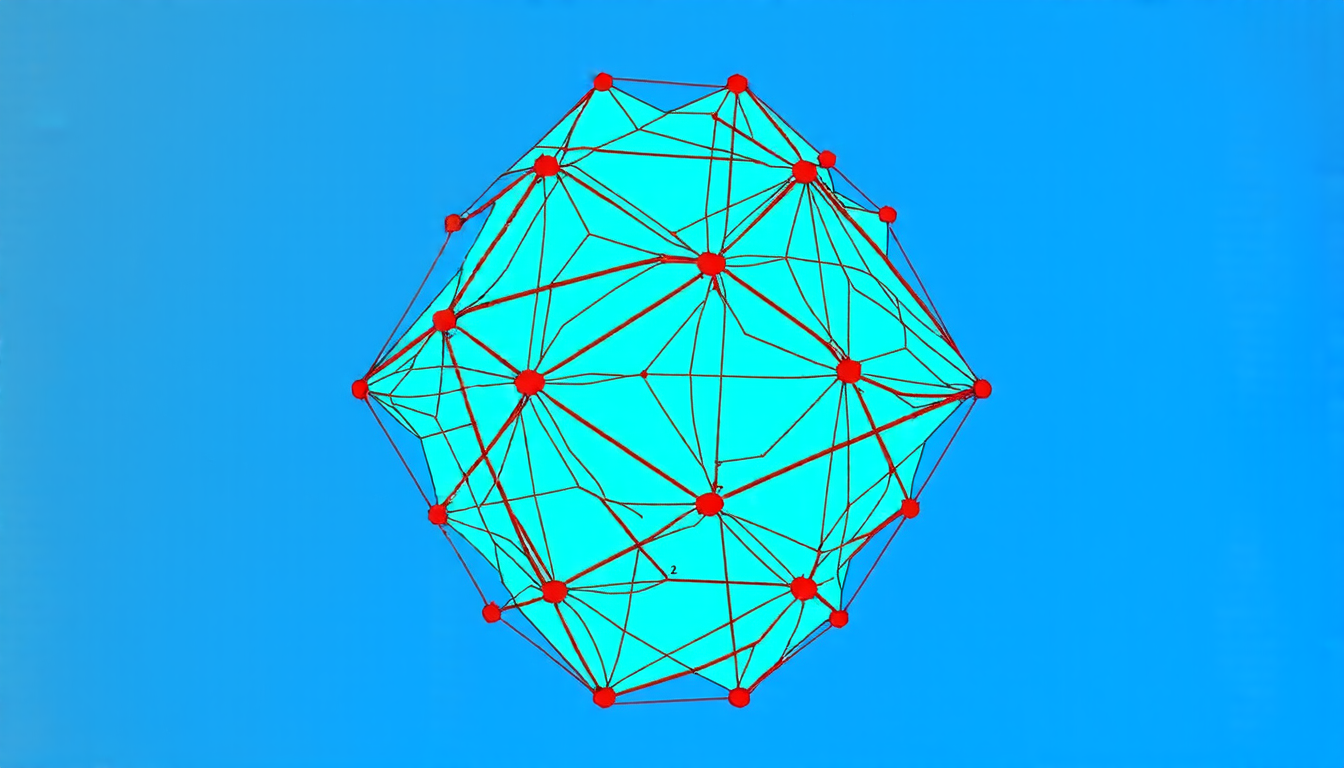
For those unfamiliar with the term, a multilinear polytope is a mathematical object that represents the feasible region for a binary polynomial optimization problem. In essence, it’s a geometric representation of the possible solutions to an optimization problem, where each solution is a combination of 0s and 1s. The challenge lies in finding efficient ways to solve these problems, as they are notoriously difficult.
The study in question explores three types of acyclic hypergraphs: Berge-acyclic, γ-acyclic, and β-acyclic. These hypergraphs are important because they can be used to define the structure of multilinear polytopes. The researchers discovered that the multilinear polytope for a Berge-acyclic hypergraph is equivalent to its standard linearization, which means that it’s possible to solve optimization problems involving these types of hypergraphs using relatively simple methods.
The story takes a turn with γ-acyclic and β-acyclic hypergraphs. The researchers found that the multilinear polytope for these types of hypergraphs is more complex, containing exponentially many facet-defining inequalities. This means that solving optimization problems involving these hypergraphs requires much more sophisticated techniques.
One of the key findings of the study is that the multilinear polytope for β-acyclic hypergraphs can have very dense facets, which are geometric features that define the boundaries of the polytope. This density makes it challenging to separate facet-defining inequalities, a crucial step in many optimization algorithms.
The researchers also explored the concept of extended formulations, which are alternative representations of the multilinear polytope that can be used to solve optimization problems more efficiently. They discovered that for β-acyclic hypergraphs, it’s possible to construct a polynomial-size extended formulation, which is a significant breakthrough in the field.
The implications of this study are far-reaching. The results provide new insights into the structure of multilinear polytopes and offer practical solutions for solving optimization problems involving acyclic hypergraphs. These findings have the potential to improve the efficiency of many algorithms used in fields such as operations research, computer science, and engineering.
Cite this article: “Unlocking Efficient Optimization Solutions through Multilinear Polytope Structure”, The Science Archive, 2025.
Optimization, Mathematics, Polytopes, Multilinear, Acyclic Hypergraphs, Berge-Acyclic, Γ-Acyclic, Β-Acyclic, Extended Formulations, Operations Research





