
Wednesday 05 March 2025
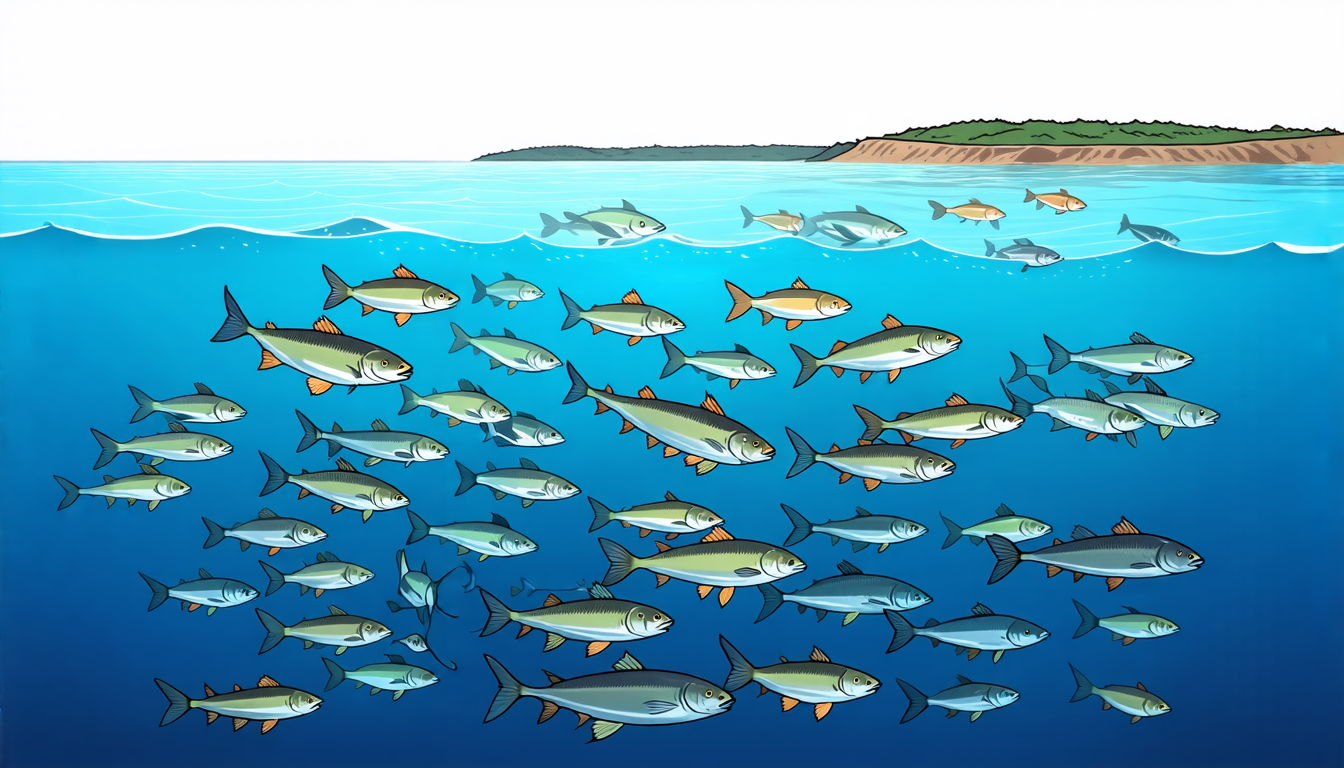
A new approach to estimating fish populations has been developed, offering a more accurate and robust method for assessing the health of our oceans.
Fisheries scientists have long relied on statistical models to estimate the size of fish populations, but these models can be limited by their inability to account for the complexity of real-world data. A team of researchers has now introduced a new approach, known as the generalized gamma distribution (GGD), which offers a more flexible and realistic way to model fish population dynamics.
The GGD is a statistical distribution that allows for a wide range of shapes and tail behaviors, making it well-suited to modeling real-world data. In contrast, traditional models often assume a specific shape or distribution, which can lead to inaccurate estimates if the actual data does not fit this assumption.
To test the GGD, the researchers applied it to 15 species of fish across three regions in the Gulf of Alaska and the coast of British Columbia, Canada. They found that the GGD performed well, with high accuracy and robustness across a range of scenarios. In fact, the GGD was selected as the best model for most of the species, outperforming traditional models such as the lognormal and gamma distributions.
The researchers also compared the GGD to other statistical models in a simulation experiment, where they generated artificial data that mimicked real-world fish population dynamics. Again, the GGD performed well, with high predictive accuracy and robustness.
One of the key advantages of the GGD is its ability to account for heavy-tailed distributions, which are common in real-world data. Heavy-tailed distributions can lead to inaccurate estimates if not accounted for, as they can produce extreme values that skew the data. The GGD’s flexibility allows it to capture these heavy tails, providing a more realistic representation of fish population dynamics.
The implications of this research are significant, particularly for fisheries management and conservation efforts. Accurate estimates of fish populations are crucial for setting sustainable catch limits and managing fisheries effectively. The GGD offers a new tool for researchers and managers to improve their estimates, leading to more informed decision-making and better conservation outcomes.
Overall, the introduction of the generalized gamma distribution marks an important advance in statistical modeling for fisheries research. Its flexibility and accuracy make it an attractive option for researchers seeking to improve their understanding of fish population dynamics and inform effective management practices.
Cite this article: “Accurate Estimation of Fish Populations with Generalized Gamma Distribution”, The Science Archive, 2025.
Fisheries, Statistics, Modeling, Fish Populations, Ocean Health, Generalized Gamma Distribution, Ggd, Fisheries Management, Conservation, Population Dynamics