

Wednesday 05 March 2025
Black holes are notorious for their ability to warp space and time, but a new study has shed light on another fascinating aspect of these cosmic behemoths: their spin.
For decades, scientists have known that black holes can rotate at incredible speeds, with some spinning hundreds of times per second. But researchers had long assumed that the maximum speed a black hole could achieve was around 99.9% of its theoretical limit. That’s because any faster and the black hole would start to break apart from the stress of its own rotation.
However, new research suggests that this assumption may have been wrong. By studying the way that magnetic fields interact with the swirling gas around a black hole, scientists have discovered that these fields can actually slow down the black hole’s spin. This means that the maximum speed a black hole can achieve is likely much lower than previously thought.
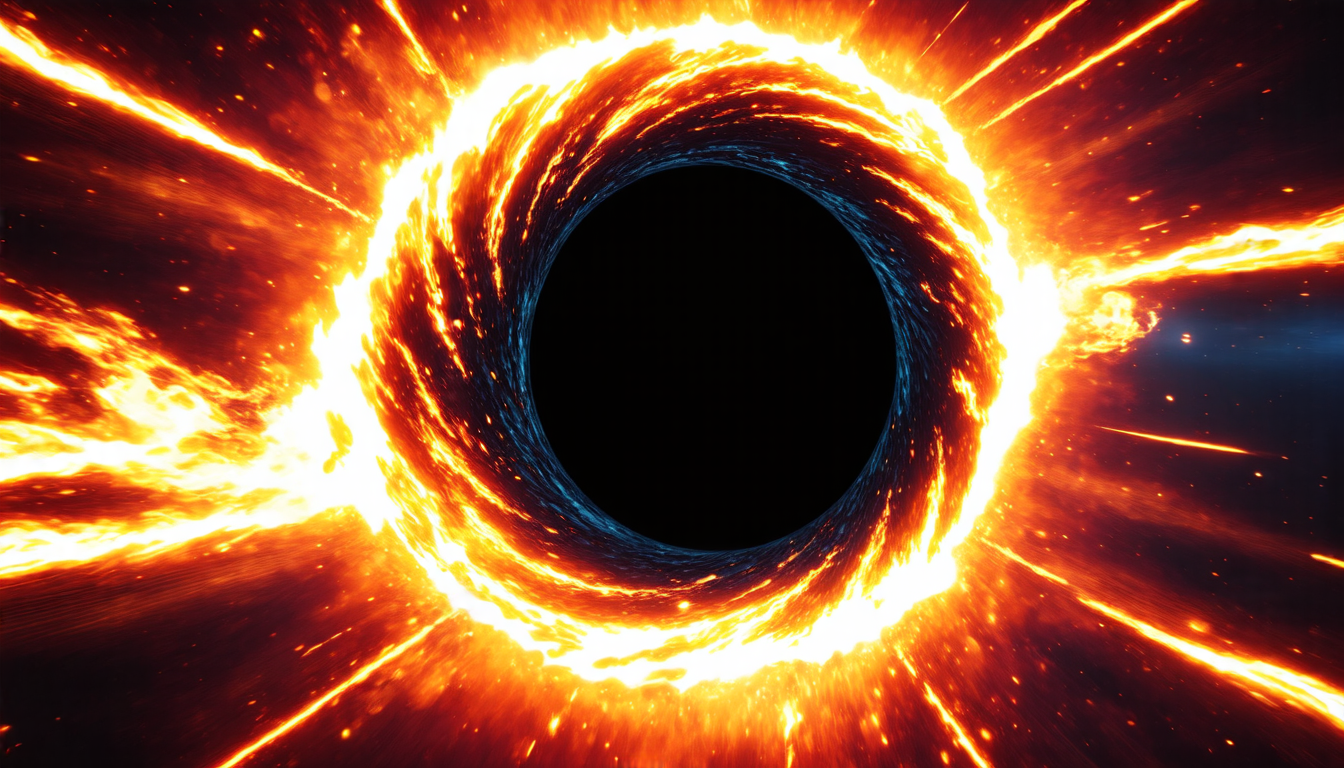
So how does this work? Well, when a star dies and collapses into a black hole, it often leaves behind a swirling disk of gas and dust. As this material spirals towards the event horizon, it becomes hotter and hotter until it finally disappears into the black hole’s abyss. But before it goes, it emits intense beams of energy that can be observed from great distances.
These beams are thought to be powered by the same magnetic fields that slow down the black hole’s spin. By studying the way these beams change as they approach the event horizon, scientists have been able to infer the strength and direction of these magnetic fields.
The implications of this research are significant. For one, it means that black holes may not be as efficient at converting energy into radiation as previously thought. It also suggests that the spin of a black hole can be influenced by its surroundings in ways that were previously unknown.
But perhaps most fascinatingly, this research has opened up new avenues for studying black holes and their role in shaping the universe around us. By observing the subtle changes in these beams of energy, scientists may be able to gain a deeper understanding of how black holes form and evolve over time.
Of course, there’s still much to be learned about these mysterious objects. But as our understanding of black holes continues to grow, so too does our appreciation for their incredible power and complexity. And who knows? Maybe one day we’ll even figure out how to harness that power ourselves.
Cite this article: “Black Hole Spin: A Surprising Twist on Cosmic Behavior”, The Science Archive, 2025.
Black Holes, Spin, Magnetic Fields, Energy Beams, Event Horizon, Radiation, Efficiency, Universe, Formation, Evolution





