

Wednesday 05 March 2025
Scientists have made a significant breakthrough in mathematics, developing a new method for accurately approximating complex functions and their derivatives. This innovation has far-reaching implications for fields such as physics, engineering, and computer science.
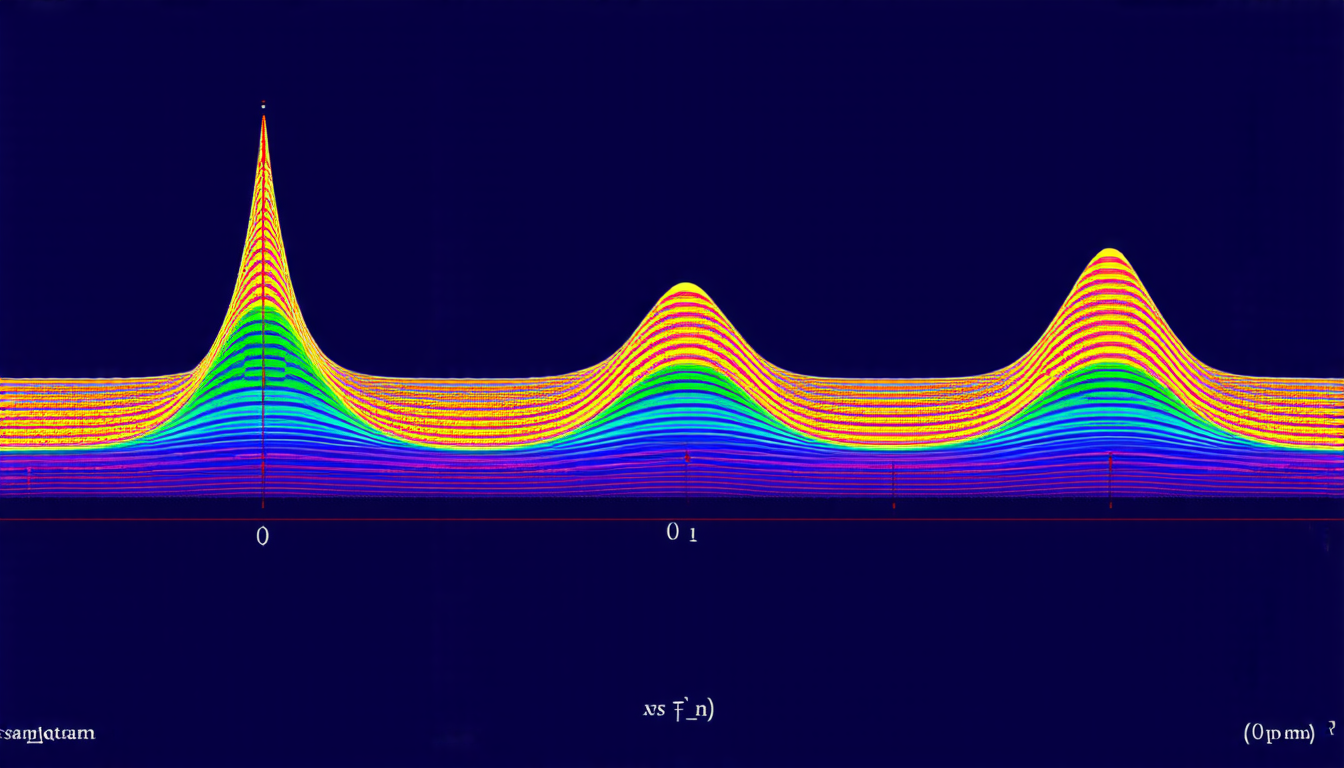
The new technique, called the Direct Rational Radial Basis Function Partition of Unity (DRRBF-PU) method, allows researchers to compute the derivatives of functions with steep gradients or singularities. These types of functions are common in many areas of science, but they can be notoriously difficult to work with.
Traditionally, mathematicians have used various methods to approximate these complex functions, including radial basis functions (RBFs). RBFs are a type of mathematical function that can be used to create a smooth approximation of a given function. However, existing RBF-based methods often struggle when dealing with functions that have steep gradients or singularities.
The DRRBF-PU method addresses this limitation by using a combination of rational functions and radial basis functions. Rational functions are a type of mathematical function that can be used to create a more accurate approximation of a given function. By combining these two types of functions, the DRRBF-PU method is able to create a highly accurate approximation of complex functions and their derivatives.
The new method has been tested on a range of complex functions, including those with steep gradients and singularities. The results are impressive, with the DRRBF-PU method showing significant improvements in accuracy over existing methods.
This breakthrough has important implications for many areas of science. For example, it could be used to improve the design of computer algorithms that rely on accurate approximations of complex functions. It could also be used to develop new models for understanding complex physical systems, such as those found in materials science or fluid dynamics.
In addition to its scientific importance, the DRRBF-PU method is also notable for its potential applications in real-world problems. For example, it could be used to improve the accuracy of weather forecasting models, which rely on complex mathematical functions to predict future weather patterns.
Overall, the DRRBF-PU method represents a significant advancement in the field of mathematics and has important implications for many areas of science. Its ability to accurately approximate complex functions and their derivatives makes it an essential tool for researchers working in a wide range of fields.
Cite this article: “Breakthrough in Mathematics Enables Accurate Approximation of Complex Functions”, The Science Archive, 2025.
Mathematics, Functions, Derivatives, Radial Basis Functions, Rational Functions, Partition Of Unity, Complex Systems, Scientific Computing, Approximation Methods, Numerical Analysis.





