

Wednesday 05 March 2025
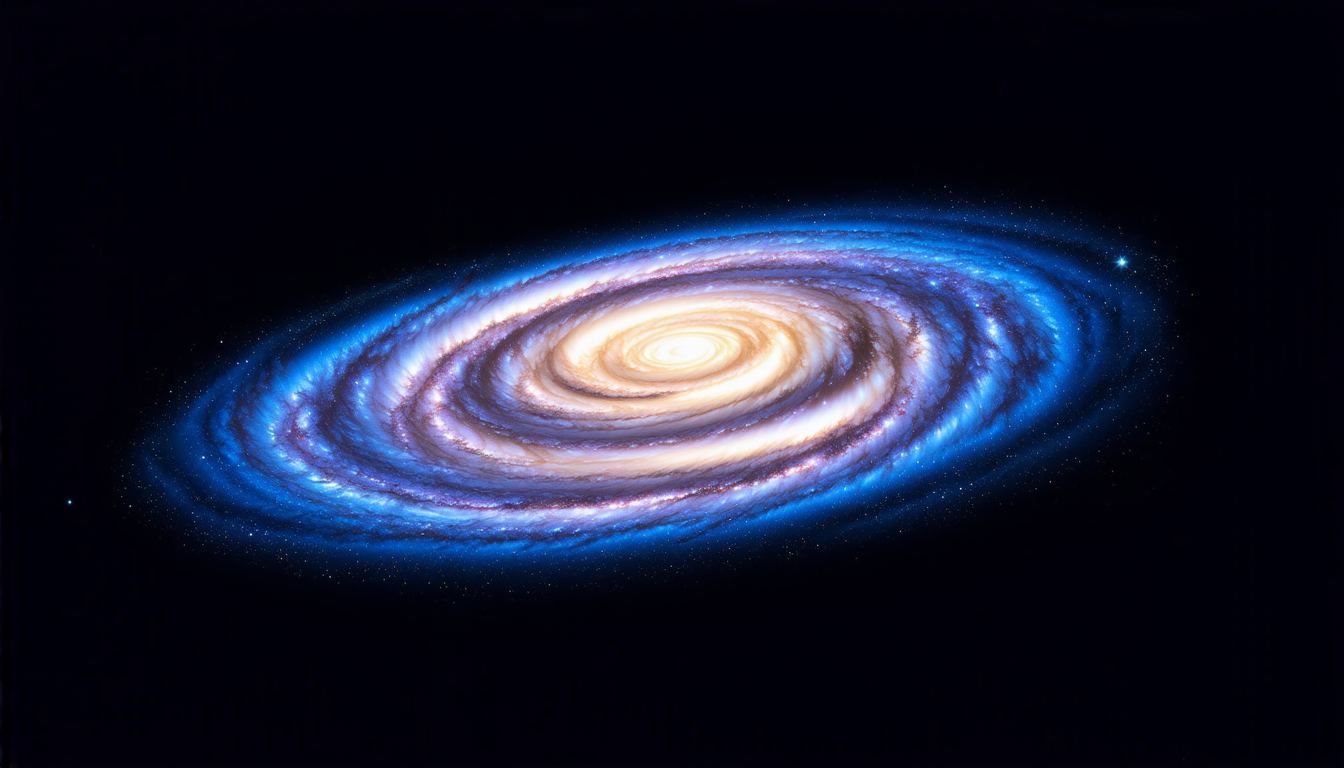
A new breed of galaxy models has emerged, offering a more realistic representation of our cosmic neighbors. These modified Kuzmin models have been designed to better capture the intricate details of galactic structure and behavior.
For decades, astronomers have relied on the Miyamoto-Nagai model to simulate the motion of stars within galaxies. While this model has been successful in explaining many observed phenomena, it has its limitations. In particular, it assumes a constant density at the center of the galaxy, which is not supported by observational evidence.
The new models, developed by Walter Dehnen and Shera Jafaritabar, address this shortcoming by introducing an exponential or sech2 vertical profile, rather than the traditional constant density. This allows for a more nuanced representation of the galactic structure, with a central density that decreases as you move away from the center.
One of the key advantages of these new models is their ability to capture the complex dynamics of galaxy formation and evolution. By incorporating a realistic vertical profile, astronomers can better understand how stars and gas are distributed within the galaxy, and how this distribution affects the overall structure and behavior of the system.
The modified Kuzmin models also offer improved accuracy in predicting the motion of stars and other celestial objects within the galaxy. This is because they take into account the non-uniform density profile, which is more representative of real galaxies.
The implications of these new models are far-reaching, with potential applications in understanding the formation and evolution of our own Milky Way galaxy, as well as other galaxies in the universe. By better understanding the dynamics of galaxy structure and behavior, astronomers can gain valuable insights into the history and fate of our cosmic neighborhood.
These modified Kuzmin models have been incorporated into the discBar code, a software tool used to simulate the motion of stars within galaxies. This allows researchers to easily incorporate these new models into their simulations, and explore the implications for galaxy evolution and structure.
In summary, the new modified Kuzmin models offer a more realistic representation of galactic structure and behavior, with improved accuracy in predicting the motion of stars and other celestial objects. With potential applications in understanding the formation and evolution of our own Milky Way galaxy, these models are an exciting development in the field of astrophysics.
Cite this article: “Enhancing Galactic Simulations with Modified Kuzmin Models”, The Science Archive, 2025.
Galaxy Models, Modified Kuzmin, Galactic Structure, Galaxy Evolution, Astronomy, Astrophysics, Simulation, Star Motion, Density Profile, Milky Way





