

Wednesday 05 March 2025
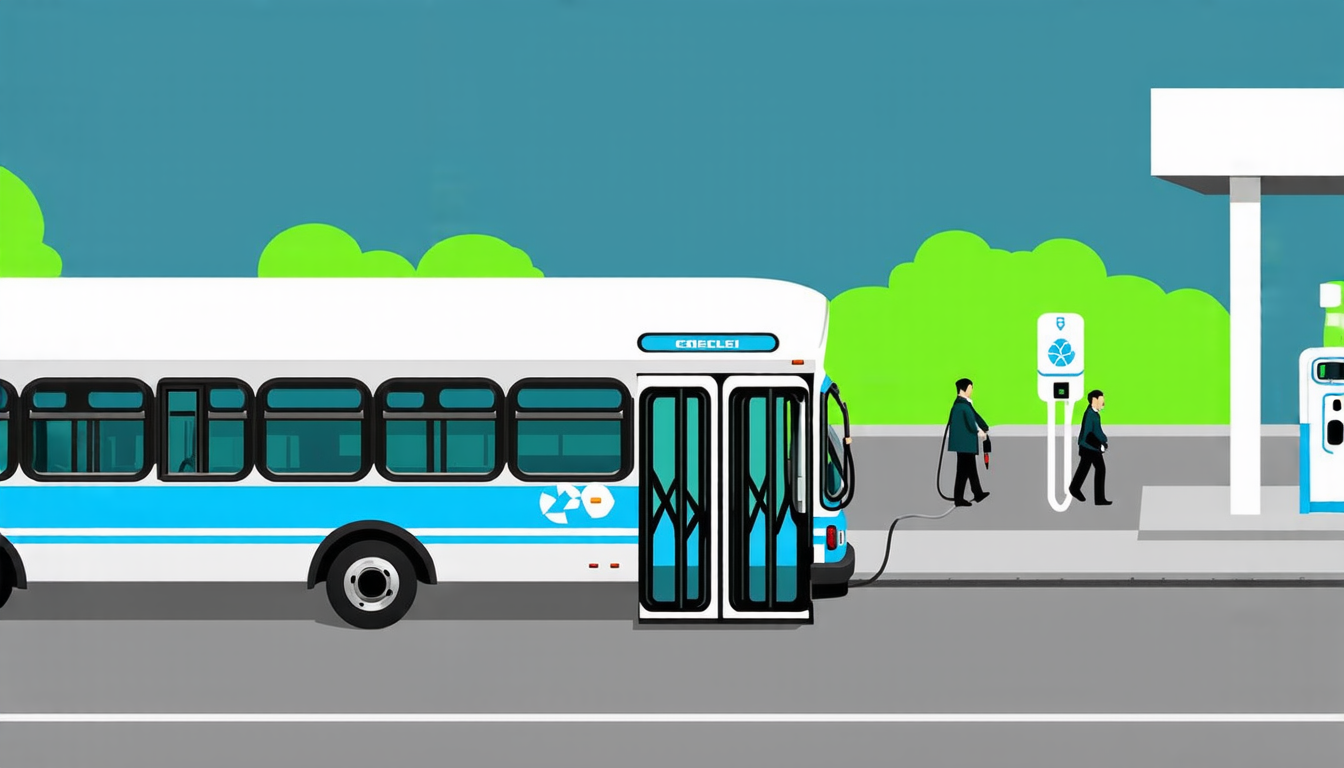
As cities around the world grapple with the challenge of reducing their carbon footprint, a new approach to designing electric bus networks is gaining traction. A team of researchers has developed a novel method for optimizing charging infrastructure, ensuring that buses can run efficiently and reliably while minimizing costs.
The problem lies in the unpredictability of energy consumption by electric buses. Unlike traditional fossil-fuel powered vehicles, which burn through fuel at a relatively consistent rate, electric buses’ energy demand can vary significantly depending on factors such as road terrain, weather conditions, and even the number of passengers onboard. This unpredictability makes it difficult to design charging infrastructure that can meet the needs of these buses.
To address this challenge, the researchers developed two mathematical models: one that accounts for uncertainty in energy consumption by using robust optimization techniques, and another that leverages real-world data to provide more flexible and informed solutions.
The first model, known as Box Uncertainty (BoU), assumes that energy consumption follows a specific probability distribution. This allows the algorithm to generate multiple scenarios, each representing a possible outcome based on varying energy demands. By considering these different scenarios, the BoU model can identify the most cost-effective charging infrastructure design that meets the needs of all possible energy consumption patterns.
The second model, Distributionally Robust Optimization with Chance Constraints (DRCC), takes a more data-driven approach. It uses real-world data to estimate the probability distribution of energy consumption and then optimizes the charging infrastructure design based on this information. This approach provides a more accurate representation of energy demand patterns, allowing for more efficient and reliable bus operations.
To test these models, the researchers applied them to the Rotterdam bus network in the Netherlands. The results showed that ignoring variations in energy consumption can lead to operational unreliability, with up to 55% of scenarios resulting in infeasible trips. By contrast, the BoU model reduced costs by 28% compared to the box uncertainty model while maintaining reliability.
The implications of this research are significant. As cities continue to transition to electric transportation, optimizing charging infrastructure will become increasingly important for ensuring efficient and reliable operations. The models developed by this team provide a valuable tool for policymakers and transportation planners, enabling them to design more effective charging networks that meet the needs of both buses and passengers.
In practical terms, this means that cities can now plan their charging infrastructure with greater precision, minimizing costs while maximizing reliability.
Cite this article: “Optimizing Electric Bus Charging Infrastructure”, The Science Archive, 2025.
Electric Buses, Charging Infrastructure, Energy Consumption, Uncertainty, Optimization Techniques, Robust Optimization, Real-World Data, Distributionally Robust Optimization, Chance Constraints, Bus Network





