

Wednesday 05 March 2025
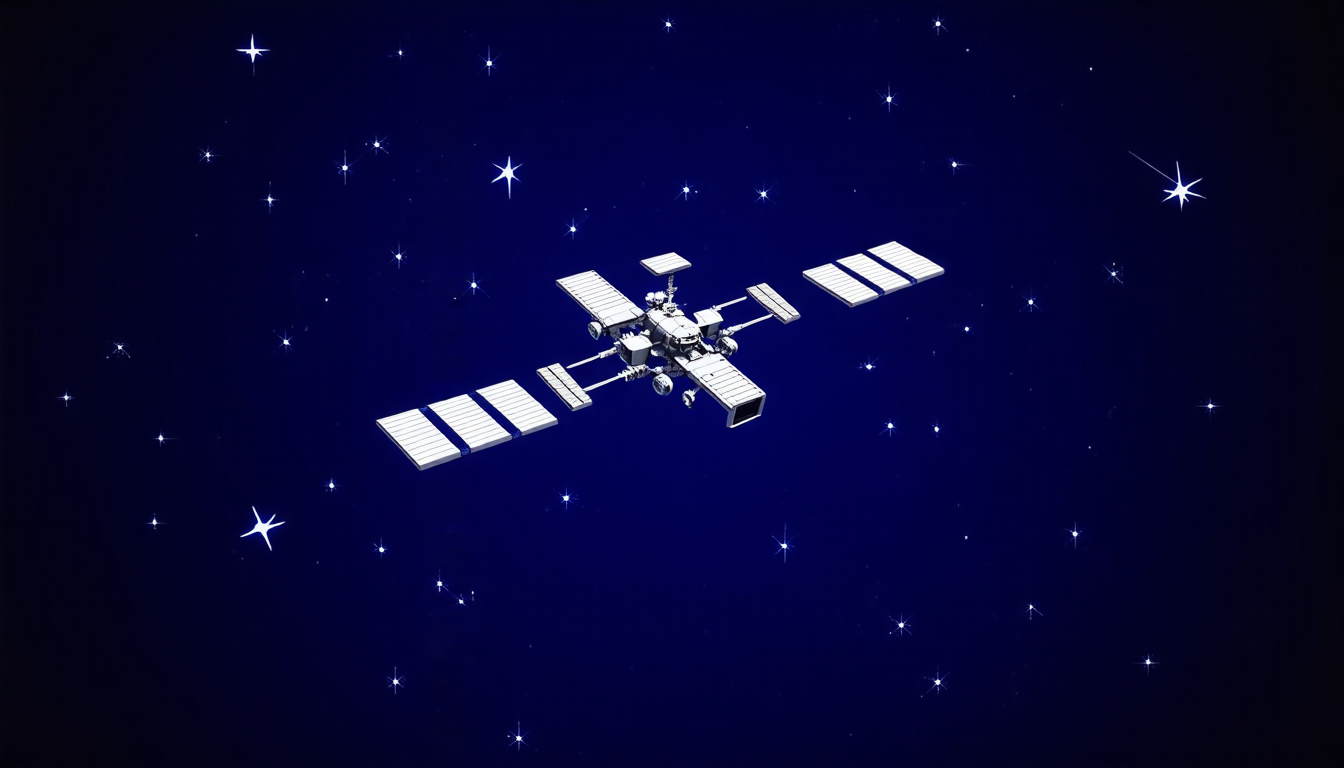
Spacecraft inspection is a critical task that requires precision and efficiency. As space missions become more complex, the need for reliable and autonomous systems grows. Researchers have been exploring ways to use reinforcement learning (RL) to develop policies for spacecraft inspection tasks. RL is a type of machine learning where an agent learns to take actions in an environment by interacting with it and receiving rewards or penalties.
Recently, scientists have made significant progress in developing RL-based policies for spacecraft inspection tasks. In a new study, researchers trained agents to inspect a simulated spacecraft using various sensors and reference frames. The goal was to investigate the impact of observation space design choices on training and performance.
The team used a scenario where a deputy spacecraft needs to inspect a chief spacecraft by navigating its surface and identifying uninspected points. They designed three types of sensors: one that provides information about the Sun’s position, another that counts the number of inspected points, and a third that detects clusters of uninspected points.
The results show that RL agents can learn to successfully inspect the spacecraft without additional sensors, but the sensors do help the learning process and produce more optimal behavior. The count sensor, however, hindered the learning process and produced lower-performing policies.
The study also explored the impact of reference frames on training and performance. A reference frame is a system used to define an agent’s position and orientation in space. The researchers found that changing from a chief-centered reference frame to an agent-centered one had minimal impact on the learning process for translational inspection tasks.
This research has significant implications for autonomous spacecraft operations. By developing RL-based policies, scientists can create more efficient and reliable systems for inspecting spacecraft. This could lead to improved mission success rates and reduced costs.
The study’s findings also highlight the importance of sensor design in RL-based systems. By carefully designing sensors that provide relevant information, researchers can improve the learning process and produce better-performing agents. Additionally, exploring different reference frames can help scientists develop more robust and adaptable policies for complex tasks like spacecraft inspection.
These advancements have the potential to transform the field of autonomous spacecraft operations. As space missions become increasingly complex, the need for reliable and efficient systems grows. By developing RL-based policies that can learn from experience and adapt to changing environments, scientists can create more sophisticated and effective systems for inspecting spacecraft.
The next step is to apply these findings to real-world scenarios. Researchers will need to test their RL-based policies in simulated or actual spacecraft inspection tasks to validate their effectiveness.
Cite this article: “Reinforcement Learning Boosts Spacecraft Inspection Efficiency and Reliability”, The Science Archive, 2025.
Reinforcement Learning, Spacecraft Inspection, Autonomous Systems, Machine Learning, Sensor Design, Reference Frames, Space Missions, Inspection Tasks, Policy Learning, Robotics





