

Thursday 06 March 2025
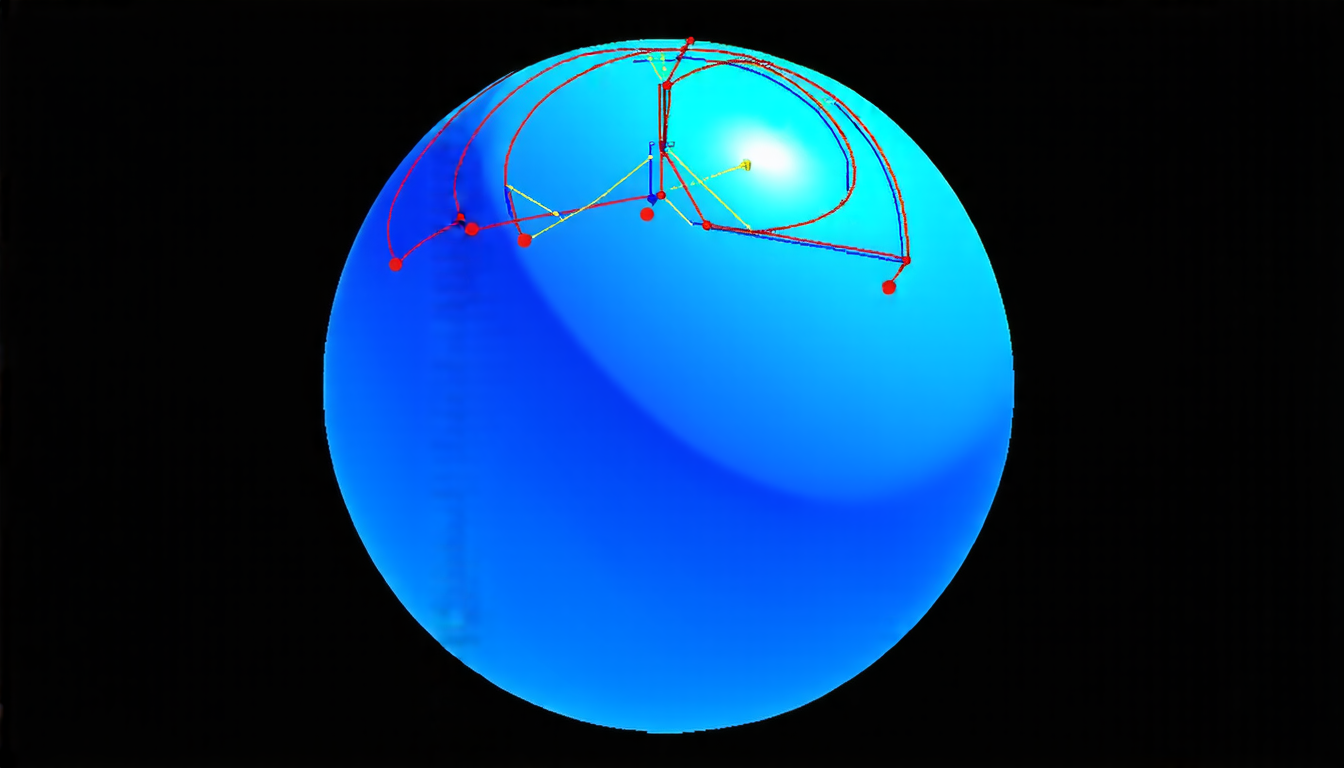
Scientists have long been fascinated by the way that shapes can be used to approximate complex mathematical functions. One of the most intriguing examples of this is the concept of t-design curves, which are curves on a sphere that can be used to calculate integrals with great accuracy.
Recently, researchers have made significant progress in understanding how these curves work and how they can be used to solve complex problems. The key to their success lies in the way that the curves are designed to cover the surface of the sphere evenly.
The researchers started by creating a network of points on the surface of the sphere, which they then connected with geodesic arcs. These arcs are the shortest paths between two points on the surface of the sphere and are used to create the t-design curve.
By carefully selecting the number of points and the length of the arcs, the researchers were able to create a curve that covers the entire surface of the sphere evenly. This means that any function defined on the sphere can be approximated with great accuracy using this curve.
The beauty of these curves is that they can be used to solve complex problems in many different fields, from physics and engineering to computer science and mathematics. For example, they could be used to model the behavior of particles in a magnetic field or to optimize the design of electronic circuits.
The researchers have also discovered that these curves have some remarkable properties. For example, they are able to capture the intricate details of complex functions with great precision, even when the function is not smooth and continuous.
These discoveries have significant implications for many fields and could lead to new breakthroughs in areas such as materials science, computer graphics, and medical imaging. The researchers’ work has opened up a new frontier in the study of shapes and their relationship to mathematical functions, and it will be exciting to see where this research takes us in the future.
One of the most promising applications of these curves is in the field of computer graphics. By using t-design curves to model the behavior of light and shadow on a surface, researchers could create more realistic and detailed images of complex scenes. This technology could have a major impact on fields such as film and video game production, where creating realistic visual effects is crucial.
Another potential application of these curves is in medical imaging. By using t-design curves to model the behavior of light as it passes through the body, researchers could create more accurate and detailed images of internal organs and tissues.
Cite this article: “T-Design Curves: A New Frontier in Approximating Complex Mathematical Functions”, The Science Archive, 2025.
Shapes, Mathematics, Curves, Sphere, T-Design, Integrals, Geodesic Arcs, Computer Graphics, Medical Imaging, Mathematical Functions





