

Thursday 06 March 2025
Researchers have made significant strides in developing a new control framework for aerial manipulators, which are essentially drones equipped with robotic arms. These devices have the potential to revolutionize various industries such as manufacturing, construction, and search and rescue operations.
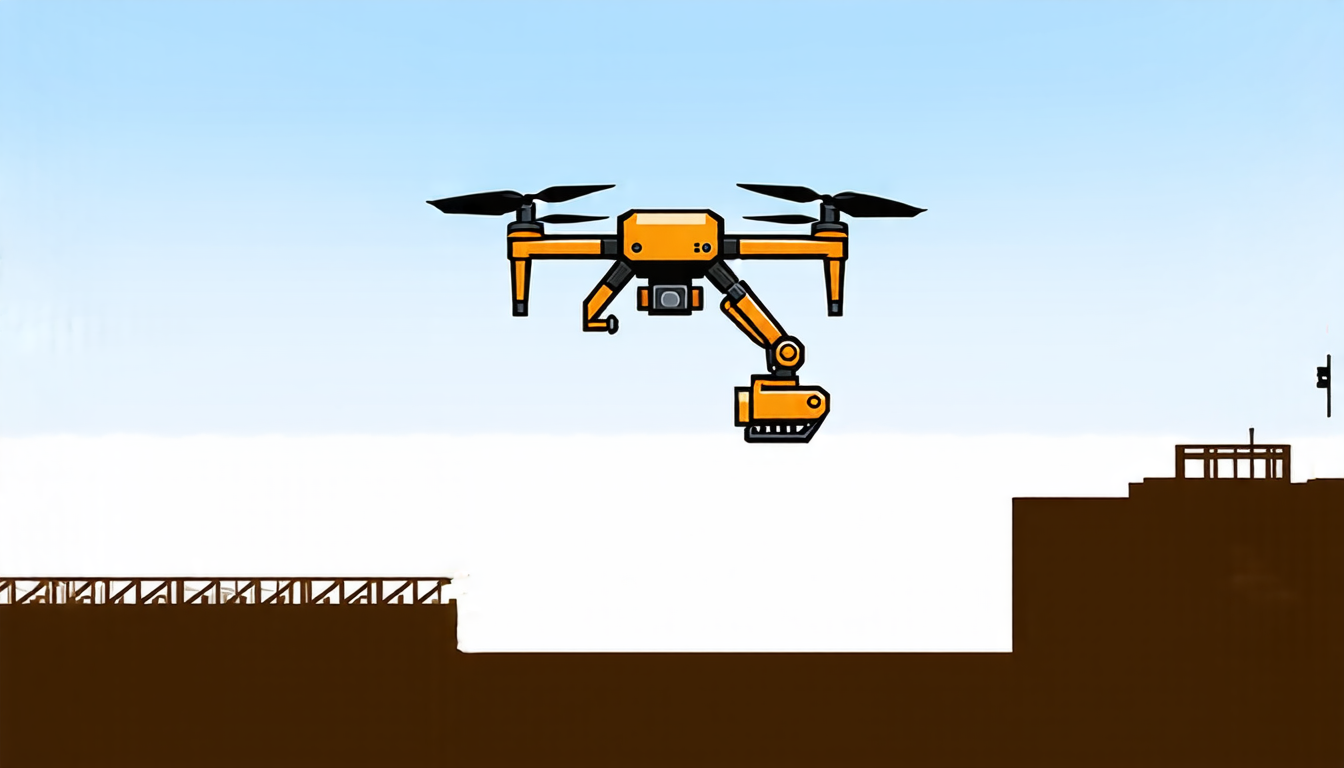
Aerial manipulators consist of two main components: the drone itself, also known as the quadrotor, and the robotic arm attached to it. The quadrotor provides the necessary lift and propulsion for the system, while the robotic arm enables precise manipulation of objects in mid-air. However, controlling these complex systems is a challenging task that requires careful consideration of multiple factors.
One of the key challenges is disturbance rejection, which refers to the ability of the system to compensate for external disturbances such as wind, turbulence, and vibrations. These disturbances can cause the drone to lose its stability and precision, making it difficult to perform tasks accurately.
To address this issue, researchers have developed a new control framework that combines two innovative techniques: nonlinear disturbance observers (NDOs) and high-frequency compensation. The NDOs are designed to detect and reject low-frequency disturbances, while the high-frequency compensation technique is used to mitigate the impact of high-frequency disturbances such as wind and turbulence.
The control framework has been tested in various experiments, including a scenario where the drone was tasked with stabilizing its position while carrying a payload of 400 grams. The results showed that the system was able to maintain stability and precision even in the presence of significant external disturbances.
Another experiment involved tracking a complex trajectory, which required the drone to move at high speeds and adjust its position accordingly. The results demonstrated that the control framework was able to track the trajectory with high accuracy and precision.
The implications of this research are far-reaching. Aerial manipulators have the potential to revolutionize industries such as manufacturing, construction, and search and rescue operations. For example, they could be used to perform tasks such as assembly, inspection, and maintenance in hard-to-reach areas.
In addition, aerial manipulators could be used for environmental monitoring and conservation efforts. They could be equipped with sensors that can detect changes in air quality, monitor wildlife populations, or track the spread of invasive species.
Overall, this research has significant potential to improve the performance and versatility of aerial manipulators, enabling them to perform a wide range of tasks with precision and accuracy.
Cite this article: “Advances in Control Framework Enable Precise Operation of Aerial Manipulators”, The Science Archive, 2025.
Aerial Manipulators, Drones, Robotic Arms, Control Framework, Nonlinear Disturbance Observers, High-Frequency Compensation, Stability, Precision, Manufacturing, Construction





