

Thursday 06 March 2025
The quest for seamless autonomous driving has been an ongoing challenge, with researchers and engineers working tirelessly to perfect the technology. A recent paper takes a significant step forward in this endeavor, proposing a novel framework that integrates vision-language models (VLMs) with graph-based representations of urban environments.
The concept is straightforward: by combining the strengths of VLMs and graph theory, the proposed CoDriveVLM framework enables autonomous vehicles to better navigate complex urban scenarios. In essence, the system uses VLMs to analyze visual data from cameras and sensors, while simultaneously processing spatial information from graphs that represent roads, buildings, and other obstacles.
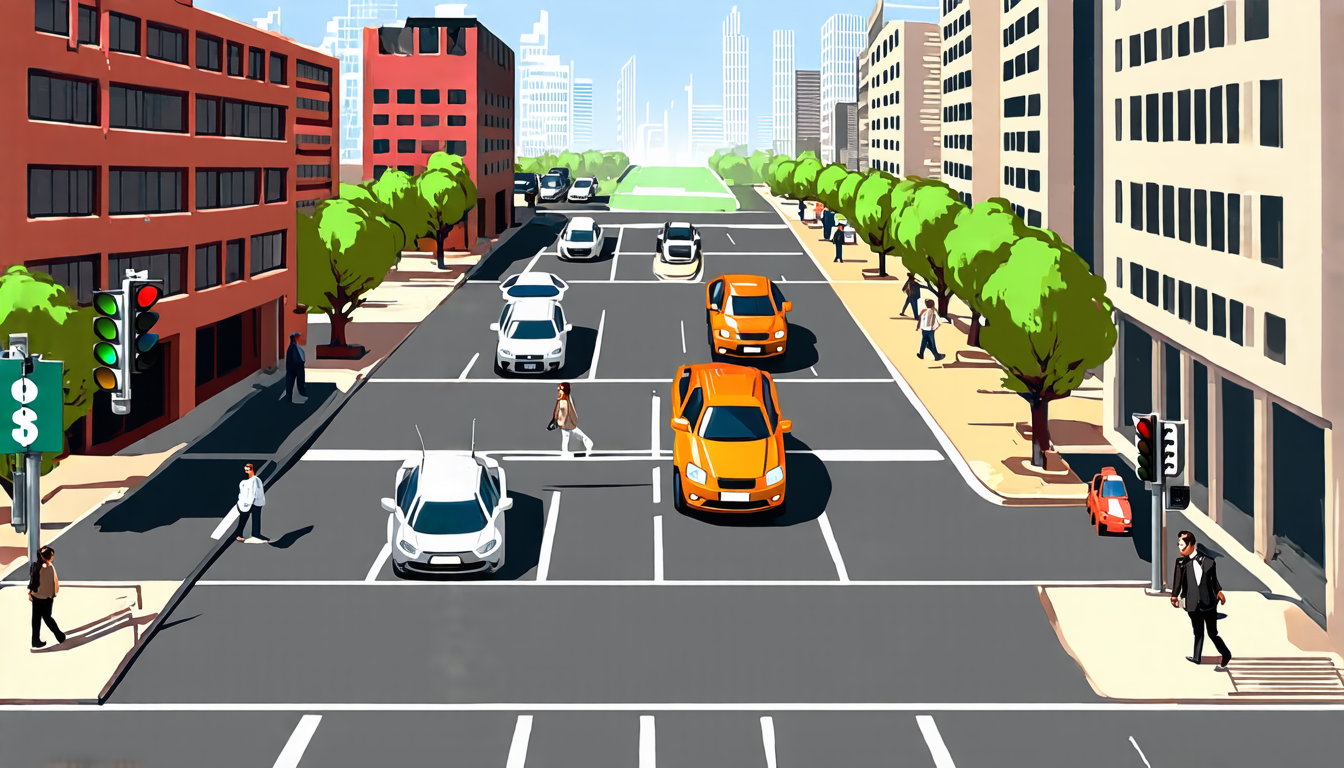
The key innovation lies in how these two components are integrated. By fusing the outputs of both, the framework creates a more comprehensive understanding of the environment, allowing autonomous vehicles to make more informed decisions about route planning and obstacle avoidance. This is particularly useful in scenarios where traditional computer vision approaches struggle, such as navigating through crowded city streets or recognizing pedestrians.
The authors demonstrate the effectiveness of CoDriveVLM by testing it on a range of simulated urban driving scenarios. The results are impressive: the system is able to successfully navigate complex routes, avoid collisions, and even respond to unexpected events like pedestrian crossings. Moreover, the framework’s ability to learn from experience allows it to adapt to changing environmental conditions, such as construction zones or road closures.
One of the most compelling aspects of CoDriveVLM is its potential for real-world implementation. By leveraging existing infrastructure – think traffic lights, street signs, and building layouts – the system can be easily integrated into existing urban environments. This means that cities can begin to adopt autonomous driving technology without having to rebuild entire road networks from scratch.
Of course, there are still challenges to overcome before CoDriveVLM makes its way onto public roads. For one, the framework requires significant computational resources, which may not be feasible for current hardware. Additionally, the system’s performance will need to be validated in real-world scenarios, rather than simply simulated environments.
Despite these hurdles, the potential of CoDriveVLM is undeniable. By combining the strengths of VLMs and graph theory, researchers have created a powerful framework that could revolutionize the field of autonomous driving. As cities continue to grapple with the challenges of urban traffic congestion and safety, solutions like CoDriveVLM offer a beacon of hope for a safer, more efficient, and more sustainable future.
Cite this article: “Seamless Autonomous Driving: A Novel Framework Combines Vision-Language Models with Graph Theory”, The Science Archive, 2025.
Autonomous Driving, Urban Environments, Vision-Language Models, Graph Theory, Route Planning, Obstacle Avoidance, Computer Vision, Simulation, Real-World Implementation, Traffic Congestion.





