

Thursday 06 March 2025
Radio signals are all around us, but have you ever wondered how they behave in different environments? From your home to a busy office building, every space has its own unique characteristics that affect how radio waves travel through it. Now, scientists have developed a new way to predict the path of these signals with unprecedented accuracy.
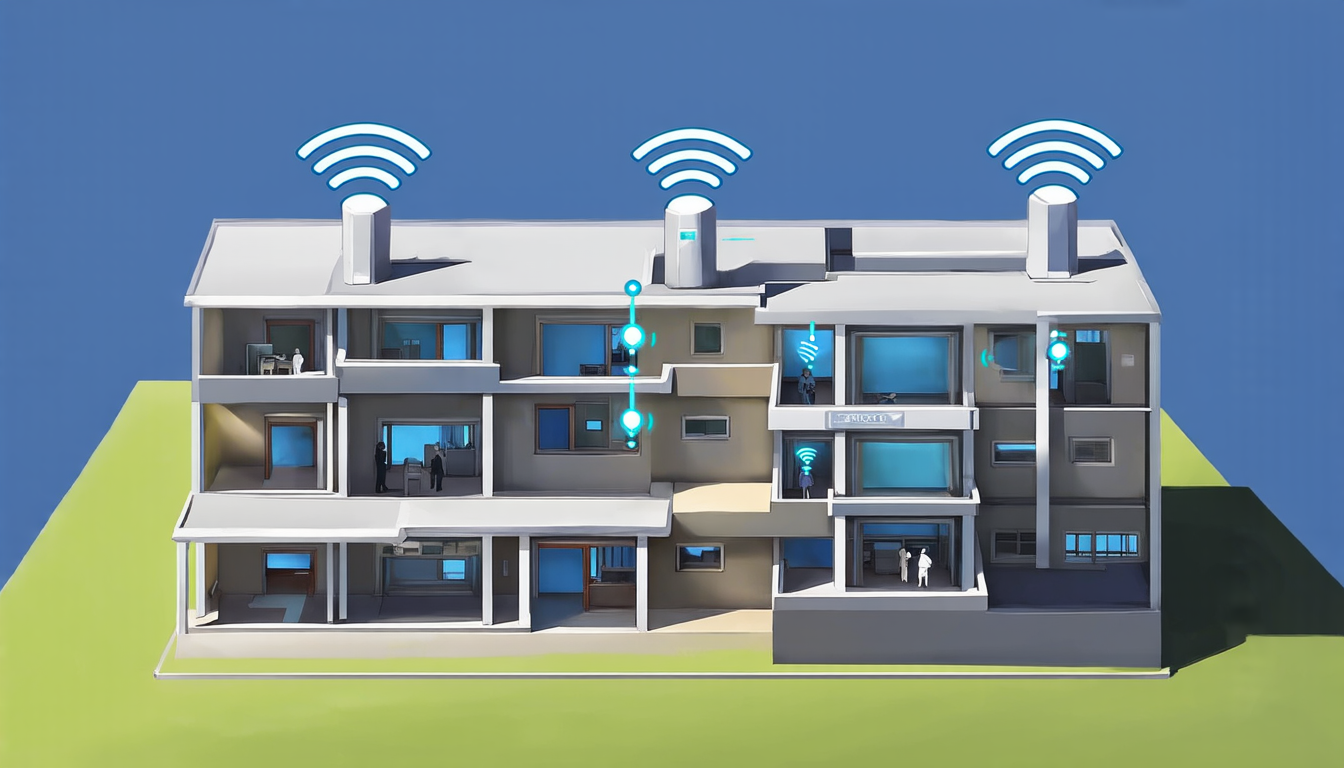
The challenge is called indoor pathloss radio map prediction. It’s a mouthful, but essentially, it means predicting where and how strong radio signals will be in different parts of a building or space. This information is crucial for designing wireless communication systems that work efficiently and reliably.
Traditionally, scientists have used complex simulations or physical measurements to predict radio signal behavior. However, these methods are often slow, expensive, and limited by the complexity of the environment they’re trying to model.
To tackle this problem, researchers turned to artificial intelligence (AI). They developed a deep neural network called IPP-Net that can learn from large amounts of data and make accurate predictions about radio signal behavior. But here’s the twist: IPP-Net wasn’t trained on just any data. It was trained on a combination of simulated data and real-world measurements, making it incredibly versatile.
The researchers used a dataset that included 25 different indoor scenarios, three frequency bands, and five antenna radiation patterns. Each scenario was represented as an RGB image, with the first two channels showing reflectance and transmittance values, and the third channel representing physical distance between the transmitter and each pixel.
IPP-Net’s architecture is based on a UNet model, which is commonly used for image processing tasks. The network consists of five encoding/decoding layers, a bottleneck layer, skip connections, and an output layer. By combining these components in a specific way, IPP-Net can learn to extract relevant features from the input data and make accurate predictions about radio signal behavior.
To train IPP-Net, researchers employed a curriculum learning strategy that progressively increased the complexity of the tasks. First, they trained the network on simulated data for varied indoor scenarios. Then, they fine-tuned it on simulation data for different frequency bands, and finally, they refined it on real-world measurements for various antenna radiation patterns.
The results are impressive: IPP-Net achieved a weighted root mean square error (RMSE) of 9.501 dB across three competition tasks, earning it the second overall ranking in a recent challenge. This means that IPP-Net is not only accurate but also generalizable to new and unseen environments.
Cite this article: “Predicting Radio Signal Behavior with Artificial Intelligence”, The Science Archive, 2025.
Radio Signals, Indoor Pathloss, Radio Map Prediction, Wireless Communication Systems, Artificial Intelligence, Deep Neural Network, Ipp-Net, Simulated Data, Real-World Measurements, Image Processing





