
Thursday 06 March 2025
The latest research in the field of integrated sensing and communication (ISAC) has taken a significant step forward, offering a promising solution for the next generation of wireless networks. By leveraging the unique properties of reconfigurable intelligent surfaces (RISs), researchers have developed a novel multi-perspective observation framework that enhances target detection performance in clutter-rich environments.
In traditional sensing systems, radar and communication functions are often treated as separate entities, with each requiring its own dedicated infrastructure. However, this approach can lead to inefficiencies and limitations, particularly in scenarios where both functions need to operate simultaneously. ISAC systems, on the other hand, aim to integrate these two functionalities into a single platform, enabling seamless sharing of resources and spectrum.
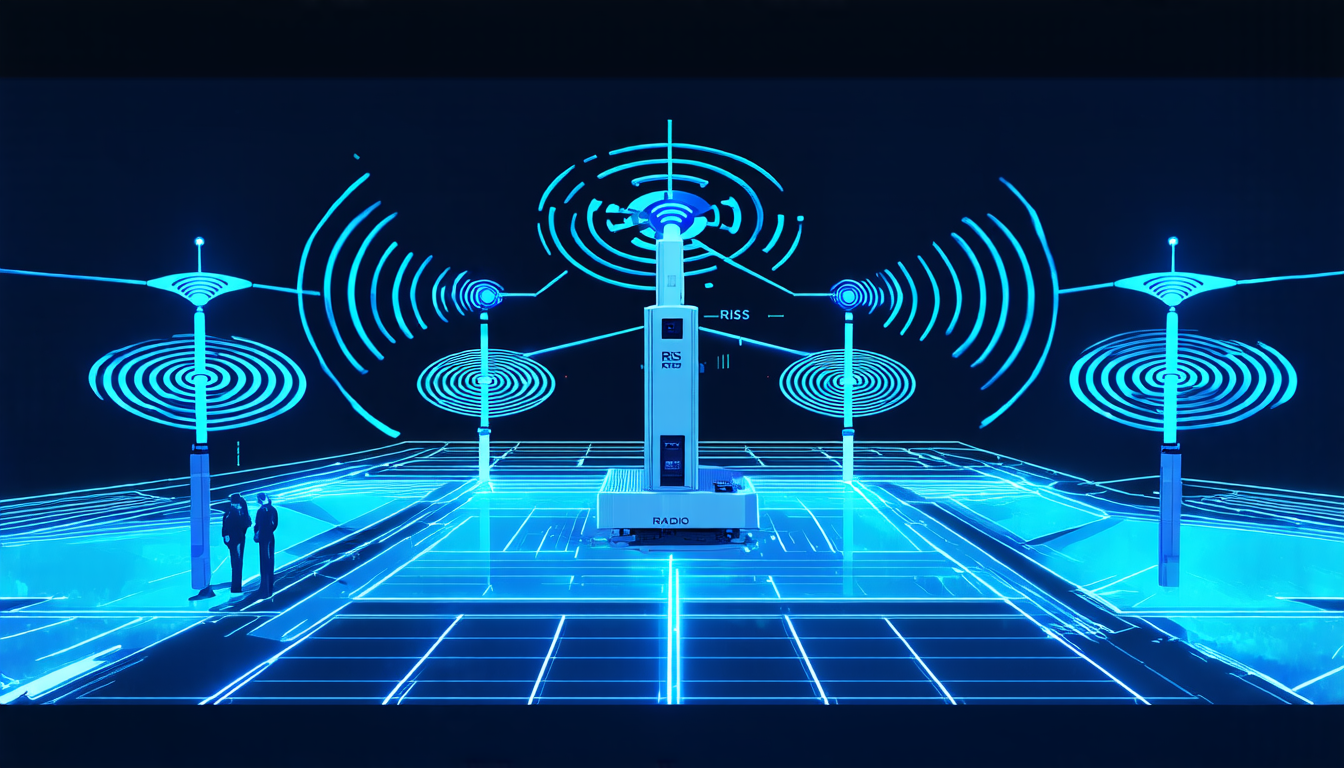
The key innovation here lies in the use of RISs, which are capable of dynamically reconfiguring their reflection coefficients to manipulate the radio frequency (RF) signals incident upon them. By strategically placing multiple RISs within an ISAC system, researchers have developed a multi-perspective observation framework that exploits the unique characteristics of target and clutter echo signals across spatial, delay, and Doppler domains.
The proposed approach utilizes a joint design of space-time transmit waveform, reflection coefficients of active RISs, and spatial- temporal receive filters to maximize radar output signal-to-clutter-plus-noise ratio (SCNR) while ensuring the quality-of-service (QoS) requirements of communication users. To address the resulting non-convex optimization problem, an efficient algorithm is developed that integrates fractional programming, majorization-minimization, and alternating direction method of multipliers.
Simulation results demonstrate the effectiveness of the proposed approach in enhancing target detection performance in challenging environments. By leveraging multiple RISs and exploiting the diversity of observation paths, the scheme consistently outperforms traditional beamforming techniques and achieves superior radar SCNR performance even at low target velocities.
The implications of this research are significant, particularly for future wireless networks that will require both sensing and communication capabilities. The ability to integrate these functions in a single platform can lead to more efficient use of resources, improved network reliability, and enhanced user experience.
As the field of ISAC continues to evolve, it is clear that RISs will play a crucial role in unlocking its full potential. By leveraging their unique properties to manipulate RF signals, researchers are opening up new avenues for sensing and communication applications.
Cite this article: “Integrating Sensing and Communication with Reconfigurable Intelligent Surfaces”, The Science Archive, 2025.
Integrated Sensing And Communication, Reconfigurable Intelligent Surfaces, Radar, Communication, Wireless Networks, Target Detection, Clutter-Rich Environments, Radio Frequency Signals, Space-Time Waveform, Spatial-Temporal Receive Filters.