

Thursday 06 March 2025
A team of researchers has made a significant breakthrough in code generation, a crucial aspect of software development. Their approach uses a multi-agent framework that breaks down complex coding tasks into smaller, manageable units, allowing for more reliable and efficient code creation.
The traditional method of generating code involves feeding a large language model with a programming problem and asking it to produce a solution. However, this approach has several limitations. Large language models are only as good as the data they were trained on, which can lead to errors and inaccuracies in the generated code. Additionally, these models struggle with long, complex coding tasks that require multiple steps and nuanced decision-making.
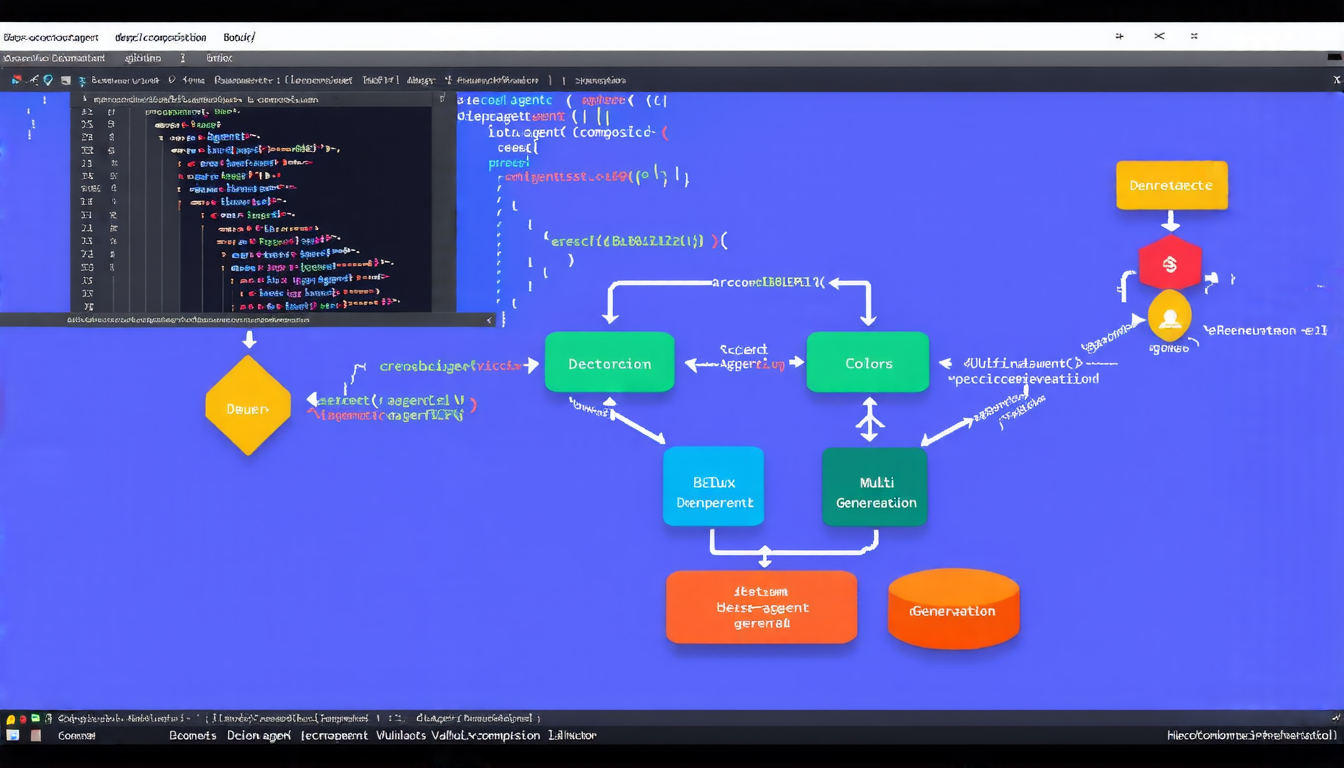
To address these limitations, the researchers developed a multi-agent framework that consists of three main components: hierarchical decomposition, bottom-up generation, and multi-agent validation. The first component involves breaking down a complex coding task into smaller sub-problems, which are then solved by separate agents. This approach allows for more accurate and efficient code creation, as each agent only needs to focus on a specific aspect of the problem.
The second component, bottom-up generation, uses these sub-solutions to build a complete solution. This involves combining the outputs from each agent into a cohesive whole, which is then validated by another agent. This validation process ensures that the generated code is not only correct but also follows best practices and coding standards.
The third component, multi-agent validation, provides an additional layer of quality control. Each agent reviews the work of other agents, identifying any errors or inaccuracies and providing feedback to improve the overall solution.
The researchers tested their approach using OpenAI’s HumanEval benchmark, which evaluates code generation models on a range of programming tasks. The results showed that their multi-agent framework outperformed traditional large language model-based approaches by 23.79 percentage points in Pass@1 scores.
This breakthrough has significant implications for the field of software development. It opens up new possibilities for automating complex coding tasks, reducing errors and inaccuracies, and improving overall code quality. Additionally, it may enable the creation of more sophisticated software systems that can adapt to changing requirements and environments.
The researchers’ approach also highlights the potential benefits of combining traditional software engineering principles with modern AI capabilities. By leveraging the strengths of both approaches, developers may be able to create more robust, maintainable, and scalable software systems that meet the needs of a rapidly evolving technology landscape.
Cite this article: “Breakthrough in Code Generation: A Multi-Agent Framework for Efficient and Reliable Software Development”, The Science Archive, 2025.
Code Generation, Multi-Agent Framework, Software Development, Programming Problem, Large Language Model, Hierarchical Decomposition, Bottom-Up Generation, Multi-Agent Validation, Openai’S Humaneval Benchmark, Pass@1 Scores.





