

Thursday 06 March 2025
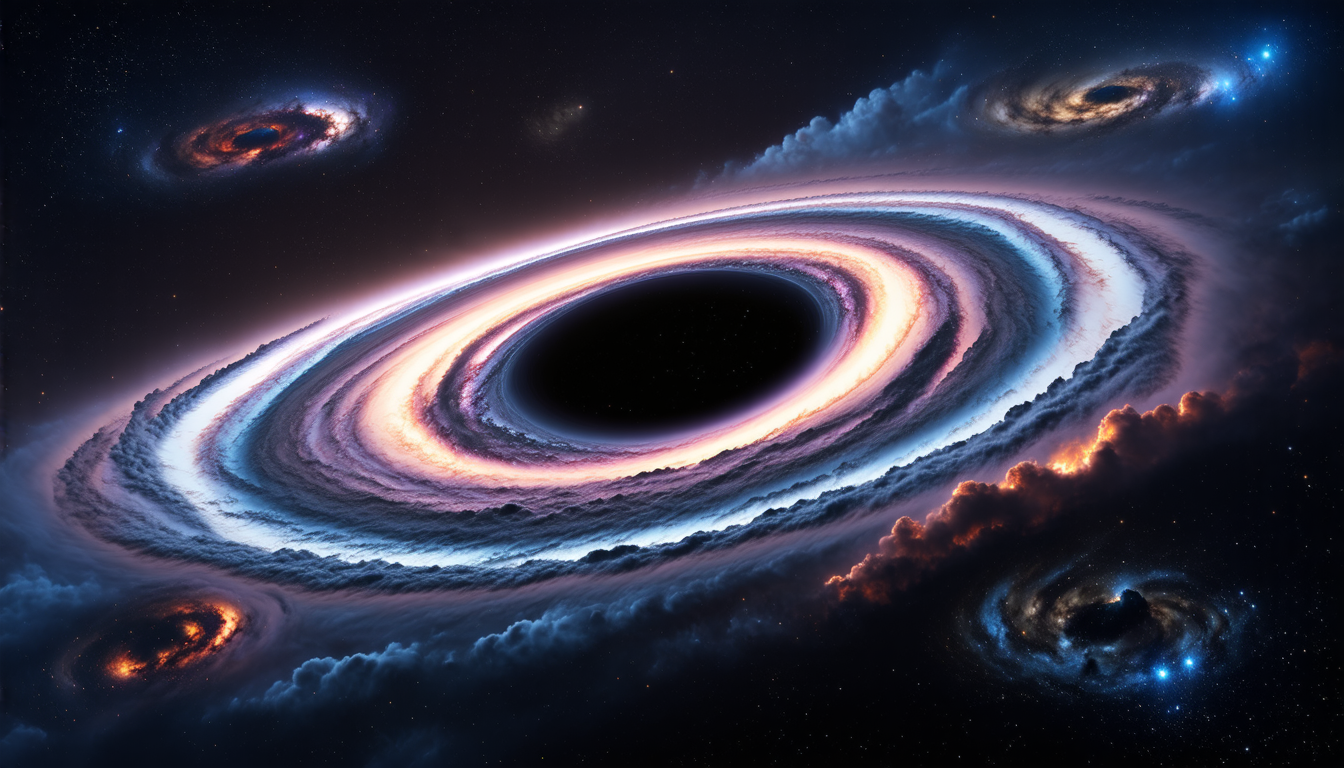
Scientists have long struggled to accurately model the behavior of Active Galactic Nuclei (AGN), which are incredibly luminous objects at the hearts of galaxies. These behemoths emit massive amounts of energy, but their inner workings remain shrouded in mystery.
To tackle this challenge, researchers have developed complex models that attempt to simulate the behavior of AGN. One such model is CYGNUS, a software package designed to accurately predict the spectral energy distributions (SEDs) of galaxies. SEDs are plots that show how much energy an object emits at different wavelengths, and they’re essential for understanding what’s happening inside those galaxies.
The CYGNUS team has now put their model through its paces by applying it to a sample of 200 galaxies at a distance of about 10 billion light-years from us. These galaxies are thought to be representative of the early universe, when stars and supermassive black holes were still in the process of forming.
The results are promising, but not without their caveats. CYGNUS was able to accurately predict the SEDs of most galaxies, but there’s a significant amount of variation between different models for the AGN torus – a donut-shaped region surrounding the supermassive black hole that absorbs and re-emits light.
The team found that using different AGN models can lead to drastically different estimates of key physical properties like star formation rates and stellar masses. This highlights the need for more precise modeling, as well as further observations to test these predictions against reality.
One intriguing finding is that a significant number of galaxies in this sample are better fit by spherical host geometries rather than disk-like ones. This challenges our current understanding of galaxy evolution, which suggests that most galaxies should have formed through mergers and interactions with other galaxies.
The CYGNUS model also provides new insights into the behavior of AGN themselves. For example, it’s possible to estimate the ratio of outer to inner torus radius, which has implications for our understanding of how energy is transferred between the central black hole and the surrounding galaxy.
Of course, there are still many questions left unanswered. What drives the variation in AGN models? How do these models affect our estimates of key physical properties? And what does this all mean for our broader understanding of galaxy evolution?
The CYGNUS team’s work is an important step forward in our quest to understand the mysteries of AGN.
Cite this article: “Unlocking the Secrets of Active Galactic Nuclei”, The Science Archive, 2025.
Active Galactic Nuclei, Galaxy Evolution, Supermassive Black Holes, Spectral Energy Distributions, Cygnus Model, Star Formation Rates, Stellar Masses, Agn Torus, Galaxy Morphology, Astrophysics





