

Thursday 06 March 2025
In a breakthrough that could revolutionize our understanding of power in complex systems, researchers have developed a new method for calculating voting power in hierarchical structures. The technique, known as the Multiplicative Extended Banzhaf Power Index (MEBPI), allows for efficient computation of power indices even in unbalanced games.
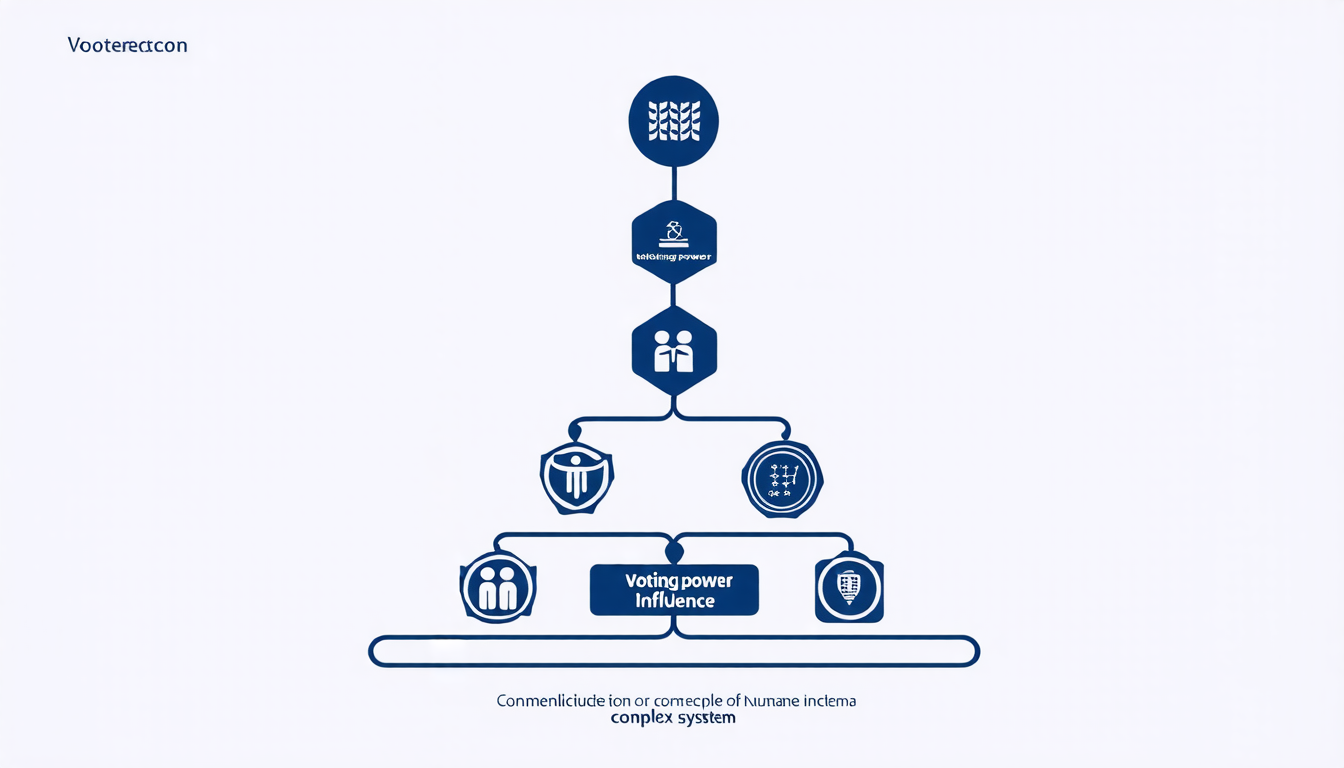
Voting power is a fundamental concept in game theory and has far-reaching implications in fields such as politics, economics, and sociology. In a traditional voting system, each voter has an equal say in the outcome. However, in more complex systems, voters may have varying degrees of influence depending on their position within the hierarchy. The MEBPI takes into account these nuances by decomposing the power indices at each level of the hierarchy.
The MEBPI builds upon earlier work by John Felsenthal and Martin Shubik, who introduced the concept of voting power in 1965. Since then, researchers have developed various methods for calculating power indices, but these approaches often rely on simplifying assumptions that may not accurately reflect real-world scenarios. The MEBPI overcomes this limitation by using a recursive formula to calculate the power indices at each level of the hierarchy.
To demonstrate the effectiveness of the MEBPI, researchers applied it to a language processing task. In this context, individual words in a sentence can be seen as voters that contribute to the overall sentiment of the text. The MEBPI was used to calculate the power of each word in determining the sentiment of the sentence. Results showed that the technique accurately reflected the influence of each word and outperformed simpler methods.
The implications of this research are far-reaching, with potential applications in areas such as social network analysis, decision-making theory, and even artificial intelligence. By providing a more accurate measure of voting power in complex systems, the MEBPI can help researchers better understand how decisions are made and how power is distributed within these systems.
In addition to its theoretical significance, the MEBPI has practical applications in fields such as politics and economics. For example, it could be used to analyze the influence of different interest groups on policy outcomes or to evaluate the effectiveness of voting systems in ensuring fair representation. By providing a more nuanced understanding of power dynamics, the MEBPI can inform decision-making processes and promote more equitable outcomes.
The development of the MEBPI marks an important milestone in the study of voting power and has significant potential for advancing our understanding of complex systems.
Cite this article: “Measuring Power in Complex Systems: The Multiplicative Extended Banzhaf Power Index”, The Science Archive, 2025.
Voting Power, Game Theory, Hierarchy, Power Indices, Multiplicative Extended Banzhaf Power Index, Mebpi, Decision-Making, Complex Systems, Politics, Economics
Reference: John Randolph, Denizalp Goktas, Amy Greenwald, “Banzhaf Power in Hierarchical Voting Games” (2025).





