

Thursday 06 March 2025
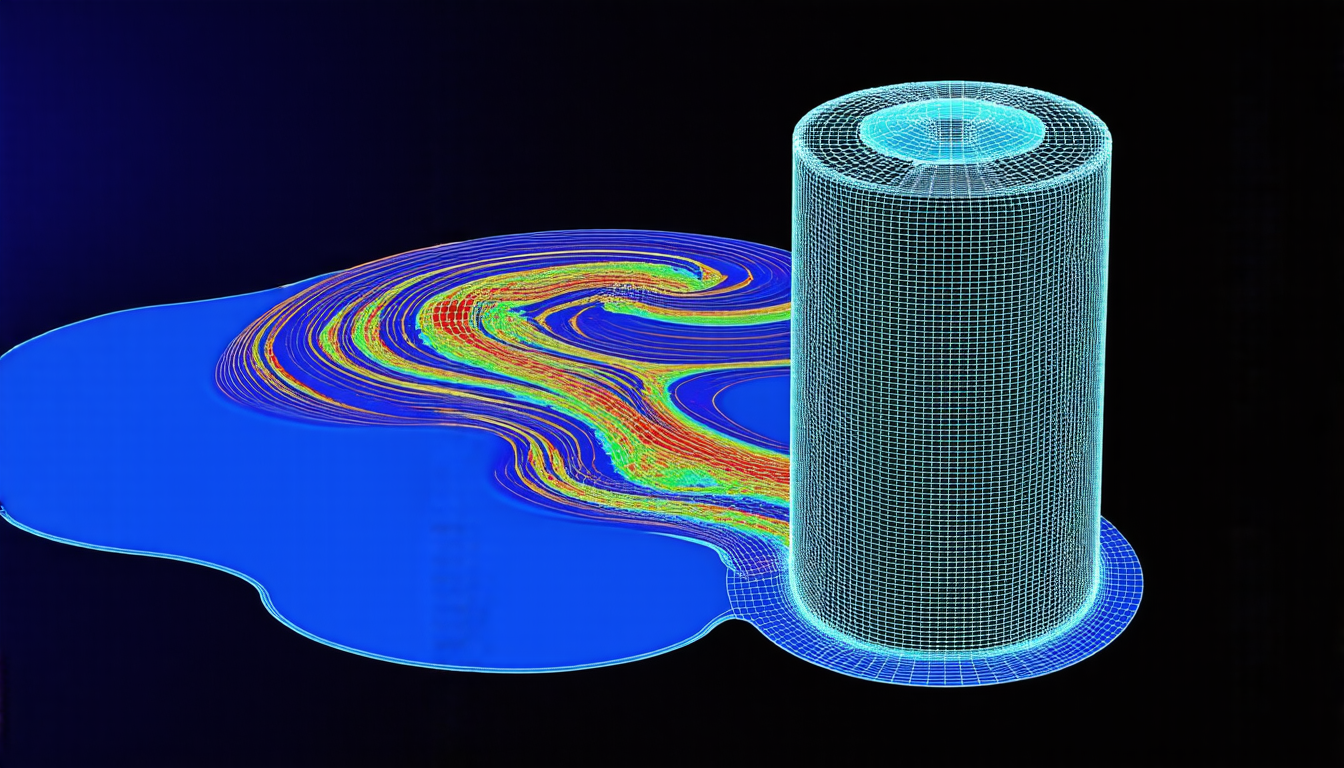
The pursuit of efficient data compression has long been a holy grail for researchers and developers alike. The ability to reduce the size of large datasets while preserving their integrity is crucial for a wide range of applications, from scientific simulations to medical imaging. Recently, a team of scientists has made significant strides in this area by developing a new framework for compressing unstructured mesh data.
Unstructured meshes are used to represent complex geometries and are commonly found in fields such as computational fluid dynamics and finite element analysis. However, these datasets can be enormous in size, making them difficult to store and transmit. Traditional lossy compression methods have been shown to be ineffective on these types of data, often resulting in a significant loss of accuracy.
The new framework, developed by researchers at Oak Ridge National Laboratory, takes a different approach by interpolating the mesh data onto a rectilinear grid. This allows for the use of established lossy compressors, such as those based on Fourier transforms or wavelets, which are designed for rectangular grids. The interpolation process is carefully controlled to ensure that the resulting compressed data meets specific error bounds.
The team’s framework consists of two main components: a mesh interpolation module and an error-controlled compression module. The interpolation module uses a combination of spatial coherence and adaptive grid refinement to create a rectilinear grid that accurately represents the original unstructured mesh. The compression module then applies a lossy compressor to the interpolated data, ensuring that the resulting compressed data meets specific accuracy requirements.
The researchers evaluated their framework using two synthetic datasets and two real-world simulation datasets from the fields of computational fluid dynamics and finite element analysis. The results were impressive, with the new framework achieving average compression ratios of 2.3-3.5 times those of state-of-the-art lossy compressors. Furthermore, the compressed data was shown to be accurate enough for use in a wide range of applications.
One of the key advantages of this new framework is its flexibility and generality. It can be applied to a wide range of unstructured mesh datasets, regardless of their size or complexity. This makes it an attractive solution for researchers and developers who need to compress large datasets while maintaining high accuracy.
The team’s work has significant implications for a variety of fields, including scientific simulations, medical imaging, and data analytics. By providing a reliable and efficient way to compress unstructured mesh data, the new framework opens up new possibilities for data storage, transmission, and analysis.
Cite this article: “New Framework for Efficient Compression of Unstructured Mesh Data”, The Science Archive, 2025.
Data Compression, Unstructured Mesh, Scientific Simulations, Medical Imaging, Finite Element Analysis, Computational Fluid Dynamics, Lossy Compression, Error-Controlled Compression, Fourier Transforms, Wavelets.





