

Friday 07 March 2025
The intricate dance of gamma-ray bursts, or GRBs, has long fascinated scientists and astronomers alike. These intense explosions of energy are thought to occur when massive stars collapse in on themselves, triggering a chain reaction that releases an enormous amount of energy into space. However, the precise mechanisms behind these events remain shrouded in mystery.
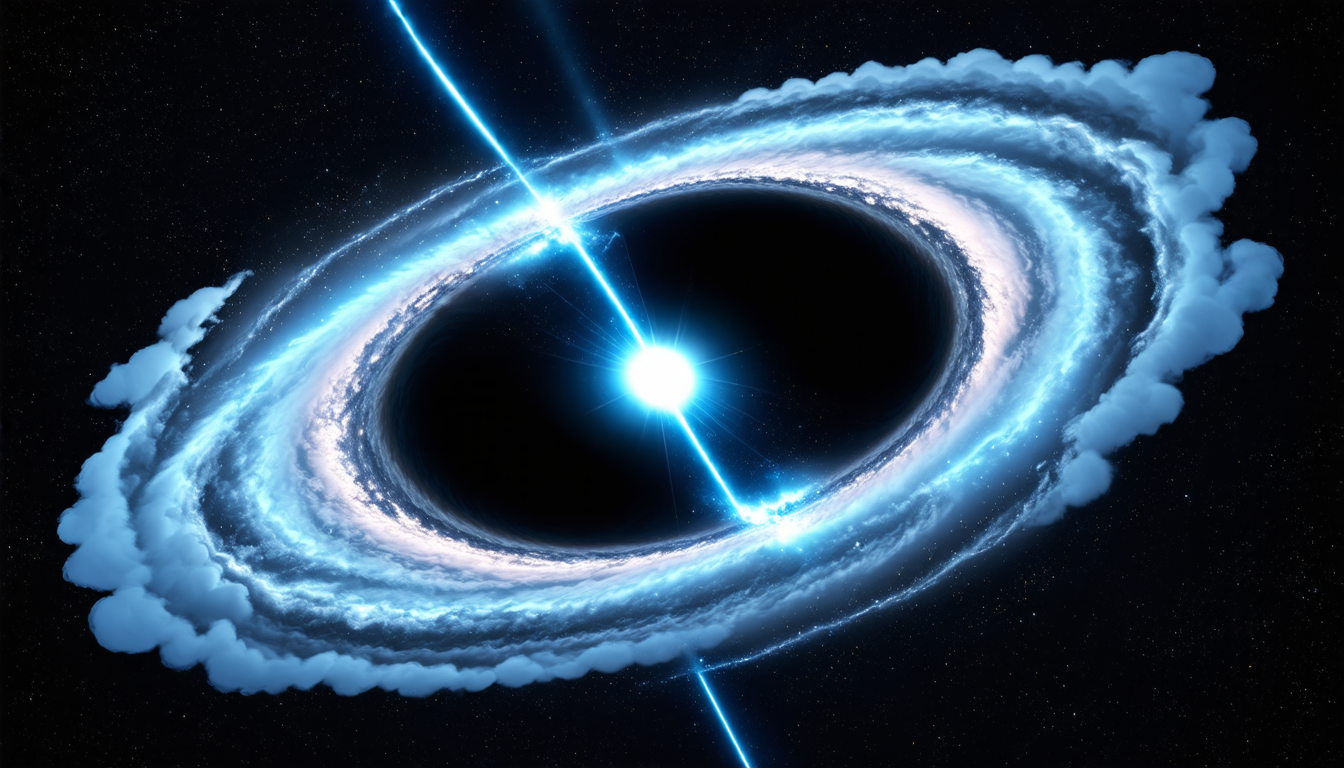
Recent advances in computer simulations have allowed researchers to dive deeper into the inner workings of GRBs. By modeling the behavior of magnetized plasma flows around black holes and neutron stars, scientists can recreate the conditions that lead to these bursts of energy.
A new study published in the journal Astronomy & Astrophysics takes this approach a step further by simulating the dynamics of short gamma-ray bursts, or sGRBs, which are thought to originate from the merger of two compact objects. The researchers used a combination of numerical methods and general relativistic magnetohydrodynamics (GRMHD) simulations to model the behavior of these events.
The results are nothing short of remarkable. By simulating the interaction between the merging black holes or neutron stars and their surrounding environments, the scientists were able to reproduce many of the observed features of sGRBs, including their characteristic light curves and spectra.
One of the most striking findings is the importance of dynamic ejecta in shaping the jet structure and collimation. These ejecta, which are thought to be produced during the merger process, play a crucial role in confining and focusing the energy released by the burst. By incorporating these dynamics into their simulations, the researchers were able to produce jets that closely matched those observed in sGRBs.
The study also sheds light on the properties of the jet itself, including its opening angle and Lorentz factor. These values are critical for understanding the physics of GRBs and can be used to constrain models of these events. By comparing their simulated results with observations of sGRBs, the researchers were able to place tighter constraints on these parameters than previous studies.
The implications of this research are far-reaching. By better understanding the dynamics of sGRBs, scientists may gain valuable insights into the merger process itself and the properties of compact objects. Additionally, the ability to reproduce the observed features of GRBs using simulations has significant implications for our understanding of these events and their role in shaping the universe.
The study’s findings also have practical applications for astronomers seeking to detect and characterize GRBs.
Cite this article: “Unraveling the Secrets of Short Gamma-Ray Bursts”, The Science Archive, 2025.
Gamma-Ray Bursts, Black Holes, Neutron Stars, Magnetized Plasma, General Relativistic Magnetohydrodynamics, Numerical Simulations, Light Curves, Spectra, Jet Structure, Collimation.





