

Saturday 08 March 2025
The quest for a deeper understanding of complex systems has led researchers down a fascinating path: the study of copulas, mathematical tools used to describe the relationships between different variables. A recent paper delves into the extreme points of these copulas, uncovering new insights that can help us better grasp the intricacies of our world.
At first glance, copulas may seem like an abstract concept, a mathematical construct with little practical application. But in reality, they’re crucial for modeling complex systems, from finance to climate science. By combining different variables, such as stock prices or temperature readings, copulas can reveal hidden patterns and relationships that might otherwise remain obscure.
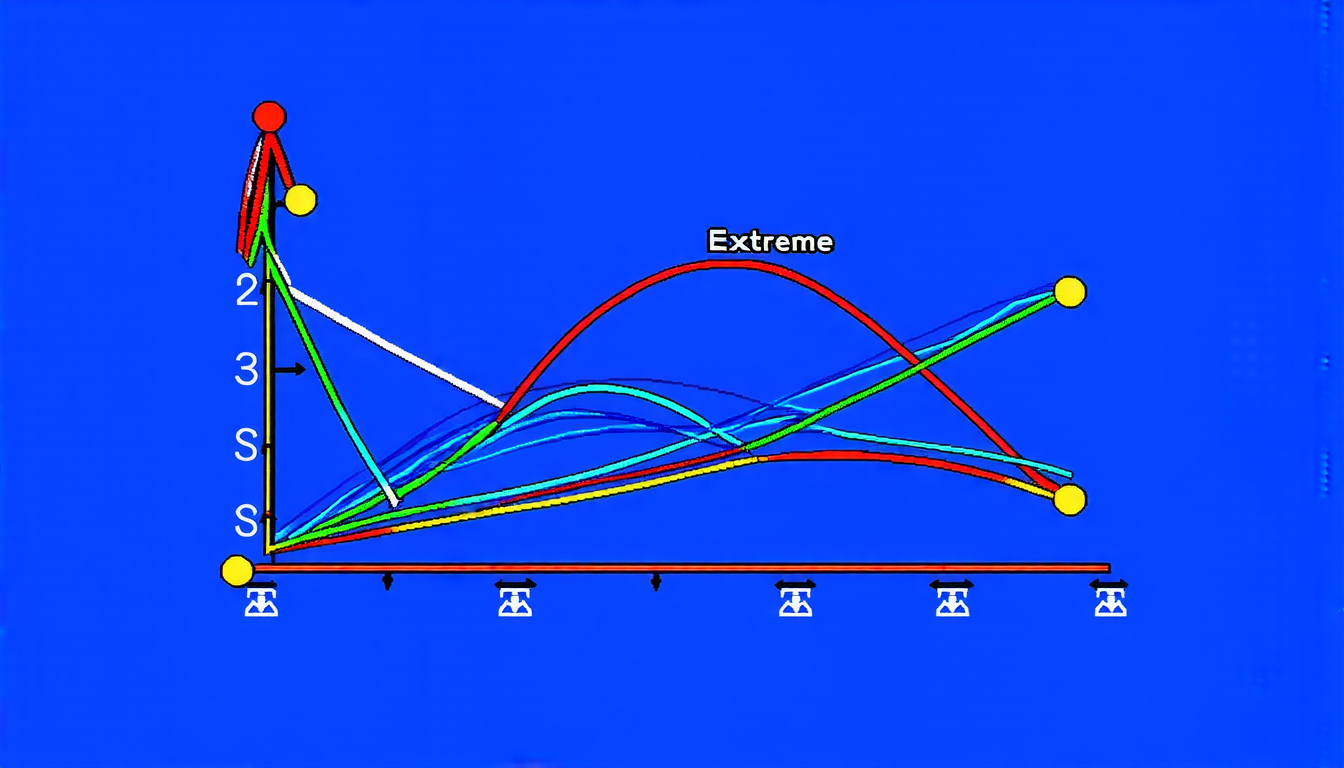
The researchers’ focus on extreme points is particularly intriguing. In the world of copulas, these points represent the most asymmetric and irregular behaviors, where the usual rules don’t apply. By studying these outliers, scientists can gain a deeper understanding of how complex systems behave under stress or in unusual circumstances.
One of the key findings is that extreme points are not isolated events but rather part of a larger pattern. The researchers discovered that certain copulas, known as semilinear copulas, exhibit extreme behavior when their diagonal sections – essentially, the relationship between two variables – follow specific patterns. This has significant implications for fields like finance, where understanding the behavior of assets under stress is crucial.
Another important discovery is that these extreme points can be used to create new classes of copulas. By combining different semilinear copulas, researchers can generate more realistic and nuanced models of complex systems. This could lead to improved predictive capabilities, enabling scientists to better forecast events like financial crises or natural disasters.
The study also sheds light on the relationship between asymmetry and tail dependence. In simple terms, asymmetry refers to how differently two variables behave when one is high and the other is low. Tail dependence, on the other hand, describes how these variables interact at their extremes. The researchers found that extreme points are often characterized by strong tail dependence, which can have significant consequences for modeling complex systems.
The implications of this research extend far beyond the realm of mathematics. By better understanding the behavior of complex systems under stress, scientists can develop more effective strategies for mitigating risks and predicting outcomes. This knowledge can be applied to a wide range of fields, from finance to climate science, with potential benefits that are both significant and far-reaching.
In summary, the study of extreme points in copulas has opened up new avenues for understanding complex systems.
Cite this article: “Unraveling Complexity: Insights from Extreme Points in Copulas”, The Science Archive, 2025.
Complex Systems, Copulas, Extreme Points, Semilinear Copulas, Asymmetry, Tail Dependence, Risk Management, Predictive Modeling, Climate Science, Finance
Reference: Fabrizio Durante, Juan Fernández-Sánchez, Manuel Úbeda-Flores, “Extreme semilinear copulas” (2025).





