

Saturday 08 March 2025
Researchers have made a significant breakthrough in understanding how artificial neural networks, like those used in machine learning and AI, learn and adapt. By studying the inner workings of these complex systems, scientists have gained valuable insights into the intricacies of optimization processes.
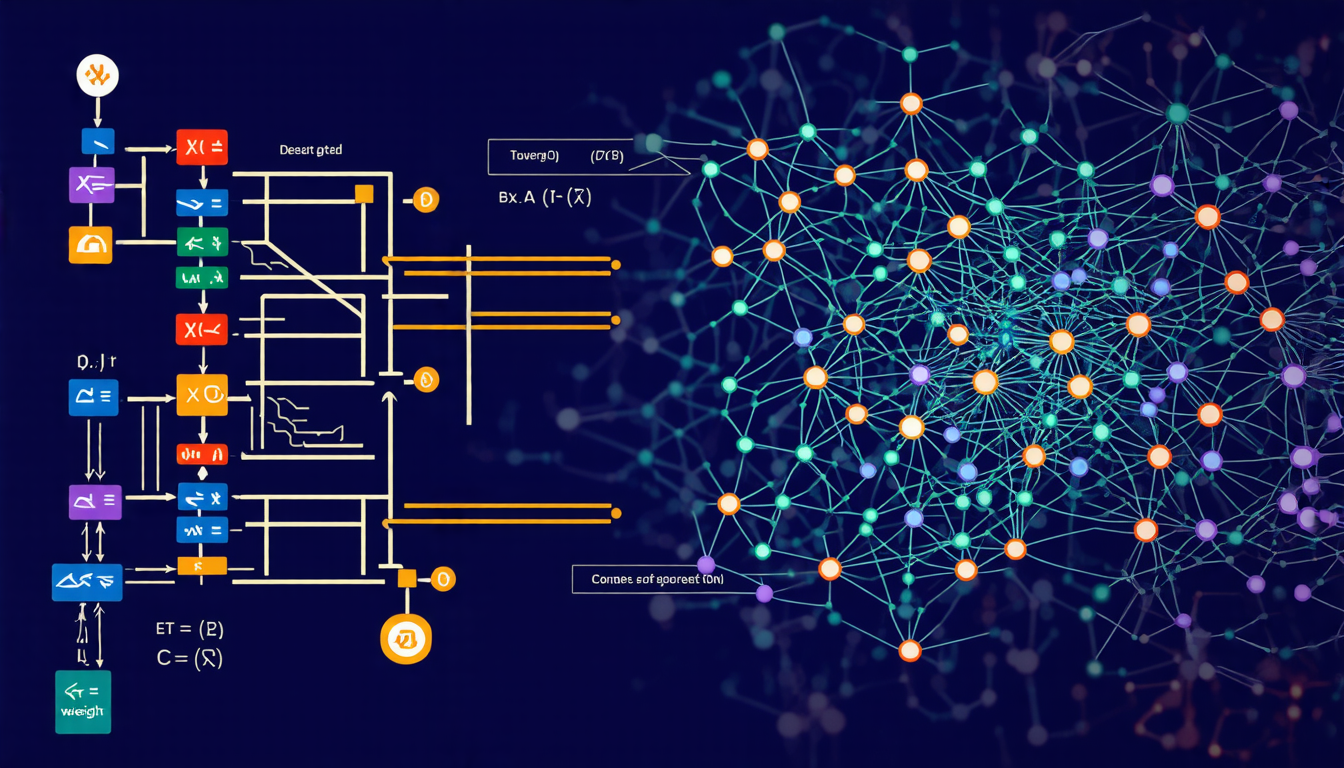
A team of researchers has been investigating the dynamics of optimization for simple sigmoidal neural networks that represent logical XOR gates. These networks are used to perform basic logic operations, such as determining whether two inputs are different or not. By analyzing the loss landscape, which is a high-dimensional space where each point represents a possible set of network parameters, scientists have uncovered hidden patterns and features.
One of the most striking findings is that the optimization process for these simple networks is not a straightforward one. Instead, it involves complex interplay between weights and biases, which are the fundamental components of neural networks. Weights determine how much each input contributes to the output, while biases shift the activation function’s center. The researchers found that as the network learns, weights and biases need to cooperate in a delicate balance to achieve correct activation.
The study also revealed that the optimization process exhibits power-law behavior, meaning that it follows a predictable pattern. This behavior is independent of the learning rate, which controls how quickly the network adjusts its parameters during training. The number of hidden neurons, however, plays a significant role in shaping this behavior.
By analyzing cross-sections through the loss landscape, scientists discovered a plethora of features that influence the optimization process. These include wells, channels, trenches, barriers, plateaus, and rims, which can either accelerate or slow down learning. The researchers found that these features are not unique to simple networks like XOR gates but are likely to be present in more complex systems as well.
The study’s findings have important implications for the design of neural networks. By understanding how optimization processes work, developers can create more efficient and effective algorithms. This could lead to significant advances in fields such as computer vision, natural language processing, and robotics.
In a broader sense, this research highlights the importance of statistical physics in understanding complex systems. The concepts developed in this study, such as microcanonical entropy, can be applied to other areas like biology, chemistry, and materials science. As scientists continue to explore the intricacies of optimization processes, they may uncover even more surprising patterns and features that shed light on the workings of these fascinating systems.
The researchers’ work is a testament to the power of interdisciplinary collaboration between computer science, physics, and mathematics.
Cite this article: “Unraveling the Optimization Dynamics of Artificial Neural Networks”, The Science Archive, 2025.
Artificial Neural Networks, Machine Learning, Ai, Optimization Processes, Sigmoidal Neural Networks, Logical Xor Gates, Loss Landscape, Power-Law Behavior, Statistical Physics, Microcanonical Entropy
Reference: Xiguang Yang, Krish Arora, Michael Bachmann, “Dissecting a Small Artificial Neural Network” (2025).





