

Saturday 08 March 2025
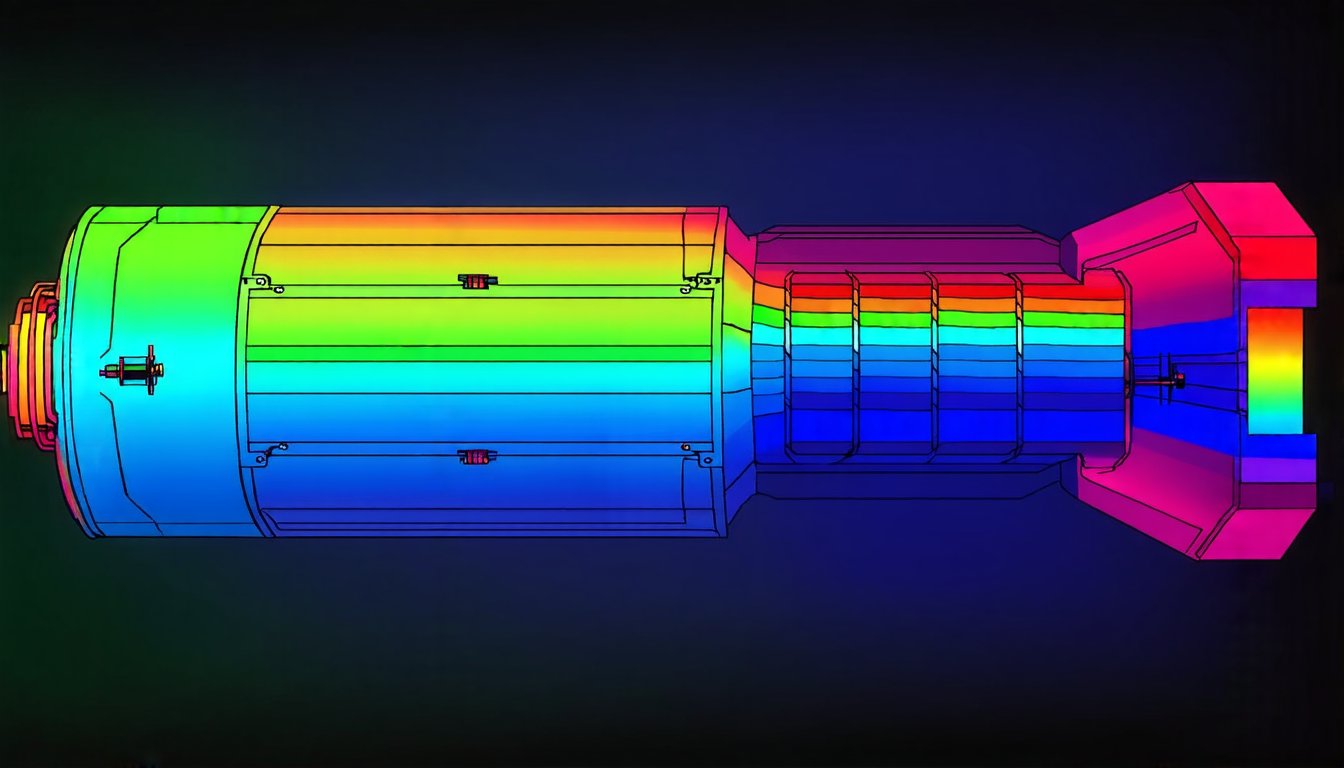
Researchers have been working on a new way to detect high-energy particles, and it’s all about harnessing the power of light. The team behind this innovation has developed a novel approach called chromatic calorimetry, which uses strategically layered scintillators to capture different wavelengths of emitted light.
Think of scintillators like special materials that glow when hit by high-energy particles. In traditional calorimeters, these materials are often used in a single layer, but this new approach takes it up a notch. By stacking multiple layers with different emission wavelengths, the researchers can better distinguish between different types of particles and even pinpoint their energy levels.
The process works like this: when a high-energy particle interacts with matter, it creates a cascade of secondary particles that emit light at specific wavelengths. The chromatic calorimeter is designed to capture these emitted lights using layers of scintillators with distinct emission spectra. By analyzing the signals from each layer, researchers can reconstruct the energy and type of incoming particle.
The team tested their device using electrons and pions (a type of subatomic particle) at energies up to 100 GeV. The results showed that they were able to accurately distinguish between these particles and even estimate their energy levels with high precision. This is a significant advancement, as current calorimeters often struggle to make these distinctions.
One of the key benefits of this new approach is its ability to improve particle identification and energy resolution. By using multiple layers with different emission wavelengths, the researchers can reduce contamination from overlapping signals and get a more accurate picture of what’s happening when high-energy particles interact with matter.
The team is already exploring ways to further refine their design, including incorporating quantum dots into the scintillator layers. Quantum dots are tiny particles that can be tuned to emit light at specific wavelengths, which could potentially enhance the device’s sensitivity and accuracy.
While this technology is still in its early stages, it has significant implications for particle physics research. Accurate detection of high-energy particles is crucial for understanding the fundamental forces of nature and unlocking secrets about the universe. The chromatic calorimeter offers a new tool for researchers to better study these phenomena, which could lead to major breakthroughs in our understanding of the cosmos.
As scientists continue to push the boundaries of what’s possible with particle detection, innovations like chromatic calorimetry are helping to drive progress and shed light on the mysteries of the universe.
Cite this article: “Unraveling the Secrets of High-Energy Particles with Chromatic Calorimetry”, The Science Archive, 2025.
High-Energy Particles, Particle Detection, Chromatic Calorimetry, Scintillators, Light, Energy Levels, Particle Identification, Quantum Dots, Particle Physics, Calorimeters





