

Saturday 08 March 2025
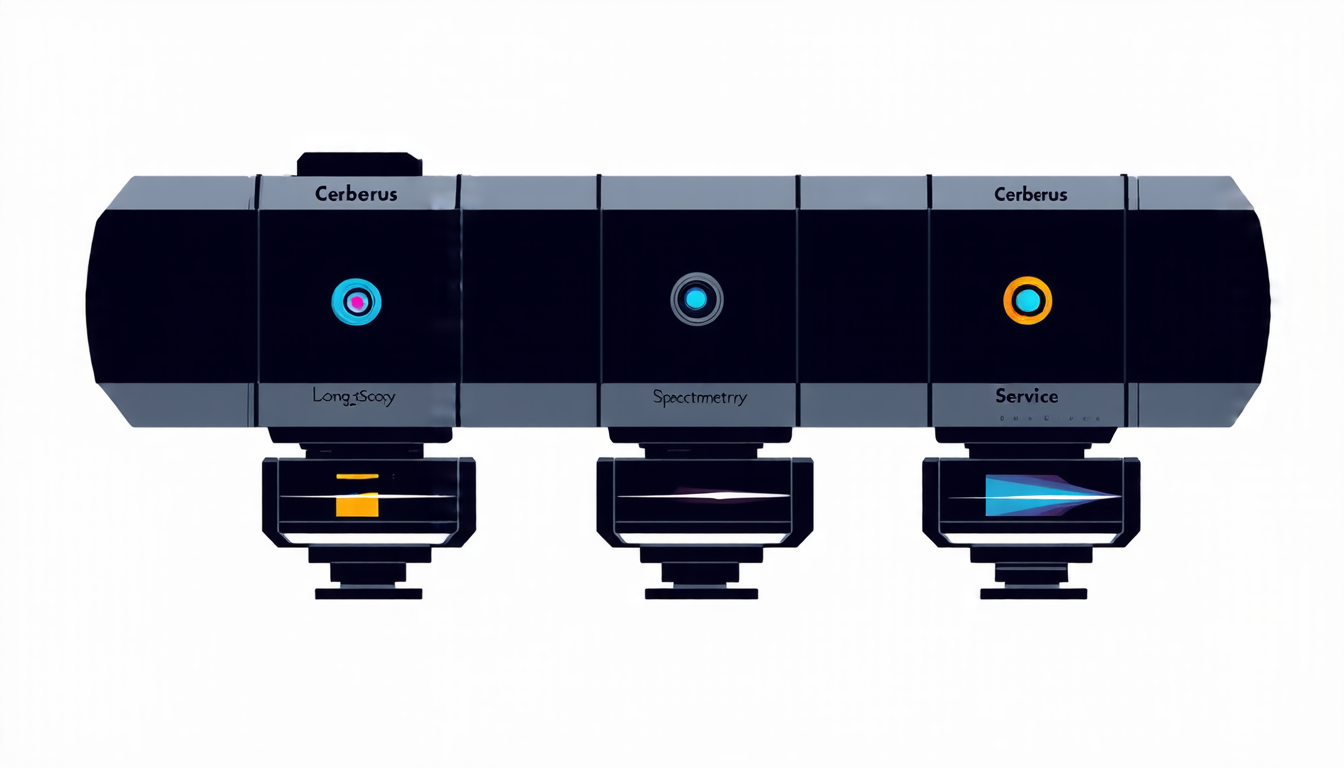
Cerberus, a new instrument designed for the OARPAF telescope in Italy, is set to revolutionize the way scientists study celestial bodies. This multi-focal station instrument combines three separate heads, each dedicated to a specific task: imaging and photometry, long slit spectroscopy, and service.
The first head, responsible for imaging and photometry, features a tip-tilt lens that can correct for wobbling caused by atmospheric distortion at a frequency of up to 10 Hz. This means scientists will be able to capture high-resolution images with unprecedented accuracy. The second head is designed for long slit spectroscopy, which involves analyzing the light emitted by celestial objects as it passes through a narrow slit. By examining this light, researchers can gain valuable insights into the composition and temperature of distant stars and galaxies.
The third head serves as a service station, initially equipped with an echelle spectrograph that can analyze the light from celestial objects in unprecedented detail. This instrument is capable of resolving power of up to 9300, allowing scientists to study the properties of stars and galaxies with greater precision than ever before.
Cerberus’s optical design has been carefully crafted to ensure that each head receives an unvignetted beam, free from aberrations caused by the telescope itself. This was achieved through the use of plane mirrors that fold the light into the new heads without affecting the default imaging mode.
The mechanical design of Cerberus is equally impressive, featuring a modular layout that allows for easy adaptation to other instruments. The linear motor that controls the movement of the plane mirrors has been carefully positioned to avoid interfering with the default imaging mode.
The software controlling Cerberus will be an extension of the existing effort to remotize and robotize the OARPAF telescope. This web-based interface will allow scientists to control the instrument from anywhere in the world, making it easier than ever to conduct remote observations.
Cerberus is expected to greatly enhance the scientific capabilities of the OARPAF telescope, enabling researchers to study celestial bodies with greater precision and accuracy than ever before. Its modular design and web-based interface make it an ideal tool for scientists working on a variety of projects, from studying distant stars to analyzing the properties of galaxies.
The installation of Cerberus is expected to be completed soon, marking a major milestone in the development of this innovative instrument.
Cite this article: “Cerberus: A Revolutionary Instrument for Celestial Research”, The Science Archive, 2025.
Telescope, Cerberus, Oarpaf, Italy, Imaging, Spectroscopy, Service, Instrument, Precision, Accuracy, Modular





