

Saturday 08 March 2025
Researchers have made significant progress in understanding the intricacies of magnetic exchange coupling, a phenomenon that governs the behavior of magnetic materials at the nanoscale. By combining ab initio calculations, spin dynamics simulations, and micromagnetic modeling, scientists have developed a comprehensive framework to describe the temperature-dependent properties of magnetic multilayers.
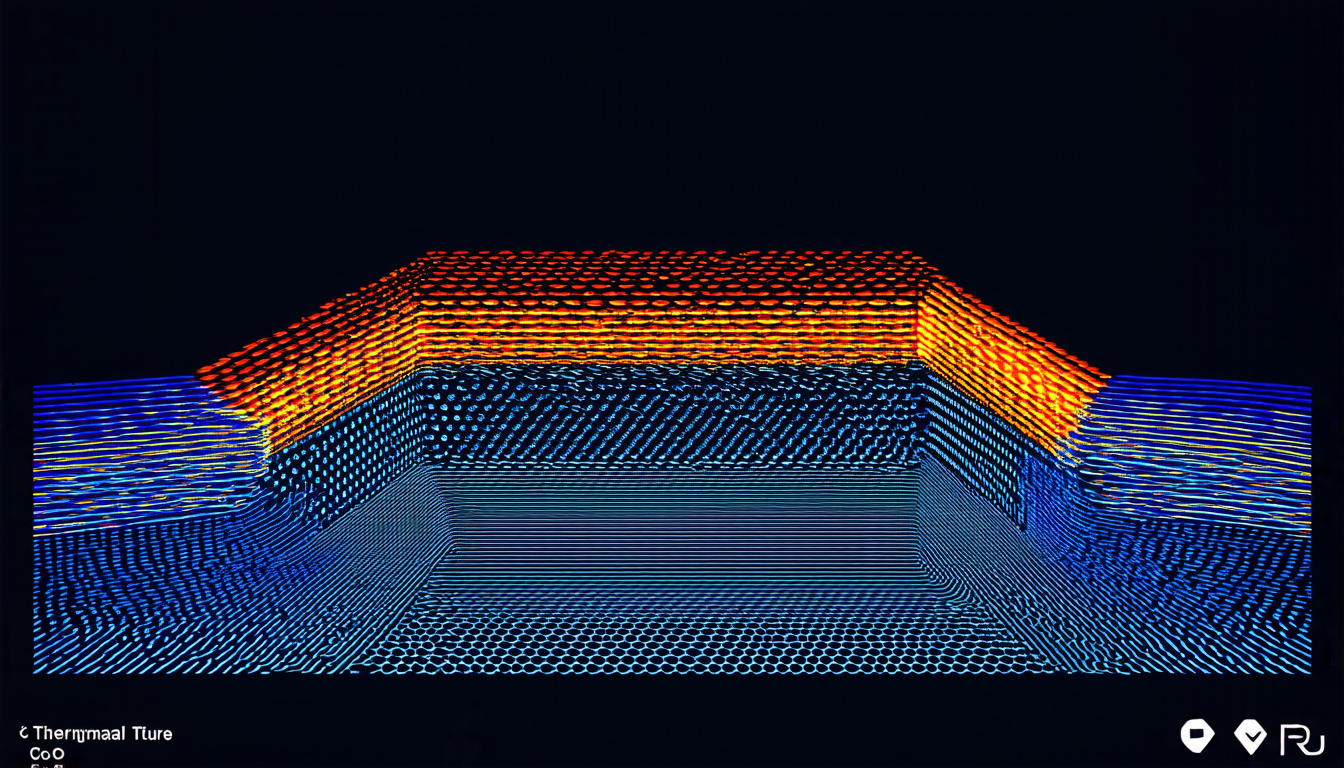
At the heart of this research is the Co/Ru/Co trilayer system, where the ferromagnetic Co layers are separated by a thin layer of nonmagnetic Ru. This arrangement gives rise to antiferromagnetic coupling between the Co layers at low temperatures, but exhibits ferromagnetic behavior at higher temperatures. Understanding this transition is crucial for designing advanced magnetic devices, such as spintronics and magnetic random-access memory (MRAM) applications.
To tackle this challenge, researchers employed a multiscale approach that integrates atomic-scale calculations with larger-scale simulations. They first used density functional theory to calculate the electronic structure of individual Co atoms and Ru layers, which revealed the subtle interactions driving the exchange coupling. Next, they performed spin dynamics simulations to study the behavior of magnetic moments in the presence of thermal fluctuations.
The results of these simulations were then fed into micromagnetic models, which allow researchers to simulate the behavior of entire trilayer structures at the nanoscale. By adjusting parameters such as temperature and layer thickness, the team was able to reproduce the experimentally observed transition from antiferromagnetic to ferromagnetic coupling.
One of the key findings of this research is that the exchange constant between Co layers decreases with increasing temperature, a phenomenon that had been previously difficult to predict. This decrease in exchange strength leads to a reduction in the domain wall width, which has significant implications for magnetic device design.
The authors also developed a novel method for extracting the interface coupling constant from spin dynamics simulations, allowing them to accurately model the transition between antiferromagnetic and ferromagnetic regimes. This approach paves the way for further studies on more complex systems, where the interplay of exchange coupling, magnetocrystalline anisotropy, and thermal fluctuations plays a crucial role.
Overall, this research demonstrates the power of combining computational methods to tackle complex problems in magnetic materials science. By integrating atomic-scale calculations with larger-scale simulations, researchers can gain a deeper understanding of the intricate interactions governing magnetic behavior at the nanoscale. This knowledge will be essential for designing next-generation magnetic devices that exploit the unique properties of these materials.
Cite this article: “Unlocking the Secrets of Magnetic Exchange Coupling in Nanoscale Multilayers”, The Science Archive, 2025.
Magnetic Exchange Coupling, Nanoscale, Co/Ru/Co Trilayer, Spin Dynamics Simulations, Micromagnetic Modeling, Density Functional Theory, Thermal Fluctuations, Domain Wall Width, Interface Coupling Constant, Magnetic Materials Science.





