

Saturday 08 March 2025
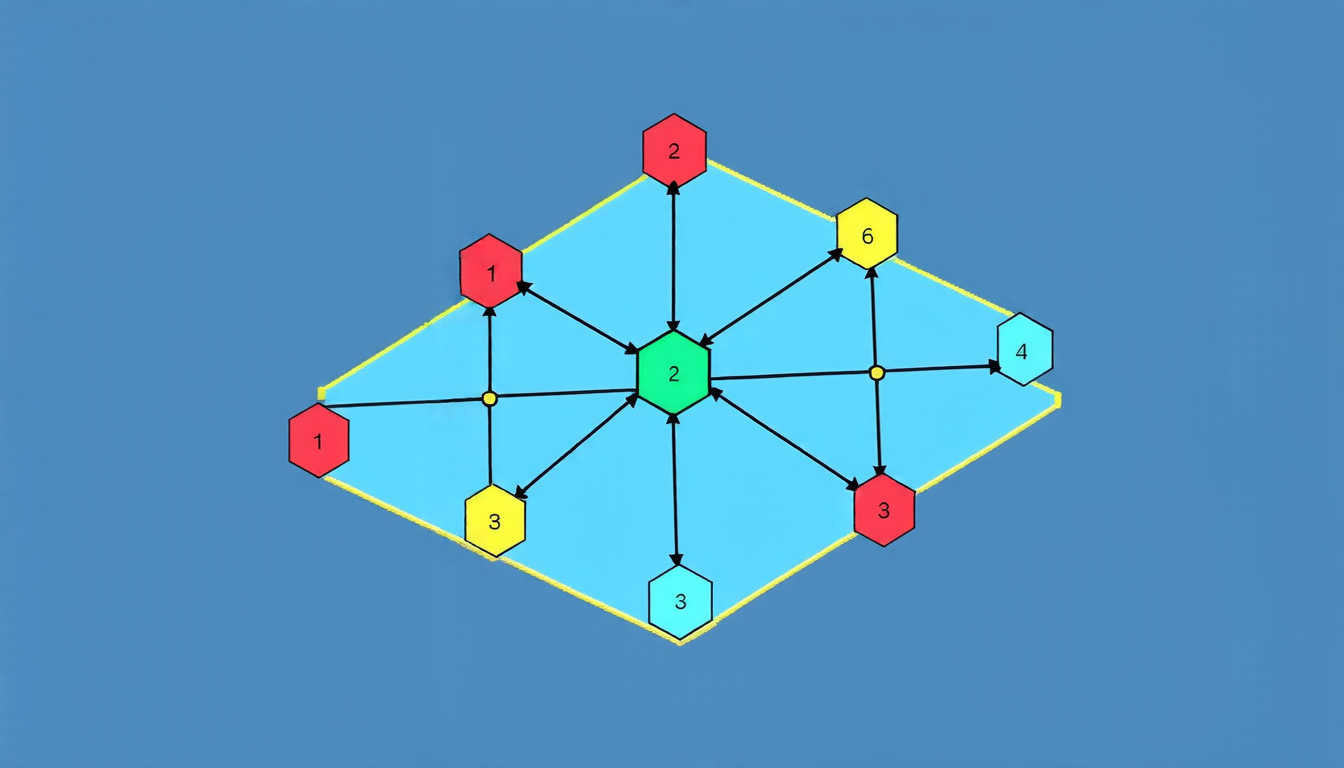
A team of mathematicians has made a significant breakthrough in understanding the relationship between groups, which are abstract algebraic structures used to describe symmetry and patterns, and graphs, which are visual representations of connections between objects. The researchers have shown that every finite group can be associated with a sequence of graphs, each with an arbitrarily large genus.
A graph is essentially a collection of dots connected by lines, but in mathematics, it’s much more than that. Graphs can represent everything from the structure of molecules to the layout of social networks. They’re used to model complex systems and understand how different components interact with each other.
In this new research, the mathematicians have focused on groups, which are sets of elements with a specific operation (like addition or multiplication) that satisfy certain properties. For example, the set of integers under addition is a group because you can add any two numbers in the set and get another number in the set.
The researchers have shown that every finite group can be associated with a sequence of graphs, each with an arbitrarily large genus. This means that for every possible group, there exists a graph that has a certain property – its genus is unbounded as it grows.
This breakthrough has significant implications for many areas of mathematics and computer science. For example, it could help researchers better understand the structure of complex systems, like the internet or social networks, by modeling them as graphs with specific properties.
The study also opens up new possibilities for solving problems in graph theory, which is a branch of mathematics that deals with the properties and behavior of graphs. By associating groups with graphs, mathematicians can use the powerful tools and techniques developed in group theory to analyze and understand complex graph structures.
In addition, this research could have practical applications in areas like computer networks, coding theory, and cryptography. For instance, it could help researchers design more efficient algorithms for searching and navigating large networks.
The discovery is also a testament to the power of abstract algebra, which is a branch of mathematics that deals with the study of algebraic structures such as groups, rings, and fields. Abstract algebra has led to many important advances in science and technology, from cryptography to computer graphics.
Overall, this breakthrough demonstrates the importance of interdisciplinary research and the potential for unexpected connections between different areas of mathematics.
Cite this article: “Mathematicians Uncover New Link Between Groups and Graphs”, The Science Archive, 2025.
Groups, Graphs, Algebraic Structures, Symmetry, Patterns, Finite Groups, Graph Theory, Computer Science, Mathematics, Abstract Algebra.





