

Saturday 08 March 2025
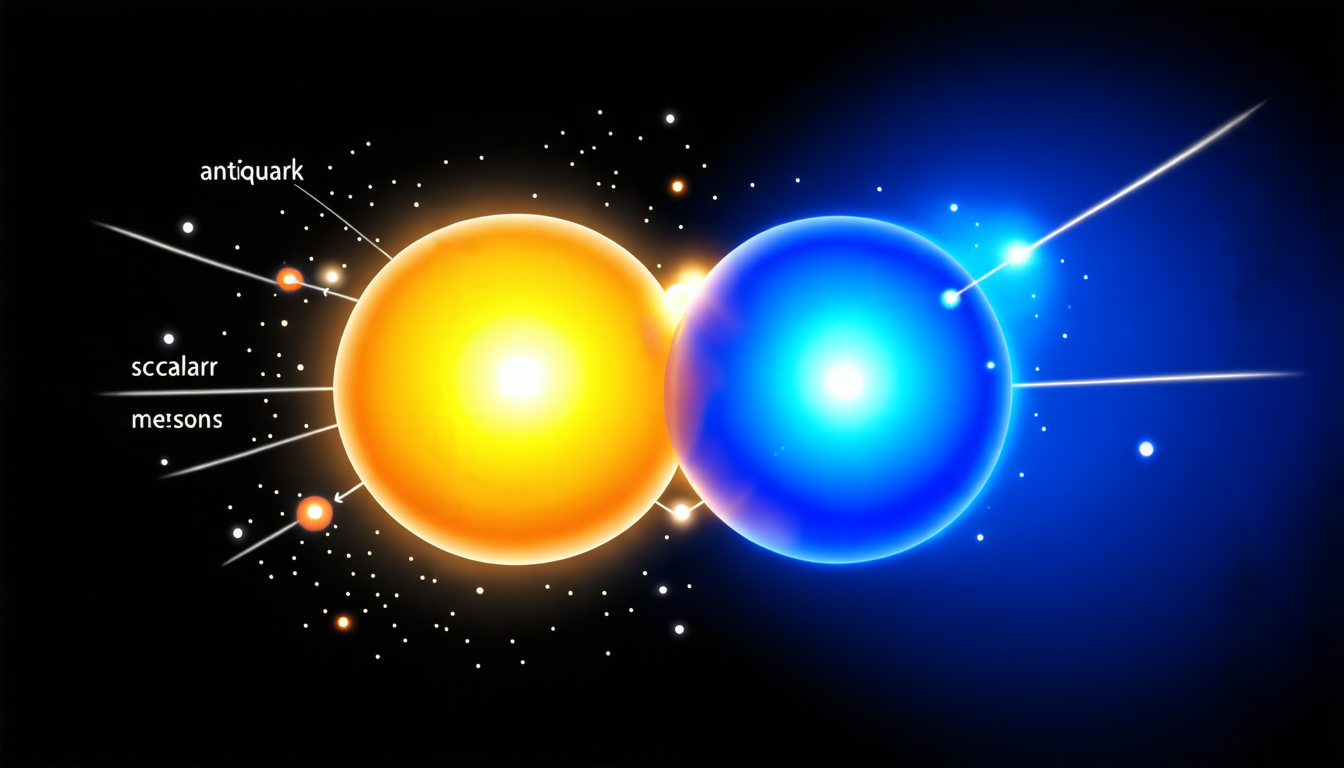
Recently, a team of physicists has made significant progress in understanding the behavior of light pseudoscalar mesons – particles that are crucial for our understanding of the strong nuclear force. These particles are composed of quarks and antiquarks, which are among the most basic building blocks of matter.
The researchers used a technique called perturbative quantum chromodynamics (pQCD) to study the properties of these particles. pQCD is a method that involves breaking down complex calculations into smaller, more manageable pieces. This allows scientists to better understand how quarks interact with each other and with other particles.
One of the key findings of this research is that the intrinsic transverse momentum distribution (iTMD) plays an important role in determining the properties of light pseudoscalar mesons. The iTMD describes the probability of finding a quark or antiquark with a certain amount of momentum perpendicular to its direction of motion.
The researchers also found that the inclusion of higher-twist corrections improves the accuracy of their calculations. Higher-twist corrections refer to terms in the pQCD calculation that are sensitive to the internal structure of the particles involved. By including these corrections, scientists can gain a more detailed understanding of how quarks interact with each other.
The study also shed light on the role of meson-photon transition form factors in determining the properties of light pseudoscalar mesons. These form factors describe the probability of finding a photon converting into a meson or vice versa. By studying these form factors, scientists can gain insight into the strong nuclear force and how it affects the behavior of quarks.
The findings of this research have important implications for our understanding of the universe. The strong nuclear force is responsible for holding quarks together inside protons and neutrons, which are the building blocks of atomic nuclei. By better understanding how quarks interact with each other, scientists can gain a deeper understanding of the fundamental forces that shape the behavior of matter.
The research also has practical applications in fields such as particle physics and nuclear physics. For example, it could help scientists design more effective experiments to study the strong nuclear force. It could also lead to a better understanding of how quarks interact with each other inside atomic nuclei, which is important for our understanding of nuclear reactions and the behavior of stars.
Overall, this research represents an important step forward in our understanding of the strong nuclear force and the behavior of light pseudoscalar mesons.
Cite this article: “Unlocking the Secrets of the Strong Nuclear Force: New Insights into Light Pseudoscalar Meson Behavior”, The Science Archive, 2025.
Light Pseudoscalar Mesons, Perturbative Quantum Chromodynamics, Quarks, Antiquarks, Strong Nuclear Force, Intrinsic Transverse Momentum Distribution, Higher-Twist Corrections, Meson-Photon Transition Form Factors, Particle Physics, Nuclear Physics.





