

Sunday 09 March 2025
Scientists have long been fascinated by the mysteries of the universe, and one of the most enduring enigmas is the origin of cosmic rays. These high-energy particles bombard Earth from space, but their sources remain shrouded in mystery.
Now, a team of researchers has made a significant breakthrough in understanding where these energetic particles come from. By studying 12 gamma-ray bursts (GRBs), they’ve discovered that some GRBs can accelerate protons to incredible energies, potentially explaining the origins of cosmic rays.
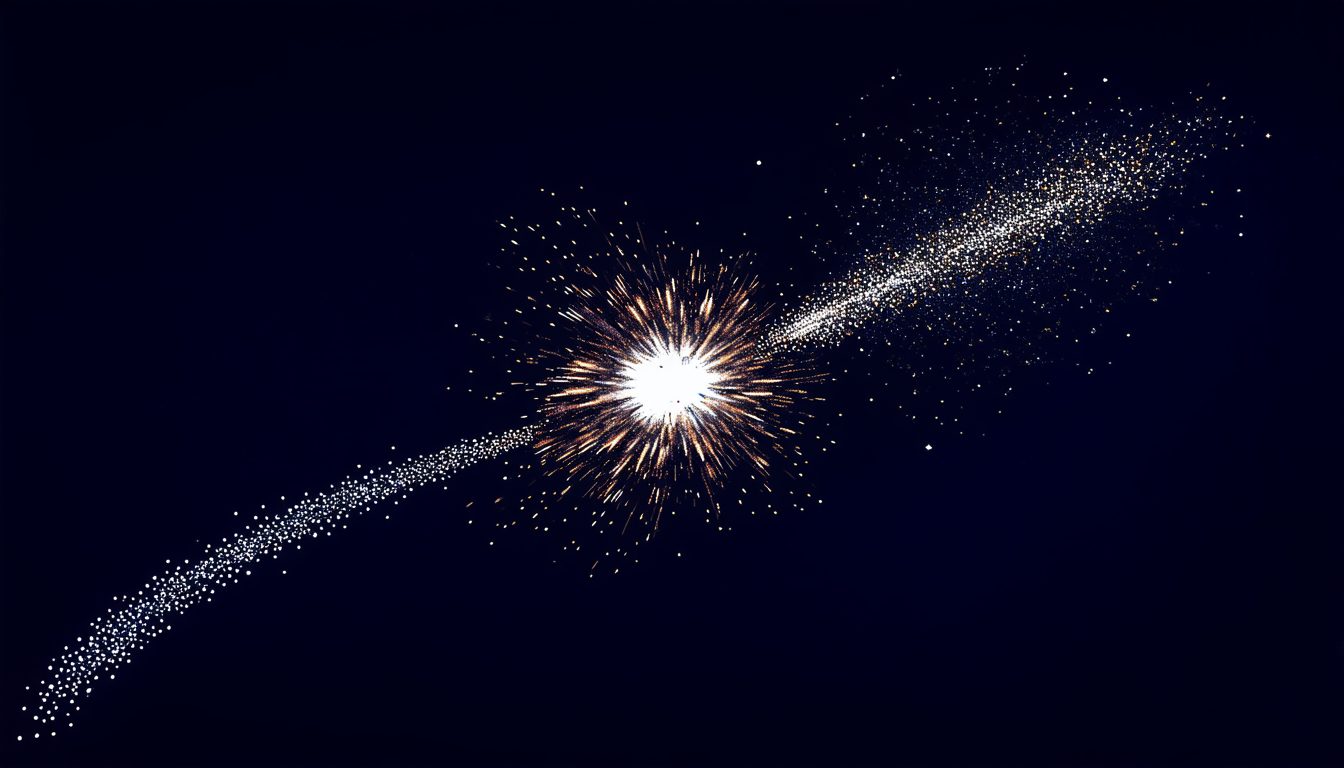
Gamma-ray bursts are massive explosions that occur when stars collapse or merge. They’re so powerful that they can outshine an entire galaxy, emitting intense radiation across the electromagnetic spectrum. Scientists have long suspected that these events could be responsible for accelerating particles to extreme energies, but until now, the evidence has been indirect and unclear.
The researchers used data from NASA’s Fermi Gamma-Ray Space Telescope and Swift Observatory to study 12 GRBs. They analyzed the bursts’ light curves, looking for signs of particle acceleration. What they found was astonishing: some GRBs showed clear evidence of proton acceleration, with particles reaching energies of up to 10^20 electronvolts (eV).
To put that in perspective, the energy of these protons is equivalent to the kinetic energy of a baseball traveling at over 100,000 miles per hour. These energetic particles could potentially travel across vast distances, interacting with magnetic fields and other particles along the way.
The findings have significant implications for our understanding of the universe. If GRBs are indeed responsible for accelerating cosmic rays, it could explain why these particles are so ubiquitous in space. It also opens up new avenues for studying these enigmatic events, as scientists can now look for signs of particle acceleration in future observations.
One of the most exciting aspects of this research is its potential to shed light on the properties of exotic objects known as magnetars. These incredibly powerful magnets are thought to be responsible for some GRBs, and their discovery could reveal new insights into the fundamental laws of physics.
The study also highlights the importance of continued space-based observations. By monitoring the universe from above, scientists can gather crucial data that helps us better understand the workings of the cosmos.
In short, this research has taken a major step towards unraveling one of the greatest mysteries of our time. By studying gamma-ray bursts and their potential role in accelerating cosmic rays, scientists are getting closer to understanding the origins of these enigmatic particles.
Cite this article: “Uncovering the Secrets of Cosmic Rays: A Breakthrough in Understanding Their Origins”, The Science Archive, 2025.
Cosmic Rays, Gamma-Ray Bursts, Proton Acceleration, Fermi Gamma-Ray Space Telescope, Swift Observatory, Particle Physics, Magnetars, Space-Based Observations, High-Energy Particles, Electromagnetic Spectrum





