

Monday 10 March 2025
The quest for efficient communication in wireless sensor networks has long been a thorny problem. With the increasing demands of IoT devices and edge computing, finding ways to reduce energy consumption while maintaining data integrity is crucial. Recently, researchers have made significant strides in developing novel approaches to tackle this challenge.
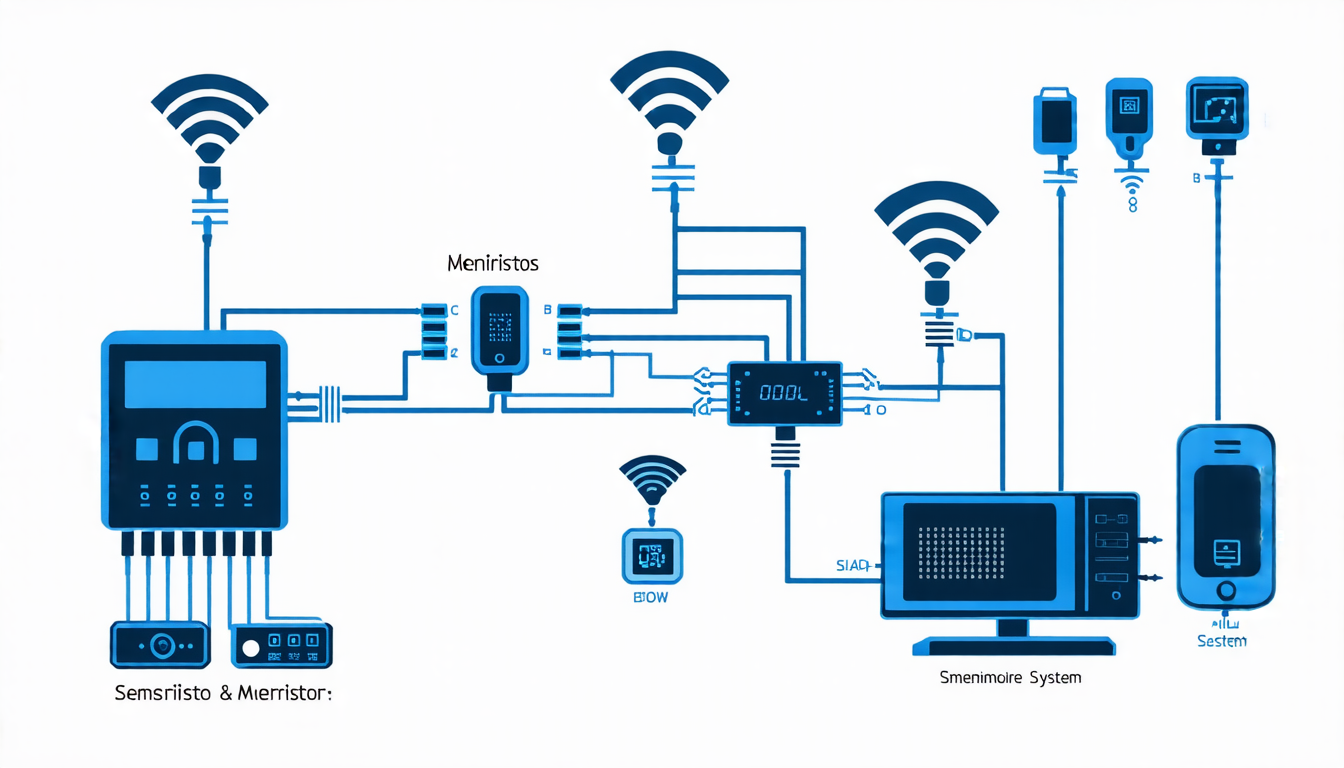
One such approach is the use of memristor-based analog computing for wireless inference. Memristors are two-terminal electrical components that can store information based on their resistance, making them ideal for neuromorphic computing applications. By leveraging these devices, researchers have created a system that combines multiple sensors with analog computing to enable efficient data transmission.
The system, which utilizes the memristor’s ability to mimic neural networks, has shown remarkable energy efficiency gains compared to traditional CPU and GPU computations. In fact, it was found that the memristor-based system achieved an energy savings of over 4.6 times more than its digital counterparts. This significant reduction in power consumption makes it an attractive solution for edge devices with limited resources.
But how does this work? The system utilizes a combination of analog computing and sensor fusion to enable efficient data transmission. Sensor fusion, which combines multiple sensors’ data to create a single, more accurate output, is typically a computationally intensive process. However, by leveraging the memristor’s ability to perform analog computations, researchers were able to reduce the computational overhead significantly.
The system also incorporates a novel approach to over-the-air sensor fusion, which enables devices to combine their data without the need for physical connectivity. This not only reduces energy consumption but also increases the scalability of the system. By allowing devices to communicate with each other wirelessly, this approach makes it easier to integrate multiple sensors and create a more comprehensive understanding of the environment.
The potential applications of this technology are vast. For instance, in IoT devices such as smart home systems or industrial automation, energy efficiency is crucial for prolonged battery life. In edge computing applications, where data processing occurs at the edge of the network rather than in the cloud, reducing energy consumption can significantly improve performance and reduce costs.
While there is still much work to be done, this breakthrough has significant implications for the future of wireless communication. By leveraging memristor-based analog computing and sensor fusion, researchers have created a system that not only reduces energy consumption but also increases scalability and accuracy.
Cite this article: “Revolutionizing Wireless Communication: Memristor-Based Analog Computing for Efficient Data Transmission”, The Science Archive, 2025.
Memristors, Analog Computing, Wireless Sensor Networks, Iot Devices, Edge Computing, Energy Efficiency, Neural Networks, Sensor Fusion, Over-The-Air Sensor Fusion, Neuromorphic Computing.





