

Monday 10 March 2025
A team of researchers has made a significant breakthrough in developing a new approach to teaching robots how to perform complex tasks, such as manipulating objects while moving around. By combining machine learning algorithms with physical simulations, the scientists have created a system that allows robots to learn from experience and adapt to new situations.
The key innovation is the use of a technique called sim-to-real transfer, which enables robots to learn in a simulated environment before being deployed in the real world. This approach has several advantages over traditional methods, where robots are taught to perform tasks through trial and error in the physical world. For one, it reduces the risk of damage or injury to both humans and robots. Additionally, sim-to-real transfer allows for more efficient learning, as robots can try out different actions and scenarios without actually performing them.
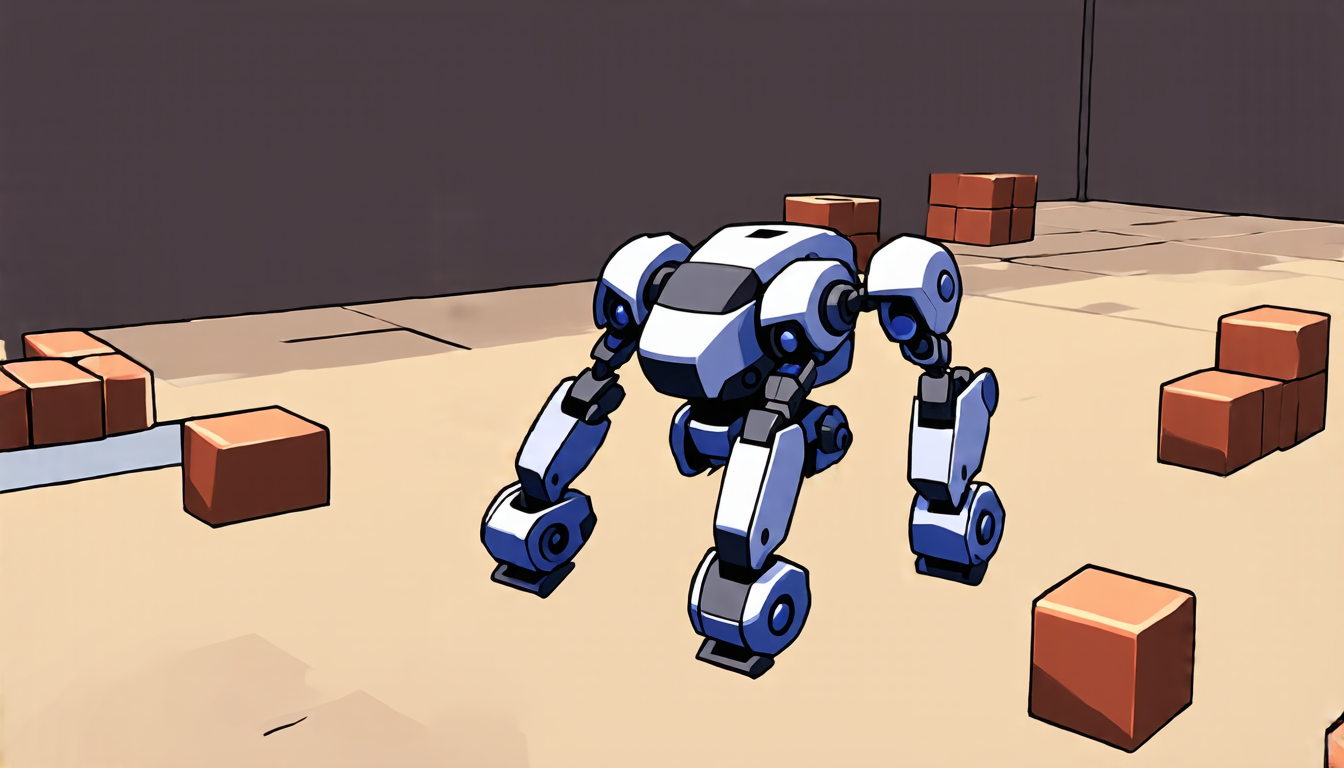
The researchers used a quadruped robot, similar to Boston Dynamics’ Spot, to test their approach. They created a simulated environment that mimicked the physical world, complete with obstacles and challenges. The robot was then trained using a machine learning algorithm called SIM-FSVGD, which combines simulations with real-world data.
The results were impressive. The robot was able to learn complex tasks, such as tracking an ellipsoidal reference trajectory while manipulating its end-effector, in just a few hours of training. This would be impossible for humans to achieve without extensive practice and training. Moreover, the robot’s performance improved significantly when it was transferred from the simulated environment to the real world.
The researchers also experimented with different sample sizes used for learning, finding that their approach worked well even with limited data. This is important, as it means that robots can learn quickly and effectively in scenarios where there is limited training data available.
One of the most promising aspects of this technology is its potential applications in fields such as search and rescue, manufacturing, and healthcare. For example, a robot could be trained to navigate through rubble-strewn buildings or perform delicate surgical procedures with precision.
The team’s approach also has implications for the development of more advanced artificial intelligence systems. By combining simulations with real-world data, robots can learn from experience and adapt to new situations, much like humans do. This could lead to the creation of more sophisticated AI agents that are capable of complex decision-making and problem-solving.
Overall, this breakthrough in sim-to-real transfer has significant implications for robotics and artificial intelligence research.
Cite this article: “Robot Learning Breakthrough: Simulating Reality for Efficient Training”, The Science Archive, 2025.
Robotics, Artificial Intelligence, Machine Learning, Simulations, Real-World Data, Quadruped Robot, Spot, Boston Dynamics, Search And Rescue, Manufacturing, Healthcare





