

Monday 10 March 2025
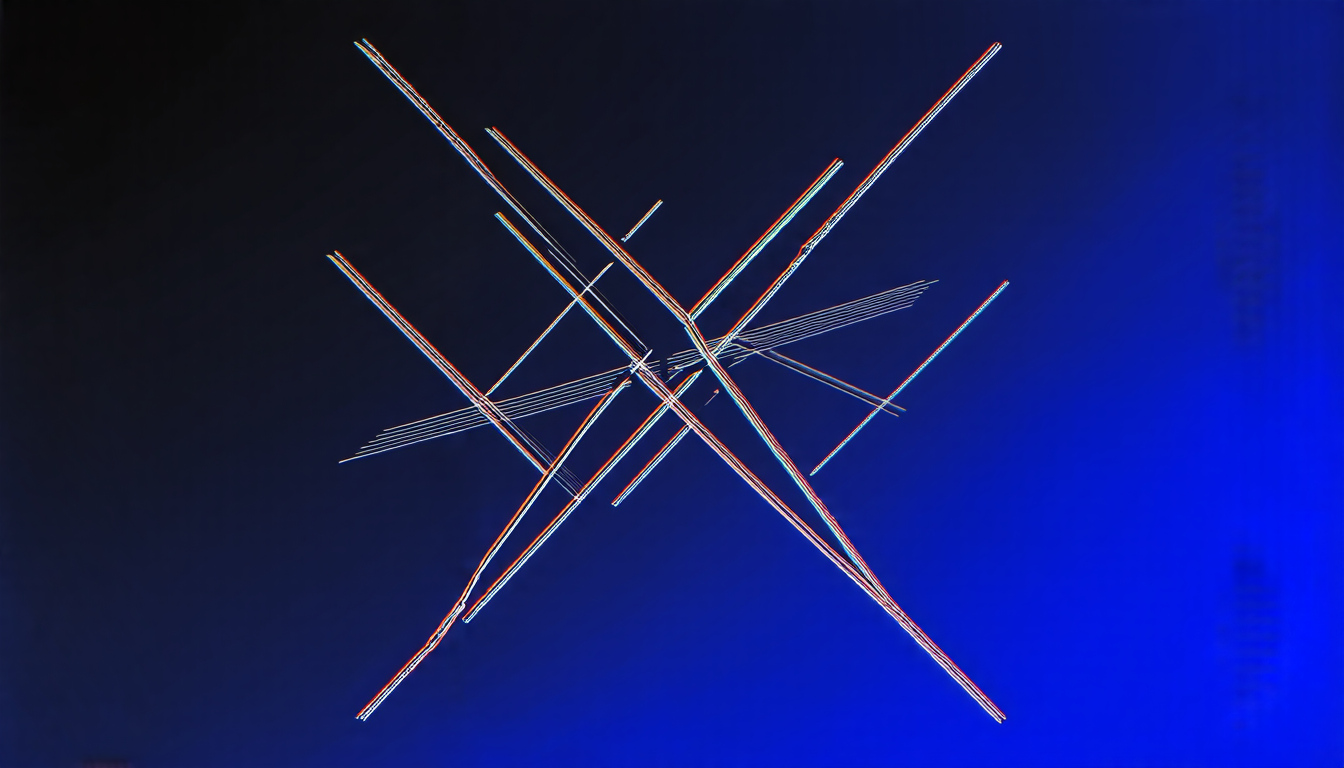
For centuries, mathematicians have been fascinated by complex line arrangements in space. These intricate patterns of lines can be found in various areas of mathematics, such as algebraic geometry and topology. Recently, a team of researchers has made significant progress in understanding these arrangements by developing a new topological invariant.
A complex line arrangement is a set of complex lines that intersect at specific points. Each line represents a solution to a polynomial equation, and the intersections between lines correspond to solutions where multiple equations are satisfied simultaneously. By studying these arrangements, mathematicians can gain insights into the properties of algebraic curves and surfaces.
One of the challenges in understanding complex line arrangements is that they can have different topological types, even if they share the same combinatorial structure. This means that two arrangements with the same pattern of lines and intersections can still behave differently from a topological perspective. To address this issue, researchers have been searching for ways to distinguish between these arrangements.
The new invariant developed by the team is based on the interaction between the complement of an arrangement (the space outside the arrangement) and its boundary manifold. The complement is essentially the set of points that are not part of any line in the arrangement, while the boundary manifold is a topological object that encodes the information about how the lines intersect.
By analyzing this interaction, researchers can determine whether two arrangements have the same topological type or not. This invariant has far-reaching implications for many areas of mathematics, including algebraic geometry, topology, and number theory.
One of the key applications of this new invariant is in identifying Zariski pairs, which are pairs of arrangements that share the same combinatorics but have different embeddings in space. These pairs are important because they can help mathematicians understand the relationship between the topological properties of an arrangement and its geometric structure.
The development of this new invariant has also opened up new avenues for research in algebraic geometry and topology. For example, researchers can now use this invariant to study the topology of complex surfaces and curves, which is crucial for understanding many important problems in mathematics and physics.
In addition to its theoretical significance, this new invariant also has practical applications in computer science and engineering. For instance, it can be used to optimize algorithms for solving systems of polynomial equations, which is essential for tasks such as cryptography and computer graphics.
Overall, the discovery of this new topological invariant marks an important milestone in the study of complex line arrangements.
Cite this article: “Unveiling Complex Line Arrangements: A New Topological Invariant”, The Science Archive, 2025.
Complex Geometry, Algebraic Geometry, Topology, Invariant, Line Arrangements, Polynomial Equations, Computer Science, Engineering, Cryptography, Computer Graphics.
Reference: Adrien Rodau, “Homology inclusion of complex line arrangements” (2025).





