

Monday 10 March 2025
Scientists have made a significant breakthrough in understanding the fundamental laws of physics that govern our universe. By studying the orbit of a satellite, researchers were able to test the theory of general relativity and confirm its predictions with unprecedented precision.
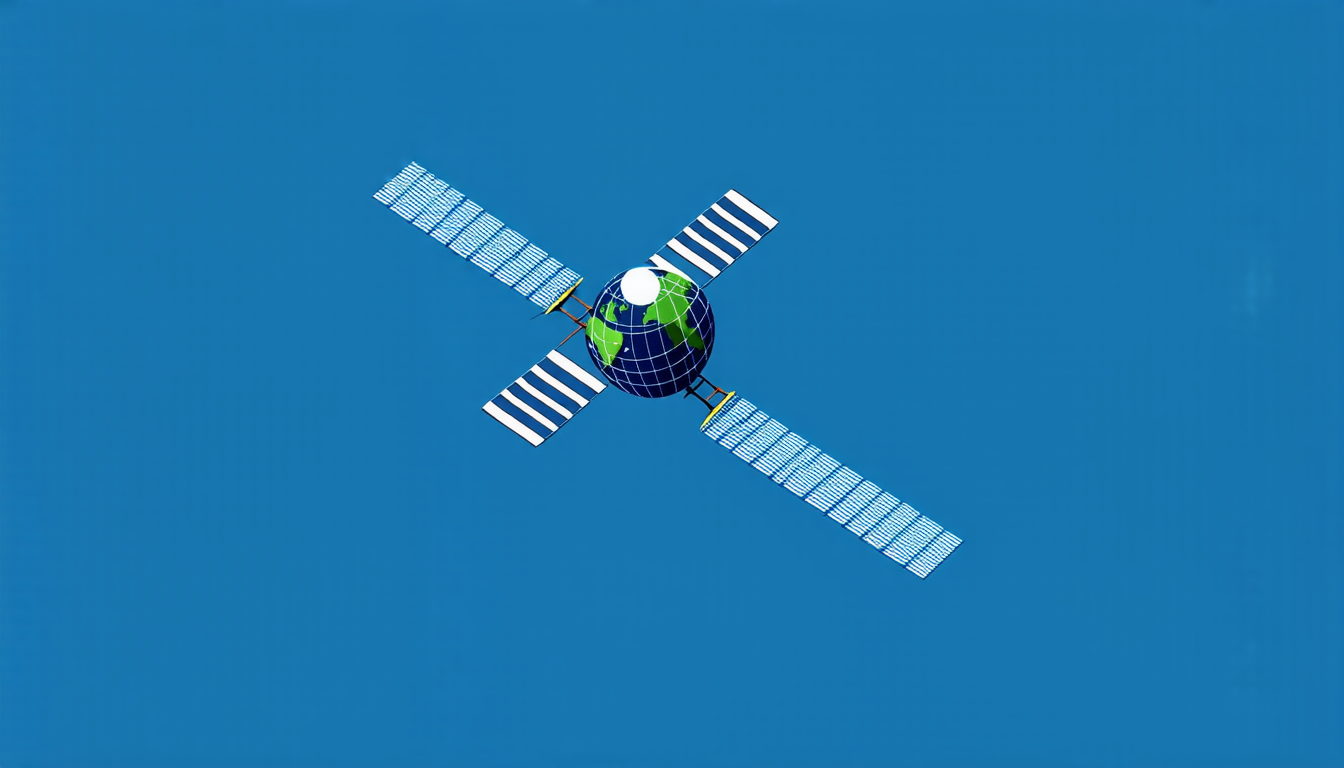
The satellite in question is LAGEOS II, a geodetic satellite launched by NASA in 1992. Its purpose was to provide precise measurements of the Earth’s gravitational field, which is crucial for understanding the planet’s rotation, tides, and even the movement of the oceans. But in addition to its practical applications, LAGEOS II has also become a tool for testing fundamental theories of physics.
In particular, scientists have been studying how the satellite’s orbit is affected by the curvature of space-time predicted by general relativity. According to this theory, massive objects like planets and stars warp the fabric of spacetime around them, causing nearby objects to move along curved trajectories. By measuring these curves, researchers can test the accuracy of Einstein’s famous equation, E=mc^2.
The new study used data from LAGEOS II to measure the satellite’s orbit with unprecedented precision. The team analyzed 28 years’ worth of observations, taking into account various sources of error and noise that might affect the measurements. They then compared their results to predictions made by general relativity, finding a remarkable match between theory and observation.
The implications of this result are significant. Not only does it confirm our understanding of general relativity, but it also sets new limits on alternative theories of gravity that attempt to explain phenomena in terms of preferred frames or additional fields. In other words, the study provides strong evidence for the validity of Einstein’s original theory and rules out many competing explanations.
But what makes this result especially impressive is its precision. The team was able to measure the effects of general relativity on LAGEOS II’s orbit with an accuracy of better than one part in a billion. This level of precision requires incredibly sophisticated data analysis techniques, as well as a deep understanding of the underlying physics involved.
The study also has practical applications for future space missions. By understanding how to accurately model the effects of general relativity on satellite orbits, scientists can design more precise navigation systems and improve our ability to predict celestial events like eclipses and planetary alignments.
In short, this breakthrough represents a major milestone in our quest to understand the fundamental laws of physics that govern our universe.
Cite this article: “Measuring the Fabric of Space-Time: A Breakthrough in General Relativity”, The Science Archive, 2025.
Physics, General Relativity, Lageos Ii, Satellite, Gravity, Einstein, Theory, Precision, Orbit, Nasa





