

Tuesday 11 March 2025
The pursuit of photorealistic 3D modeling has long been a holy grail for computer graphics researchers, with various approaches emerging over the years. One such technique is the use of neural radiance fields (NRFs), which have shown promising results in generating highly realistic images and videos. However, these models often struggle to accurately capture the complex interactions between light, materials, and geometry, particularly when dealing with reflective surfaces.
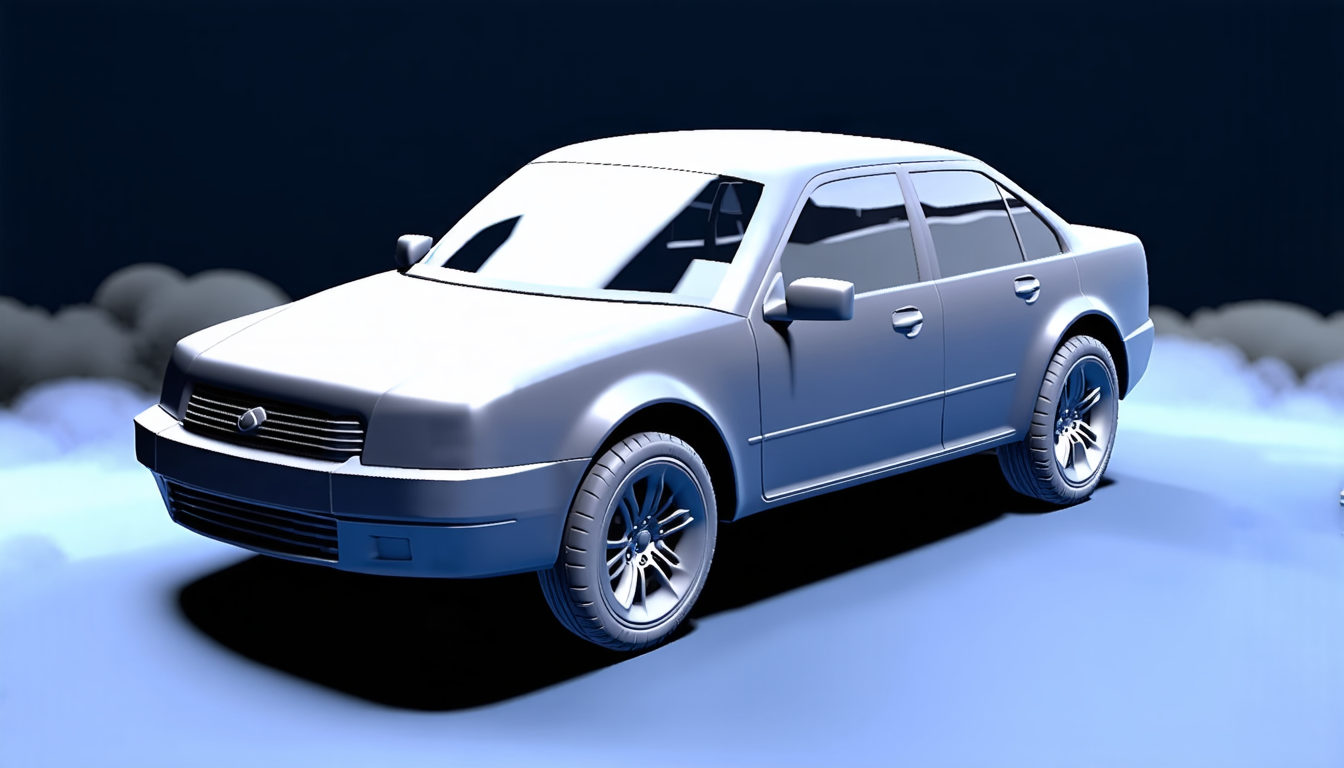
In a recent paper, researchers from DeepRoute.ai have proposed a novel approach called Car- GS, designed specifically to address these challenges in 3D car modeling. The method combines three key innovations: view-dependent Gaussian primitives for modeling surface reflections, learnable geometry-specific opacity for transparent objects, and a quality-aware supervision module that leverages normal priors from pre-trained large-scale models.
The authors’ approach is rooted in the concept of Gaussian splatting, which involves projecting 3D points onto a 2D image plane using Gaussian functions. By incorporating view-dependent primitives, Car-GS effectively captures the subtle variations in surface reflections caused by different viewing angles. This allows for more accurate rendering of car surfaces, including glossy paints and transparent materials like windshields.
To tackle the issue of opaque objects, Car-GS introduces a learnable geometry-specific opacity parameter for each 2D Gaussian primitive. This dedicated opacity value is solely responsible for rendering depth and normals, enabling the model to better handle transparent objects without compromising overall reconstruction accuracy.
The quality-aware supervision module is another crucial component of Car-GS. By leveraging normal priors from pre-trained large-scale models, this module adaptively adjusts its supervision strategy based on the camera view’s proximity to glass surfaces. This ensures that reconstruction errors are minimized when dealing with these challenging regions.
Experimental results demonstrate the effectiveness of Car-GS in achieving precise 3D car surface reconstruction and outperforming prior methods. The approach achieves high accuracy while maintaining a relatively short training time, making it well-suited for real-time applications like autonomous driving simulation or virtual/augmented reality.
The significance of Car-GS lies not only in its technical innovations but also in its potential to bridge the gap between 3D modeling and photorealistic rendering. By accurately capturing the complex interactions between light, materials, and geometry, this approach has far-reaching implications for various fields, including computer graphics, robotics, and gaming.
Cite this article: “Car- GS: A Novel Approach to Photorealistic 3D Car Modeling”, The Science Archive, 2025.
Computer Graphics, Neural Radiance Fields, 3D Modeling, Photorealistic Rendering, Surface Reflections, Gaussian Primitives, Learnable Geometry, Opaque Objects, Quality-Aware Supervision, Autonomous Driving Simulation





