

Tuesday 11 March 2025
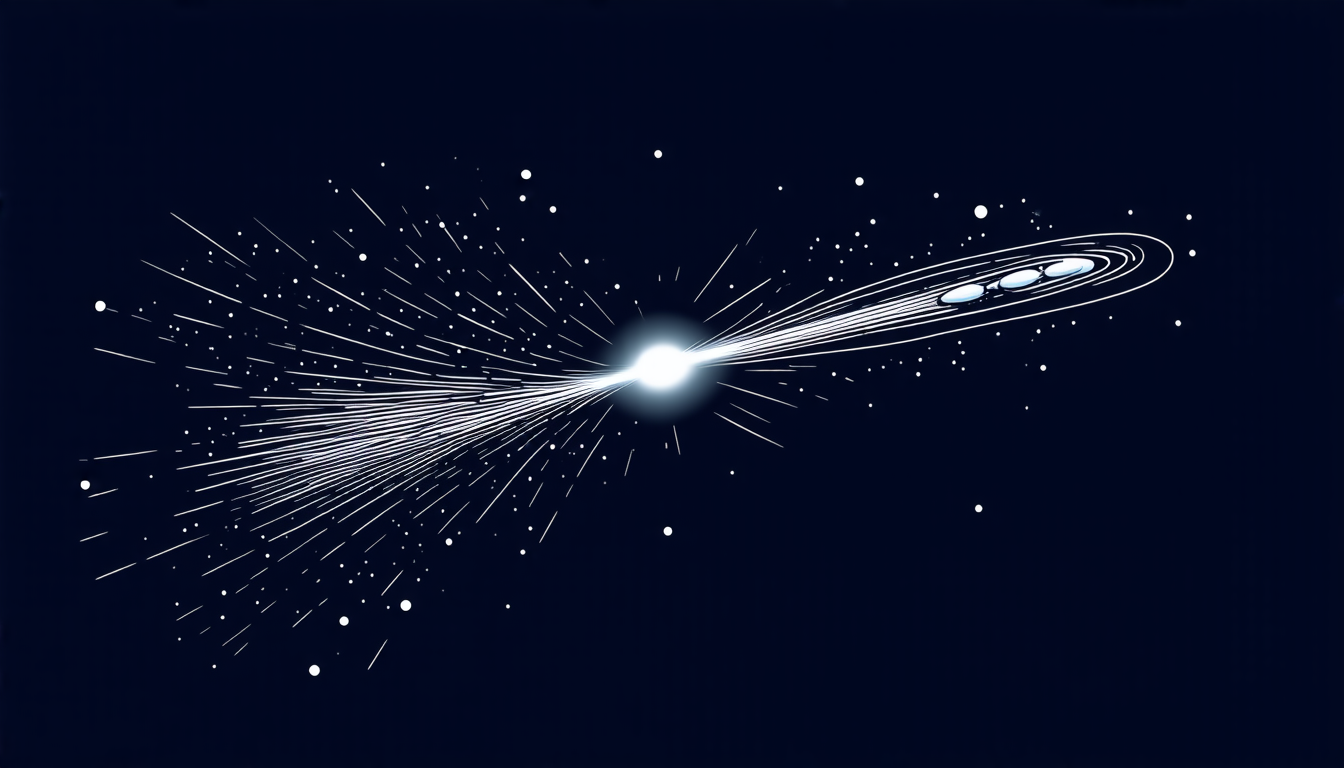
Solar winds, which are high-energy particles streaming out of the sun, have long been a mystery to scientists. One aspect that has puzzled researchers is how these winds interact with comets, small icy bodies that orbit the sun. Comets are thought to have formed during the early days of our solar system and may hold clues about its origins.
Recently, scientists used a computer simulation to study the interaction between solar winds and comets. They found that the type of particles in the solar wind can greatly affect how they interact with comets. In particular, they discovered that the presence of alpha particles, which are high-energy helium nuclei, can change the shape of the comet’s magnetosphere.
The magnetosphere is a region around a comet where the magnetic field is influenced by the solar wind. It’s thought to play a crucial role in the formation of cometary tails, which are long, wispy structures that stream behind comets as they approach the sun.
The simulation showed that when there are more alpha particles present in the solar wind, the magnetosphere becomes larger and weaker. This means that the comet’s magnetic field is less intense, allowing the solar wind to penetrate deeper into the comet’s atmosphere.
In contrast, when there are fewer alpha particles present, the magnetosphere remains smaller and stronger. This allows the comet’s magnetic field to maintain its intensity, keeping the solar wind at bay.
The researchers also found that the interaction between solar winds and comets is not a simple one-way process. Instead, it involves a complex dance of particles and fields, with each side influencing the other.
For example, when the solar wind interacts with the comet’s magnetic field, it can cause the field to become distorted and weaker. This in turn affects the way the solar wind flows around the comet, creating regions where the flow is faster or slower than elsewhere.
The study provides new insights into the complex interactions between solar winds and comets. It suggests that the type of particles present in the solar wind can have a significant impact on the formation of cometary tails and the structure of the magnetosphere.
These findings could also help scientists better understand the origins of our solar system. Comets are thought to have formed during the early days of the solar system, and studying their interactions with solar winds could provide clues about how they evolved over time.
Cite this article: “Solar Winds Impact on Comet Magnetospheres Revealed through Computer Simulation”, The Science Archive, 2025.
Solar Winds, Comets, Magnetosphere, Alpha Particles, Helium Nuclei, Solar System, Formation, Tails, Magnetic Field, Atmosphere





